
PORT TOWNSEND — How can we collectively preserve and create spaces for Black men’s tenderness in America?
That is the question posed at the end of the credits of “Dark and Tender: The Big Island,” directed by workshop facilitator Aaron Johnson.
The short documentary also contains the seed of an answer.
The film sees 10 Black men gathering together with the intention of cultivating skills of relating, experiencing rest and showing themselves, said film producer Ben Wilson, CEO and founder of Port Townsend-based Color of Sound (COS).
“There is some one-on-one coaching that goes on with Aaron, there is a meditation and body-work component, multiple group discussions and then there’s the exercises,” Wilson said.
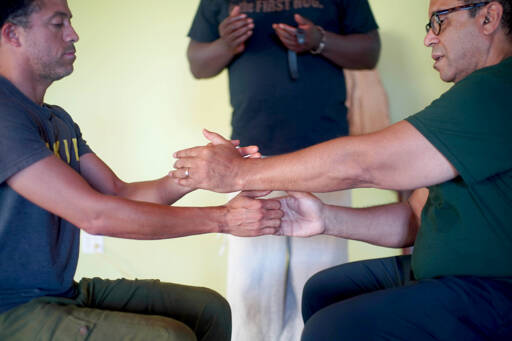
Exercises are designed around the idea of the healing quality that comes from touch, specifically non-sexualized platonic touch. Exercises include hand holding and tucking in, wherein one person lies or sits down and is surrounded by four to six others, who may touch them supportively or sing over them.
Everything is consent-based and can be engaged with partially or fully, said Wilson, who experiences a surreal and almost out-of-body experience during his tucking-in exercise in the film.
The experience was healing, he said.
The workshops are intended to help participants undermine the effects of the “Black brute” narrative that has shaped how Black men are seen and how many Black men come to see themselves, Wilson said.
The framing of Black men as violent or sexualized has done significant harm, from straining their nervous systems and limiting their wellness to being systemically funneled toward prison.
“For the same reason Martin Luther King chose nonviolence,” Wilson said. “We’re choosing nonviolence as well. We’re replacing violence with tenderness, empathy and understanding as a way to heal people from a stereotype that has permeated our society, and to promote nonviolence within our community and beyond.”
The film is the second installment in the Chronically UnderTouched (CUT) project, produced by COS.
The film opens with a wide view of a tropical landscape, a large structure nestled under a jungle-laden ridge, and the sound of men’s voices holding long notes, one voice leading others through vowel sounds.
The sequel to 2024’s Whidbey Island-based “Dark and Tender,” the film was set on the Big Island of Hawaii, near Hilo.
Since the premiere of “Dark and Tender” at the 2024 Port Townsend Film Festival, Color of Sound and the CUT project have been busy. The film was screened at nine international film festivals, and it also was screened at a number of events organized by the filmmakers.
Selling individual streaming access online helped to fund the making of the new installment, Wilson said.
A preview of the film was screened at a three-day event which brought the work of mostly Seattle-based regional Black filmmakers together. The event was produced in partnership between PTFF and COS last year. The events, held at Port Townsend’s Rose Theater, were all completely full, said Wilson, who is featured in the film.
The project also has completed about 20 workshops and recently received a two-year, $200,000 grant to create a Touch Activist program to train primarily people of color to facilitate this work and to help them launch local businesses to provide those services.
Wilson said the hope is that retreat participants will not only heal individually but also learn the model well enough to replicate it in their own communities and eventually lead workshops themselves, expanding the work beyond a single facilitator.
In the film, Wilson shares how his father not being present or reliable hurt him deeply and led him to discomfort with Black men.
Retreat participant Aliko Weste spoke of the love he had for his father as a child; falling in love with him, with his rough beard and his skin.
“Then he broke me,” Weste said in the film. “He literally shattered my soul and my heart and my emotional field.”
Weste, who is a trans man, said he did not have any Black male friends outside of queer spaces.
Weste, who is featured prominently in the film, speaks to a fear he has felt toward Black men. In the film, he is seen making safe and secure connections with other Black men.
The film’s only music comes from the singing, which takes place in the workshops.
“Music is absolutely critical to the films and to the healing process,” Wilson said. “It becomes not only the soundtrack for the film, but the medicine for the participants, grounding them individually and connecting them spiritually to one another.”
“I am my ancestors’ dream, even if I just breathe, even if I just breathe, even if I just breathe,” the men sing together in the film.
People can watch the films or host screenings kinema.com/films/dark-and-tender-the-big-island-rtaivu.
COS also is presenting live screenings on Feb. 6 in Aurora, Colo.; on Feb. 20 in Clinton, Wash.; and April 30-May 3 as part of the Seattle Black Film Festival. Interested parties can learn more about the events at cutproject.org/events.
Future events put on by COS and the CUT project will screen both of the films, which complement each other and can be viewed in less than 45 minutes, Wilson said.
Those interested in attending workshops or becoming touch activists can learn more on the Cut Project’s website.
Later this year, the filmmakers plan to produce a feature-length documentary, including elements from both films, unused footage and new material, Wilson said.
________
Reporter Elijah Sussman can be reached by email at elijah.sussman@peninsuladailynews.com.
