
PORT ANGELES — The cost of building affordable housing is influenced by many factors: limited funding, high interest rates, restrictive regulations and rising construction costs.
But there’s one factor, often overlooked, that could play a large role in driving up the costs for any publicly funded housing project: prevailing wages. That’s the minimum hourly rate of pay given to any workers on government-funded projects.
Both public and private entities that use public funding for projects are required to pay prevailing wage rates, which differ by trade and county.
The state’s goal in setting prevailing wages is to ensure contractors who are paid with public money are being paid fairly, said Colleen McAleer, the executive director for the Clallam Economic Development Council.
However, some people argue those wages vastly outpace what standard market rates are — especially for rural counties — driving up costs for housing that is supposed to be affordable.
“It has been bastardized at this point, so that the wage rates are not at all prevailing,” McAleer said. “They are much higher than what is the true prevailing wage being paid in Clallam County. It’s a broken system.”
Setting prevailing wage
Thirty-two states have state prevailing wage laws; Washington’s prevailing wages are established by its department of Labor & Industries (L&I).
For commercial and industrial public projects, L&I adopts the rate established by the highest collective bargaining agreement (CBA) within that county. When there are no CBAs for a trade within a county, or if the work is a residential project, L&I uses surveys to determine prevailing wage rates.
To do so, L&I asks certain companies to report the hourly wage they paid for a construction project completed within the city limits of the county’s largest city. In Clallam County, that’s Port Angeles; in Jefferson County, it is Port Townsend.
L&I then sets either the median or average survey response as the prevailing wage, depending on certain factors. However, if a contractor is not sure whether all the hours they’re reporting were done within the city limits, then L&I won’t consider that company’s answers when determining prevailing wage.
That system means prevailing wages in small, rural counties often are based on only one or two survey responses, McAleer said. Those responses typically come from larger, non-local unionized companies who have done work in that county, she added, because small local companies are unlikely to respond to the surveys.
Impact on residential projects
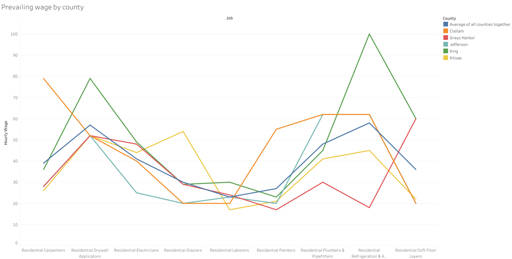
This phenomenon results in situations where L&I sets residential prevailing wages above the median hourly wage that most laborers in that county actually make, McAleer said. And, becuase hourly wages paid by Interstate 5 corridor companies for work done on the North Olympic Peninsula can be inflated due to travel costs and other factors, it can result in situations where the prevailing wage in Clallam County outpaces nearby counties — even those like King County.
For example, in Clallam County, the going prevailing wage for residential carpenters is $79 an hour. In King County, the prevailing wage is set at $36 an hour.
A similar trend holds true for residential painters in Clallam County, whose prevailing wage is set at $55 an hour. In King County, the rate is $23 an hour.
While McAleer said she supports local contractors being paid well, “by significantly raising the prevailing wage rates, we pay in a cumbersome and artificial process, we make it more lucrative for companies to travel from the I-5 corridor to bid on these jobs, and we aren’t able to stretch our local public dollars to do more.”
These higher costs can hit entities in rural counties especially hard, Clallam Housing Administrator Tim Dalton said, because they often have a more difficult time securing public funds.
When affordable housing developers are required to pay prevailing wages, McAleer said it can often double, triple or even quadruple the cost of that project, driving costs up and profit margins into the ground. Sometimes, that makes it counterintuitive to accept public funds.
“That’s why the private sector doesn’t build affordable housing,” Dalton said. “Because there’s no money in it.”
Administrative impact
The prevailing wages themselves might not be the mechanism that drives costs up, said Peninsula Housing Authority Executive Director Sarah Martinez, who added that many residential professions have prevailing wages that almost mirror market rates.
“Generally speaking, and overall, I don’t think that is that large of a disparity,” she said. “We have some that are kind of inflated, and I think that’s kind of driven from the unions.”
However, Martinez said the administrative burden that comes with prevailing wages likely decreases competition for public jobs, which can inflate costs. Contractors are the ones required to take care of the paperwork, and they must be certified by the state to become a public works contractor.
That places a large burden on the contractors that could make them hesitant to engage in public works projects, Martinez said.
“Why would they, when they can make the same amount of money and not have to do all of that burden?” Martinez said. “They don’t need prevailing-wage jobs to stay in business.”
If smaller contractors step out of the public works market, that leaves larger, unionized, non-local companies to fill the gap.
“A smaller contractor who is working at a local level may choose not to bid on something or get outbid by a larger contractor, because a larger contractor has more capacity,” Martinez said. “It’s economies of scale.”
But when non-local companies secure the jobs, Martinez said it both increases travel expenses and removes the dollars from the local economy.
“[But] what choice do I have?” she added.
McAleer said it’s frustrating “when people from outside of our county get these high-wage jobs that our tax dollars are funding. It’s a huge area of economic leakage.”
There may be better ways to set prevailing wages, McAleer said. She suggested that L&I utilize information from the state Employment Security Department to set rates based on what most laborers in the county are paid, rather than based on a survey with few responses.
“I really think that our state Legislature should re-evaluate how prevailing wage is working and take some time to really ferret out accurate data and then decide if we need our statuses updated and changed,” Martinez said.
________
Reporter Emma Maple can be reached by email at emma.maple@peninsuladailynews.com.
