
By Terrance Petty
The Associated Press
PORTLAND, Ore. — Imagine a devastating earthquake and tsunami have cut off Pacific Northwest coastal communities.
Phone and Internet service have collapsed.
Ham radio operators living on the stricken coast fire up their radios, contact emergency managers and report on the magnitude of the disaster so that no time is wasted in saving lives.
This is the scenario that will be rehearsed Tuesday through Friday in an earthquake and tsunami drill that has been developed by the U.S. government, the military and state and local emergency managers to test their readiness for what — when it strikes — will likely be the nation’s worst natural calamity.
The exercise is called Cascadia Rising.
Cascadia Subduction Zone
It is named after the Cascadia Subduction Zone — a 600-mile-long fault just off the coast that runs from Northern California to British Colu’mbia.
“This is the largest exercise ever for a Cascadia break,” said Lt. Col. Clayton Braun of the Washington State National Guard.
Braun has been a key planner of the doomsday drill, which is being overseen by the Federal Emergency Management Agency.
20,000 involved in drill
Federal officials say about 20,000 people will be involved in the disaster drill, representing various federal agencies, the U.S. military, state and local emergency response managers across the Pacific Northwest, Native American tribes and emergency management officials in British Columbia.
One main goal of the exercise is to test how well they will work together to minimize loss of life and damages when a mega-quake rips along the Cascadia Subduction Zone and unleashes a killer tsunami.
Awareness of the seismic threat looming just off the Pacific Northwest dates back to the 1980s, when researchers concluded that coastal lands long ago had been inundated by a tsunami.
Research also indicated that a tsunami that was documented in Japan in January 1700 originated from the Cascadia Subduction Zone, also known as the CSZ.
Research suggests that the CSZ on average produces magnitude-9.0 quakes every 500 years, but big quakes have been separated by as few as 200 years and as many as 1,000.
So it is impossible to predict when the next monster quake occurs.
However, tectonic stresses have been accumulating in the CSZ for more than 300 years, and seismologists say it could rupture at any time.
8 million people
More than 8 million people live in the area that is vulnerable to the Cascadia Subduction Zone.
It contains the most heavily populated areas of the Pacific Northwest, including Seattle and Portland, Ore., as well as Interstate 5, one of the nation’s busiest roads.
Coastal towns are especially at risk.
Studies have forecast that while 1,100 people could die from a 9.0-magnitude quake, 13,500 could perish from the tsunami that would slam into the coast within 15 to 30 minutes after the shaking begins.
A scenario document written in preparation for Cascadia Rising exercise states “the scale of fatalities across the coast may overwhelm the resources of local governments.”
Whole towns along the coast may disappear. Hospitals could either collapse or be too severely damaged to handle casualties.
All across the region between the Pacific and the Cascade Range, bridges and roads could be destroyed, fuel supplies and communications disrupted, and buildings and crucial infrastructure may sink into soil that’s been liquefied by the intense shaking.
The region has taken steps over the past few years to better prepare for the looming calamity.
Schools are being moved out of tsunami inundation zones.
Money is being allocated for seismic retrofits of crucial structures. Tsunami evacuation routes to high ground have been identified.
Cascadia Rising is an important part of the planning that has picked up pace over the past few years.
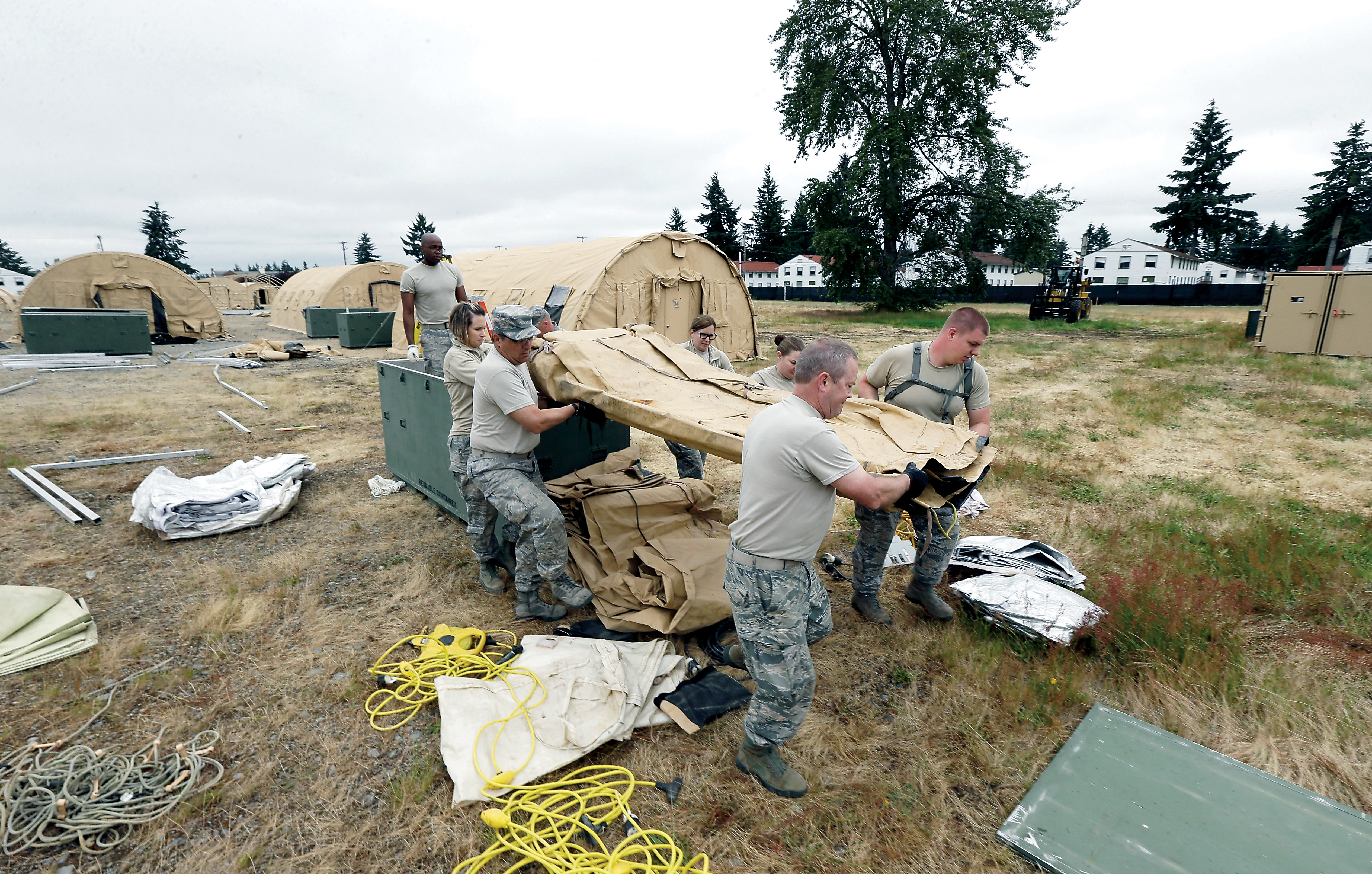
Some of the exercise will put boots on the ground. For example, Washington State National Guardsmen will conduct a landing on Vashon Island to rehearse delivery of supplies with landing craft.
National Guard
About 2,300 National Guard soldiers are among the 6,000 or so exercise participants in Washington state.
Another major drill rehearses how to get the Port of Tacoma back into operation after it has been devastated by a quake, using a U.S. Army Reserve pier that consists of a logistics support vessel, a barge derrick crane and a large tug.
In Oregon, about 580 National Guard soldiers are among some 1,400 Cascadia Rising participants from across the state.
Specialty teams will practice their roles for the disaster that will come.
This includes pulling people out of a pile of rubble that simulates a collapsed building and triaging them for medical care.
Much of Cascadia Rising will entail civilian agencies and the military coordinating in what will be extremely difficult conditions.
Participants in the exercise will contact emergency management offices with reports of specific needs during the simulated disaster.
It will be up to agencies to work together to come up with solutions.
Ham radios
Amateur radio operators are also participating in Cascadia Rising.
If Internet and phone service are severed, ham operators have the ability to act as the eyes, ears and messengers for emergency officials scrambling to figure out what they need to do to save lives and prevent more damage.
The region’s ham radio operators are even able to establish email service for emergency management officials, using amateur radio frequencies to bridge the gaps.
“We can leapfrog over the outage to where there is still Internet activity,” said Bruce Bjerke, Oregon section coordinator for Amateur Radio Emergency Services, a national non-governmental organization.
