
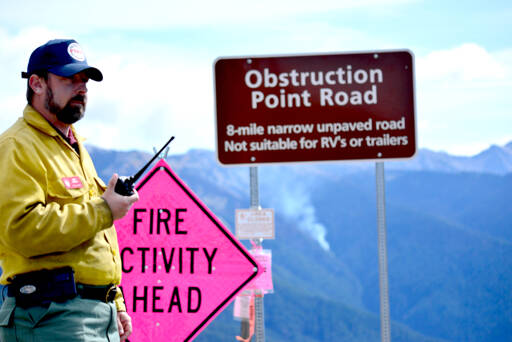
PORT ANGELES — Several fires are burning in Olympic National Park, but firefighters aren’t in a rush to put them out.
The six fires that are burning throughout the park were started in an Aug. 28, lightning storm. Most are in wilderness areas or other areas that currently pose little or no threat to people or property, so fire managers are letting them burn as they naturally would.
“We’re managing the fire using what’s called the confine and contain strategy,” said Mike Theune, regional fire communication and education specialist with the National Park Service.
“What that means is in a place like the Olympics, at an elevation like this, the fire’s going to hit rocks in some places, so when we fight fires in these areas we call it the ‘Four Rs’ of firefighting; rocks, rivers, ridges and roads,” Theune said.
The largest of the fires is currently the Eagle Point Fire roughly 5 miles down Obstruction Point Road east of the Hurricane Ridge parking lot. That fire, which remained at 85 acres for more than a week, was reported at 122 acres on Thursday.
With the fire being hemmed in by natural boundaries and burning slowly, firefighters are allowing the fire to run its course. Wildfires are a natural part of a forest ecosystem, Theune said, and can help to expand habitat for local animals.
“If you’ve got rocks and ridges, and roads, and at the bottom side of it, rivers, we can actually manage the fire for basically ecological benefit,” Theune said.
“One of the things that this fire is doing by actually getting rid of these stands, these dead and dying timber stands. In some cases, not everywhere but where the trees are primed to go, it’s actually increasing marmot habitat,” he added.
Without fires to curtail them, trees stands can encroach on meadows and habitats where animals like marmots thrive.
“So when we have a fire like this that’s burning at a lower to moderate intensity, but generally more low — it’s been almost three weeks — we can actually work with the fire to manage it for ecological benefit,” Theune said.
Firefighters work with scientists and analysts to determine in which areas a wildfire might bring some benefit and where crews should try and stop them from expanding.
Trevor Durr is the incident commander for the Eagle Point Fire. A firefighter with the U.S. Forest Service, Durr is typically based in Oregon but was brought in to help with the Olympic National Park fires.
We’ve have several different (specialists) come in and identify different points of interest that are kind of very good for fire growth and then points of interest that we need to kind of spot protect,” Durr said. “I would say a point of interest that is very good for fire growth would be the endemic marmots that live here and how the tree type here is encroaching on their habitat, the fire here is a natural event that happens that should take out those encroaching trees.”
Weather at Hurricane Ridge at this time of year typically changes between colder, wetter days and warm dry ones, and Durr expects the Eagle Point Fire to grow over the weekend as temperatures warm. But the ridge is often covered by clouds, and even on sunny days, Durr said the trees are dripping wet from fog banks.
“It is in a kind of monitor and patrol status, it’s in basically the same status since it started was being where it’s at, and doing what we want the fire to do,” Durr said. “We’ve been monitoring the growth and keeping it in check and trying to make sure that it does what fire is supposed to do naturally.”
Another fire started by lightning, the Hurricane Fire, is about 95 percent contained and on Wednesday a helicopter was brought in to help lift out equipment from the fire site located about 1,200 feet below the parking lot.
That fire has remained at roughly 4 acres since it was started in late August.
Both the Hurricane Fire and Eagle Point Fire are burning in steep and rugged terrain where it can be difficult for firefighters to get in and out.
For some of the other fires in the park such as the Low Divide Fire, currently about 90 acres, firefighters have been flown in and have set up camps to monitor the fires.
The Diamond Point Fire was at 30 acres as of Thursday, and the Martins Lake Fire was reported to be 31 acres. Delebarre was 1 acre.
While the fires are mostly contained, there’s still a danger they could spread or damage park infrastructure. Burning trees can come loose and roll down a mountainside, spreading the fire to new areas and fires can undermine the integrity of mountain roads.
The Eagle Point Fire could burn for another month or so Theune said, as what often fully extinguishes these fires is what’s called a “season-ending event” like a rainstorm. In the Olympics, those events typically happen in late October or early November.
Obstruction Point Road has been closed since the Eagle Point Fire began, and will likely remain closed into the winter, Theune said. Burnt trees are less stable than living ones, and even after the fire is out they can present a threat to the public.
“As we get into winter with the winds and everything else that we find in this place, the last thing that we want is for a tree to come down whether it be from a vehicle or another type of visitor; hiker, cross country skier,” Theune said.
“So in order to protect or to reduce the risk to the public we’ll keep those areas generally closed especially through winter to let those trees, hopefully, come down on their own.”
________
Reporter Peter Segall can be reached at peter.segall@peninsuladailynews.com.
