
PORT TOWNSEND — Ian Jablonski held in his hand a filter cartridge, a small device with hundreds of tiny fibers sprouting from the top. It’s one of 102 cartridges that fit into a single skid at Port Townsend’s water treatment facility, which opened in January 2017.
That was the first time Port Townsend’s water system was filtered. It’s a system that runs 28 ½ miles from the Big Quilcene River through underground pipes to the city.
Now tasked with updating a water plan last revised in 2008, the Port Townsend City Council is expected to consider another version Monday that looks 10 and 20 years into the future.
Population growth projections and water usage are some of the top priorities, but the document — at more than 1,100 pages — also covers rates and fees to cover capital improvements, including the treatment facility off 20th Street.
The plan had its first review July 15, when Public Works Director Greg Lanning pointed out much of the content is engineering language with charts and graphs of the system.
It also includes 20 appendices that are existing documents used as reference points and to stay consistent with policies such as water rights assessments and the connection and usage by the Port Townsend Paper Co.
“It’s a good thing,” Lanning said during the hearing earlier this month. “You now have a one-stop shop related to the water plan, all the documents, and you don’t have to go searching for them.”
While the plan had a minor update in 2014, the state Department of Health allowed the city to delay its full revision due in 2016 because it was building the treatment facility at the time.
Now the projections comply with the state’s vision for 2026 and 2036, Lanning said.
The $17 million treatment facility added filtration, a federal Environmental Protection Agency requirement set by the Safe Drinking Water Act. Prior to 2017, the water was only treated with chlorine.
Filtering became the standard after a large outbreak in Milwaukee caused by a parasite called cryptosporidium led to several hundred thousand people becoming ill in the 1990s, Jablonski said.
The EPA identified ways to treat it nationally, and the city considered an ultraviolet solution, but it chose to use the membrane-filtration system that traps organisms down to 0.04 microns, Jablonski said.
One micron is one-millionth of a meter. The size of a single strand of human hair is between 17 and 181 microns, and a cryptosporidium parasite is about six microns, Jablonski said.
“It’ll filter out some of the viruses that are pretty small, and then we’ll add chlorine to it after,” he said of the three skids at the treatment facility.
Part of the larger planning process includes projections based on census figures. Within the water service area, the plan provides for an increase of about 2,500 people by 2036 and an additional 1,500 equivalent residential units.
It also projects the average water demand per day as well as the maximum demand 20 years into the future.
The system itself will need sections of pipe replaced, Jablonski said. While the majority of the system was replaced between the mid-1950s and the early 1970s, there are about 8 miles, including a 5.7-mile stretch between Anderson Lake and the city, with original 1928 piping.
“We have to figure out how to finance that,” Jablonski said.
The plan deals with building standards that describe everything from how to put in a new water line to installing a fire hydrant. It also includes a 3 percent deduction for being more efficient with water usage in the next six years.
There are projections to include small changes to add a few meters in the Jacob Miller Road area and an expected capacity of 1,653 gallons per minute by 2036.
Financial analysis helps to determine whether metered rates stay the same or increase. They generally pay for the operations and maintenance of the system but also pay back loans on capital projects, Jablonski said.
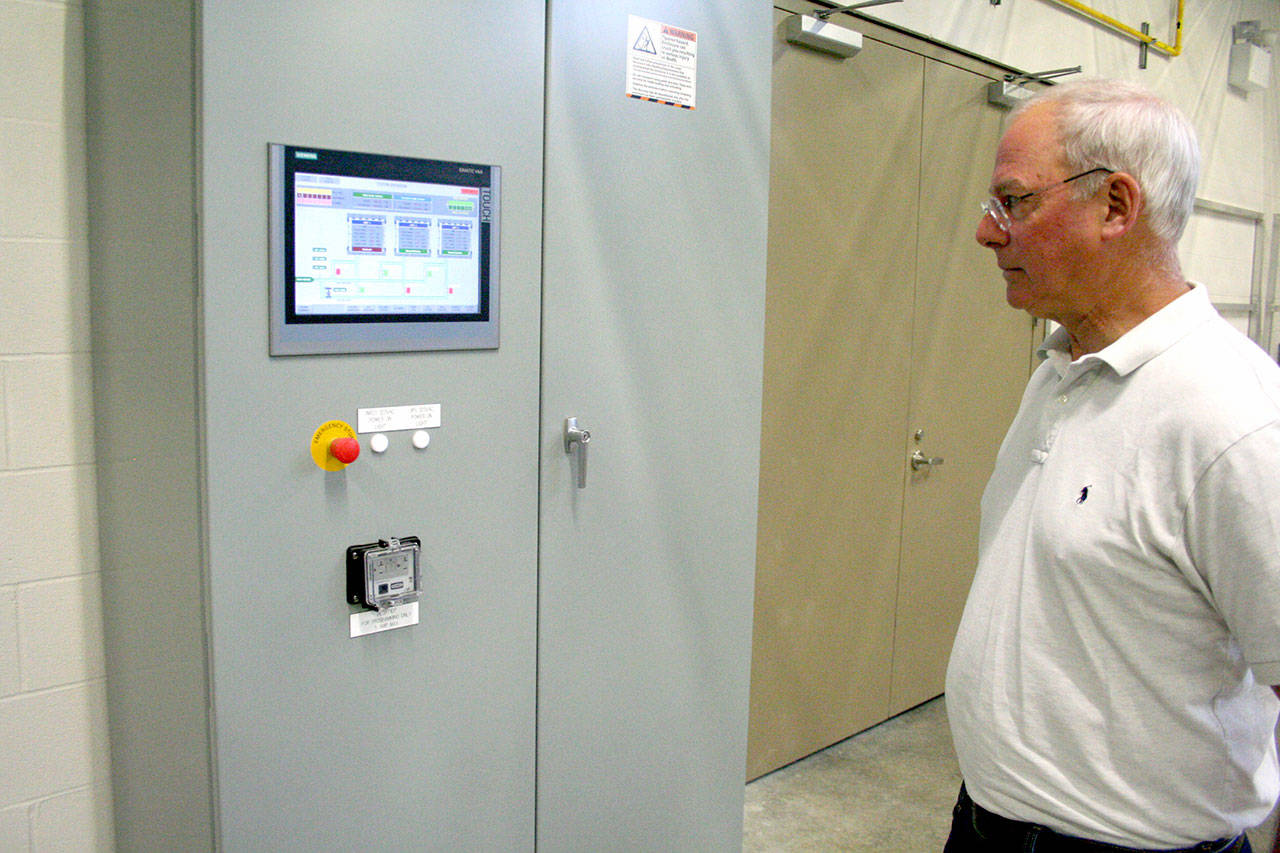
Inside the treatment facility, a programmable computer keeps track of working valves and routine cleanings. Redundancy is built in to help with maintenance or if a mechanical problem occurs.
Along with the skids that filter the water, separate devices squeeze small amounts of chlorine into the system per cycle, and the pH is tested and balanced with acids and bases.
On-site storage off 20th Street includes a 5-million-gallon tank with 10-inch-thick concrete walls and an additional 1-million-gallon stand pipe. A pump station also was built to help pressurize water where the city would need it, although that would typically only happen in the case of a high-flow event such as a large fire, Jablonski said.
The city’s water plan goes through multiple levels of review, from Jefferson County officials to the state Department of Health before it goes through the city public hearing process.
________
Jefferson County Managing Editor Brian McLean can be reached at 360-385-2335, ext. 6, or at bmclean@peninsuladailynews.com.
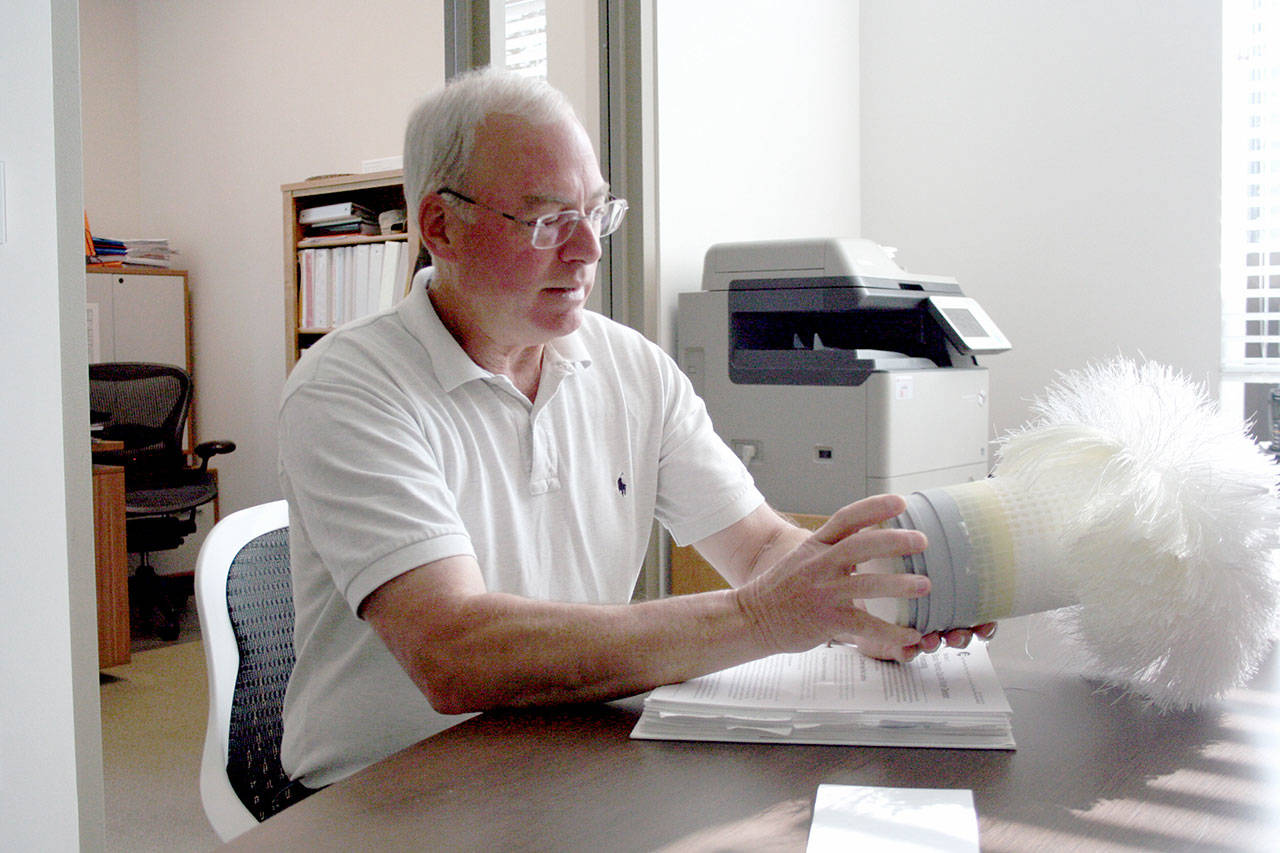
Ian Jablonski, Port Townsend’s operations manager for water resources, shows part of a filter cartridge that fits into one of three skids at the city’s water treatment facility off 20th Street. There are 102 cartridges per skid that filter water to 0.04 microns, Jablonski said. One micron is one-millionth of a meter. (Brian McLean/Peninsula Daily News)
