
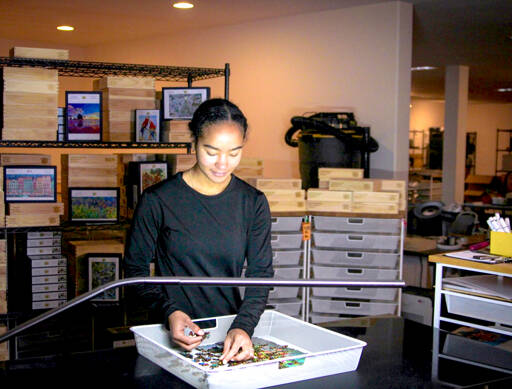
PORT TOWNSEND — Wooden jigsaw puzzle company Artifact Puzzles has produced about 600 designs, including an always-expanding Christmas selection.
“Sleigh Stop” is an artistic take on the idea that the modern world needs more than one Santa Claus. Rather than resting and refueling at a truck stop, the many santas converge at the sleigh stop.
Puzzle “Naughty or Nice” uses an image commissioned from British Painter Emily C. Woodard. It was released in November 2025, according to the Artifact Puzzles website.
“We’re always looking for that sort of West Coast take on Christmas,” said Maya Gupta, the company’s founder and owner. “This one features a dragon, who’s playing Santa, and a small boy. (The dragons) got a lot of presents in his cave. There’s a little bit more tension about, is the boy going to get the present, or is he going to be a smoldering pile of ashes?”
The company released a puzzle with a commissioned image from Seattle-based artist Vikram Madan in 2023. The popular “Holiday Spirits” features a cute and cozy grim reaper enjoying a warm drink next to a Christmas tree and in front of a fire, Gupta said.
Several years ago, a Port Townsend customer who would portion puzzles into bags as an advent gift for his parents requested that Artifact start manufacturing an advent line.
Gupta said the idea was soon manifested and now the company sells a number of different advent puzzles, which also can be fun as a holiday party activity, with different attendees assembling one portion of the puzzle.
The puzzles, made from custom plywood produced at an Oregon mill, are designed in Adobe Illustrator.
The puzzle designers, mostly based in Port Townsend, are responsible for ensuring that each puzzle is distinguished from the last.
“A normal puzzle has square pieces, but pieces don’t have to be square.” Gupta said. “We want each one to be a little unique, a little different, a little surprising.”
A typical cardboard puzzle may be more or less square with protruding-knobs and indented knob receivers. Artifact Puzzles strives to resist what is typical.
Whimsy pieces are images unto themselves, a reading boy, where the knob is a book, for example. Nestled spiral pieces only hold together in groups of three. The most unique pieces are called split-tendril connectors, Gupta said.
Overseeing the laser-cutting process is not a set-it-and-forget-it process. It requires a monitor — and challenges like the laser not cutting completely through the wood or not cutting a fine enough line — are wasteful, Gupta said.
The means by which the company attaches the images to the puzzle are a trade secret, Gupta said.
When Gupta started the company in Seattle in 2009, laser cutters were a relatively new technology. The company has seen several evolutions since then.
The company’s name refers to the time-specific nature of the laser-cutting process and the product that results.
“We think of it as an artifact of our time,” Gupta said. “These puzzles aren’t something you could do a hundred years ago. Who knows what puzzling would be like a hundred years from now.”
The name also refers to the physical nature of the wooden puzzle. The more sturdy build of the puzzles could be family heirlooms moving forward.
The things that make art great are not always what makes puzzle images great, Gupta said. Large open swaths of blue-sky, for example, do not make for good puzzles.
Part of the work of the company is to identify or commission pieces of art that would make for good puzzling, she said.
“We’ve created a lot of niche puzzles of random artwork that maybe not everyone would like, but a few people would really enjoy,” Gupta said.
One puzzle uses Edward Hopper’s painting “Soir Bleu,” which depicts a melancholic clown smoking a cigarette in a Parisian diner at night.
Artifact commissioned a painting from British painter Samuel Hayward this year. The painting was intended to include 100 metaphors. The end product, a puzzle called “Modern Metaphors,” includes 450 metaphors, including metaphors in some of the 889 puzzle pieces, Gupta said.
The puzzle even has a devoted website where puzzlers can keep track of the metaphors they come across.
The puzzle costs $220. Prices tend to range from $30 to about $300, but a sample pack can be purchased for $10.
The website allows customers to browse by difficulty levels, as well as by a number of other categories, including artist, century or piece count.
The company moved to Silicon Valley in 2013 before returning to Washington to settle into Port Townsend in 2021. Gupta said she wanted to return to Washington and her husband and Artifact co-owner Jim Muller didn’t want to move to Seattle.
Port Townsend, with its strong woodworking culture, has been a great home for the company, she added. It’s located at
During the COVID-19 pandemic, Gupta started a peer-to-peer puzzle library called The Hoefnagel Puzzle Club, which now runs out of the same building as Artifact Puzzles. Members can select a puzzle they want from Artifact Puzzles’ 600-plus collection as well as from more than 100 puzzle manufacturers around the world.
“We send the puzzles out, and then when someone finishes with the puzzles, we have them send it directly to another member of the club or of the library,” Gupta said.
Readers can browse the library and view membership options at woodenjigsawpuzzles.com.
For those interested in receiving their puzzles before Christmas, Gupta said the puzzles ship immediately. Those who live locally can contact the company via email at people@artifactpuzzles.com for local deliveries or to schedule a pickup in person at 2405 W. Sims Way. The shop, not generally a storefront, is open from 8 a.m. to 5 p.m. Monday through Wednesday.
Readers can find pictures of puzzles and locate puzzles for purchase at artifactpuzzles.com.
________
Reporter Elijah Sussman can be reached by email at elijah.sussman@peninsuladailynews.com.
