
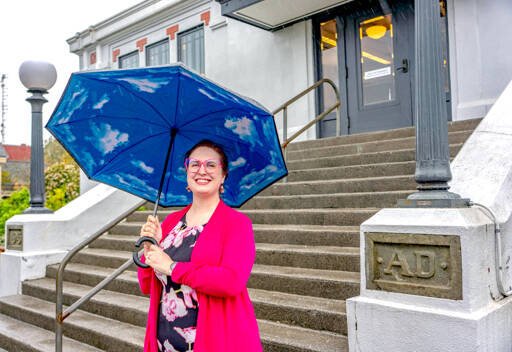
PORT ANGELES — When a staff member at the Port Townsend Library told Community Services Director Melody Sky Weaver that someone claiming to represent the Carnegie Corporation of New York had called, she was skeptical.
“The library gets a lot of unwanted solicitations and suspicious marketing calls,” Weaver said. “So when they said Carnegie, I thought, ‘OK, I’ll look into it.’”
To her surprise, the call was legitimate.
The Carnegie Corporation, one of the oldest philanthropic foundations in the nation, was reaching out to confirm that the Port Townsend Library, which still operates out of its original 1913 building, is still a free public library.
What the representative didn’t reveal was that a surprise was in the works: a $10,000 gift the Carnegie Corporation was making to every Carnegie library in the country — all 1,280 of them — to be distributed early next year in celebration of America’s 250th anniversary.
That includes Port Townsend and Port Angeles.
For Weaver, who oversees the Port Townsend Library, the call came as an unexpected reminder of how the city’s library remains tied to its early 20th-century origins.
For Noah Glaude, the North Olympic Library System’s executive director, the news arrived in a more roundabout way.
“The word was kind of spreading among library circles,” Glaude said. “I kind of expected we would be contacted by them, but we didn’t hear anything.”
So, Glaude reached out to the Carnegie Corporation to see if Port Angeles was in line for a gift. Although the current branch on South Peabody Street no longer occupies the old Carnegie building on Lincoln Street, the connection remains strong.
“Even though we haven’t operated out of the building since the 1990s, we have photos of the historic building on the walls, and the history of the museum and library is in our collection,” Glaude said.
“We also have records of the original donation.”
That was enough to persuade the foundation that Port Angeles qualified.
The Carnegie building is still owned by city of Port Angeles and leased to the Lower Elwha Klallam Tribe.
Port Townsend’s Carnegie library, built in 1913, is one of about 750 still in use as a library, although it has been remodeled over the years.
Correspondence in the Carnegie Corporation archives shows the city initially asked for between $5,000 and $8,000. The Carnegie Corporation awarded $12,500 instead, saying the smaller amount “would not suffice for the needs of a town of [its] size.”
Carnegie insisted that each town invest in its own project to ensure local commitment.
“If Port Townsend has no Library Building and desires Mr. Carnegie’s assistance in obtaining one, the taxpayers should have the proper authorities address him on the subject, stating what they are willing to do for their part,” one letter read.
The city agreed to provide a site and $1,250 in annual support.
“He would help them build it, but they had to be able to prove they could run the library,” Weaver said.
Port Angeles’ pursuit of a library began in 1905; it finally opened 1919.
Design
Andrew Carnegie loved libraries, Weaver said.
“As an immigrant who rose from working in a cotton mill to becoming the wealthiest man in the world, he believed libraries could help anyone make their own success — the way they helped him.”
Carnegie didn’t impose a single architectural style on his libraries, but he published “Notes on the Erection of Library Buildings,” a guide emphasizing economy, utility and “good taste.”
The goal was to maximize light, space and practicality — and to ensure that reading rooms, not offices or stairways, dominated the layout.
Granting of funds to Port Angeles was delayed by, among other things, the designs it submitted being continually rejected.
“The men’s toilet might be much smaller in area,” a letter from one of Carnegie’s secretary’s read.
The continual back-and-forth rather annoyed architect Harold Ginnold, who also designed Port Townsend’s library, and frustrated Port Angeles Mayor E.J. Walton, according to correspondence.
The Port Townsend and Port Angeles Carnegie libraries share many of those classic design elements: two-story construction, large windows and open areas for quiet study.
“Andrew Carnegie did see public libraries as exalted halls of knowledge,” Weaver said. “He wanted people to feel like they were ascending to a higher level by accessing the knowledge within.”
That design philosophy still shows, although it often doesn’t work well for current users.
The children’s section of the Port Angeles Carnegie, for example, was on the second floor, so parents had to carry strollers up the staircase.
“There’s now focus on accessibility,” Glaude said. “We’re making improvements to all of our buildings so that folks in wheelchairs, walkers and the blind can use them easily.”
Changing needs, constant purpose
While the role of libraries has evolved, their importance has not diminished.
“These facilities continue to get a ton of use, and folks are coming into the buildings for a lot of more different reasons,” Glaude said.
“They’re browsing the collections, but they’re also using computers. We have story times and activities that take a lot of space. These buildings need be a lot more flexible and operate in a lot of different ways than they used to.”
He noted that NOLS’ $10 million expansion and renovation of the Sequim branch — now nearing completion — is a reminder of how library design and community expectations have changed since Port Angeles built its Carnegie Library more than a century ago.
Weaver said Port Townsend’s library has faced similar challenges.
“Over the years, it was always the same story — it was so busy and outgrowing its space,” she said. “Should they move to a different building? Build a new one? Add on? The message was always the same: don’t leave the Carnegie.”
A major addition completed in the 1980s was funded almost entirely through grassroots fundraising and grants.
Today, Weaver said, the challenge is ensuring that the library continues to serve the entire community.
“I think Carnegie saw libraries as the most democratic institutions possible,” she said. “He was a deeply flawed man, but later in his life, he certainly did a lot of good. Libraries have evolved even more to be that place that truly welcomes everyone.”
Neither Weaver nor Glaude yet knows how the unrestricted $10,000 gifts will be used.
“Ideally it should be utilized in a way that really benefits our public and our beloved 113-year-old Carnegie library,” Weaver said.
Because the grants are timed to coincide with the nation’s 250th anniversary, Glaude said the funds might be used for programs or projects related to that milestone.
“There may be some opportunity to support programming that happens next summer related to that,” he said. “And there may also be some opportunities to support our archival and local history collections — to digitize materials and make them more accessible.”
Whatever the decision, both library directors said the gift serves as a meaningful reminder of how Carnegie’s original vision continues to resonate.
“We’re just excited to get the gift that recognizes the history of the library here in Port Angeles,” Glaude said.
Weaver agreed, adding that the best part of the surprise may be what it symbolizes.
“Libraries bring people together from all different walks of life to interact, to meet one another and to build a sense of community,” she said. “That was true in Carnegie’s time, and it’s still true today.”
________
Reporter Paula Hunt can be reached by email at paula.hunt@peninsuladailynews.com.
