
PORT TOWNSEND — The Port Townsend Paper Corp. will change its main fossil fuel power source for its mill from oil to compressed natural gas, a move mill officials say will cut emissions and is the first use of the fuel in a manufacturing plant in the state.
“This will lower our costs, dramatically reduce emissions and increase our boiler efficiency,” said Matt Denton, the company’s chief financial officer, at a training session of first responders Friday.
The mill, East Jefferson County’s largest private employer with 297 workers, signed a supply agreement with Xpress Natural Gas of Boston to supply compressed natural gas between May and August next year, bringing in four or five deliveries each day to its facility just south of Port Townsend.
Officials said they will begin the permitting process in the next couple of weeks to convert the kiln and boilers to dual-use, for both compressed natural gas and oil, by next spring.
Compressed natural gas is a highly concentrated material that has been used internationally for 30 years, but in large manufacturing facilities in the United States, it has been used for only the past 2½ years, mill officials said.
It’s made by compressing natural gas to less than 1 percent of its volume at standard atmospheric pressure and consists mostly of methane.
Mill officials said that its addition to Port Townsend will make Washington the 16th state to see it in use in a large manufacturing plant.
The use of compressed natural gas “will result in significant emissions reductions, including greenhouse gas emissions, by converting to natural gas relative to oil, which will be displaced,” mill officials said in a fact sheet on the change.
In preparation, Xpress Natural Gas will construct a decompression station at the mill that will receive the shipments and expand the compound for use as a power source, Denton said.
The new facility is on an unused portion of the property and will consist of “a concrete slab with a 12-foot shack on top,” according to Kevin Scott, the mill’s director of sustainability.
The facility will have a built-in automatic emergency shutdown system and other fail-safe measures that are continually monitored, according to the fact sheet.
Denton said compressed natural gas is safer during transport than standard natural gas, propane or gasoline, as it is not combustible.
If it is spilled, it dissipates into the air rather than pooling onto the highway, he added.
Denton said natural gas requires oxygen to be flammable. Inside the tanks, the gas is too concentrated to burn or sustain a flame, so it cannot explode.
A trailer of concentrated natural gas has less fuel value than a trailer of oil, gasoline, diesel, propane or liquid natural gas, Denton said.
“Most of what is on the road in Washington has probably three to four times more energy density than concentrated natural gas,” he said,
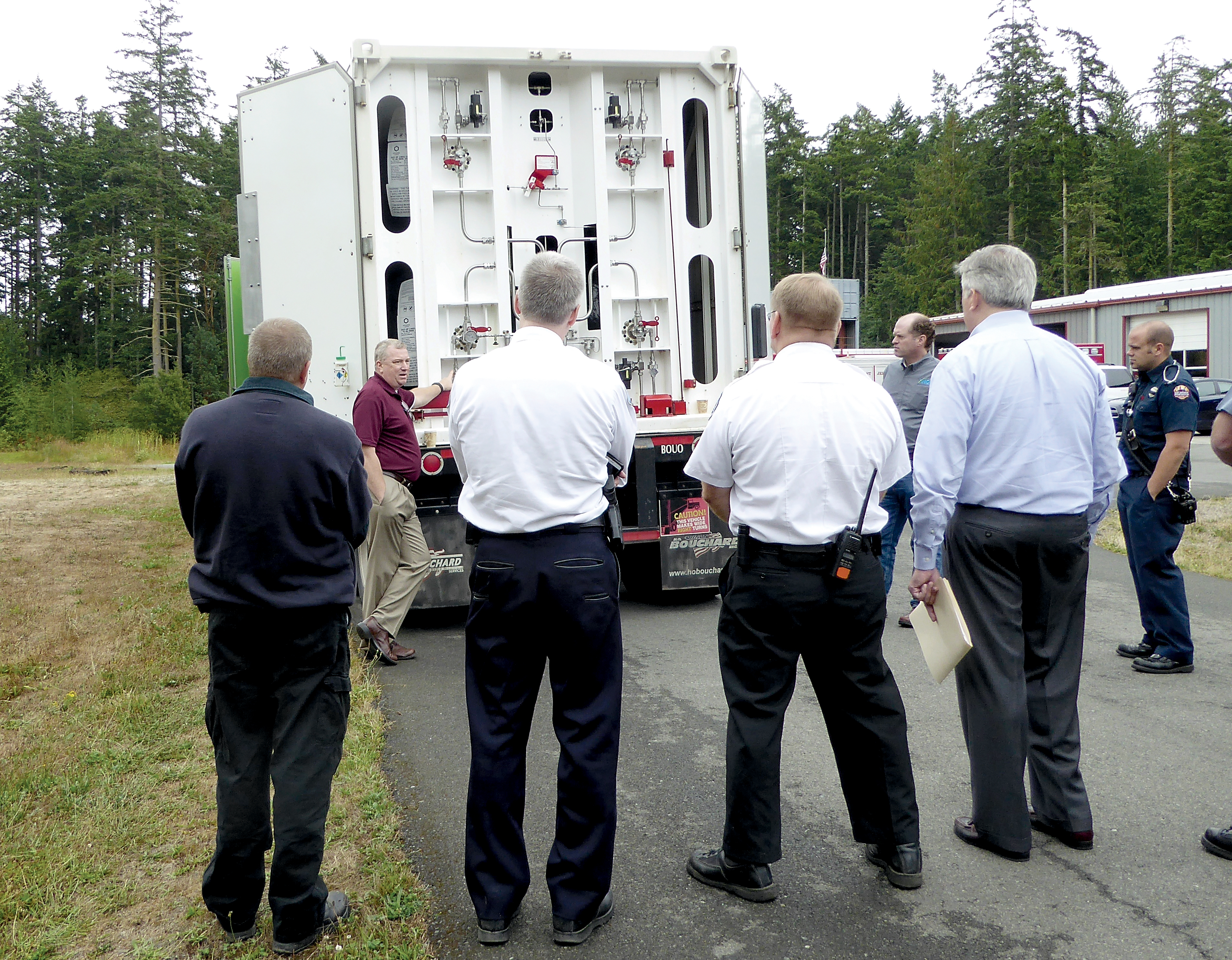
In preparation for the new technology, the mill sponsored a training session for first responders at East Jefferson Fire-Rescue Station 5, which included representatives of local fire departments, Port Townsend police and the State Patrol.
Fire Chief Chris Christopoulos from Lebanon, N.H., spoke to the group about the gas’ special qualities, its transport and spill procedures.
It is important for local first responders to be aware of the special qualities of concentrated natural gas, according to Bill Beezley, East Jefferson Fire-Rescue spokesman.
“Firefighters are called out to deal with a wide variety of hazardous materials,” Beezley said.
“There is a tremendous number of different fuels being transported on the roadways, so we need to develop a certain level of knowledge about whatever’s being transported in our district.”
In the event of a spill, the fire department would call in the State Patrol for hazardous material response.
Training is intended to teach them what they need to do in the meantime.
This would include developing a public safety perimeter, Beezley said, until the State Patrol team arrived.
The gas will be piped into Xpress Natural Gas’ Puyallup facility, now under construction, where it will be compressed and then transferred into specially designed trucks for transportation to Port Townsend and other locations.
Scott said the mill will use “as much [concentrated natural gas] as we can get” and that it will become the main source of fossil fuel power used by the mill.
The oil tanks will stay in place and will be used as a backup power source, he said.
_______
Jefferson County Editor Charlie Bermant can be reached at 360-385-2335 or cbermant@peninsuladailynews.com.
