
PORT TOWNSEND — On July 20, 1969, inhabitants of planet Earth were moonstruck.
American astronaut Neil Armstrong became the first human to walk on the surface of the moon. His history-making first step was broadcast to millions. The success of the Apollo 11 mission led to subsequent explorations ending in 1972 with the sixth moon landing by Apollo 17.
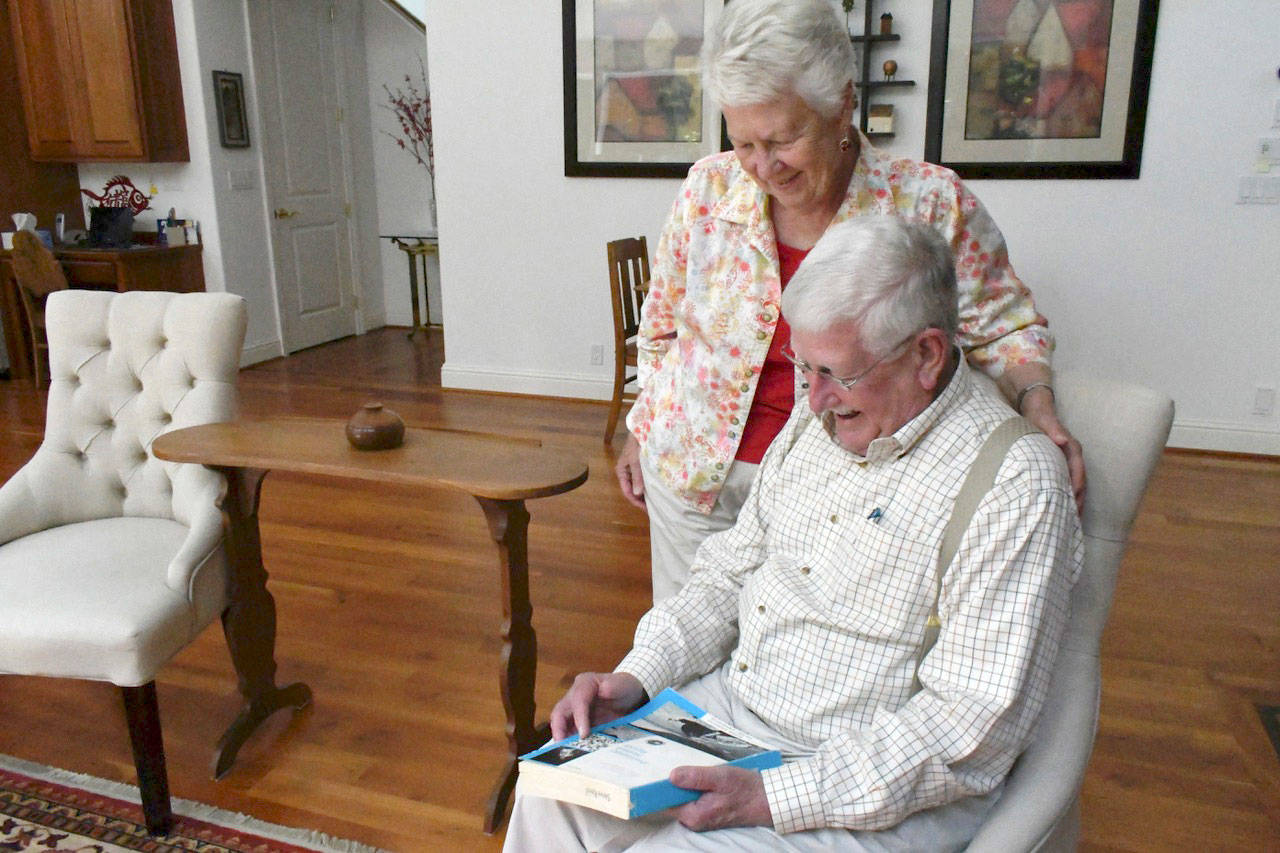
For Port Townsend residents Steve and Jean Reed, this historic event was more than a black-and-white image on a snowy television screen. It was personal.
Steve Reed, self-described as a “young, fresh geologist,” was part of the Apollo field geology team, a group within the U.S. Geological Survey’s astrogeology science center headquartered in Flagstaff, Ariz. He was in the lab with colleagues at the time of Armstrong’s walk and said being able to see it happen was “absolutely incredible.”
Reed’s wife, Jean, also was employed by the USGS and was involved in the space program.
“We both remember the landings like they just happened yesterday,” she said.
“The most fascinating part is it’s like any other exploration. You feel so privileged to be part of it, of seeing something and doing something for the very first time.
“The whole job, well, you couldn’t believe you were getting paid to do what you were doing.”
Steve said at the time he was very young, working with scientists almost twice his age.
“I went to work with them in 1967 for the unmanned lunar surveyor missions,” he recalled. “Then the Apollo program began.
“I was fortunate enough to go on training missions and work in Mission Control as part of a larger team that included people from Stanford, Brown University and the JPL (Jet Propulsion Laboratory) who were skilled in astrogeology.”
His team trained astronauts in rock identification because they were not geologists; they were mostly test pilots. The area in and around Flagstaff afforded them a place to learn geology and practice gathering samples. They also practiced using aerial photos as topographical maps to navigate terrain.
The three Apollo 11 astronauts — Armstrong, Buzz Aldrin and Michael Collins — completed training there that helped them become acquainted with the moon’s surface, all part of the preparation for the eventual historic lunar landing.
Reed said his team worked in Mission Control during the actual missions after Apollo 12.
“My group’s responsibility was to interpret the geology as the astronauts were on the moon,” Steve said.
For Apollo 11, the USGS team had done all the pre-mission lunar landing site work and mapped out the geology of the preferred landing area.
But when it came to reality, Apollo 11’s lunar module Eagle was off a bit, he said.
“When they arrived, they were in a boulder field,” he said. “They had to move off and find a smoother place to land.
“They had another second or two before they would have automatically aborted the mission.”
In later missions when they used the lunar rover and better cameras, it was possible to watch astronauts collect samples. Then the astronauts would take photos and describe the geology of the landing site in real time.
Jean Reed created transcripts focused on conversations between the astronauts and mission control. Her job was to document the geology for analysis.
As the astronauts picked up rocks, they called out the bag number and each rock was given a sample number. She documented where the sample came from by photographing a television screen.
“It was Polaroid film back then,” she said. “It helped to identify the rocks when they came back to the receiving lab.”
“You don’t know exactly what the mineral content is,” Jean said. “Apollo 11 landed on a basalt surface. Even though the chemistry is somewhat different, those lavas still have a very similar appearance to what we showed the astronauts here on Earth. They knew they were basalts, but we didn’t know the fine chemistry. They had been trained to recognize what they were looking at.”
Steve said he wished the United States had gone back to the moon after Apollo 17. He left the USGS in 1972 and moved on to work in terrestrial geology as a groundwater hydrologist.
“What we learned was really fabulous,” he said. “And the technology we developed for the space program was absolutely incredible. NASA wouldn’t advertise its technological advances like transistors, medical, miniaturization, and computers. That technology continues today through the space station.”
Although the U.S.has had only a few moon landings, Steve believes “we’ve just barely begun to see what’s really there.”
On Saturday night, the Reeds will be looking up, hoping for a clear sky and a bright moon.
And they’ll be remembering where they were 50 years ago.
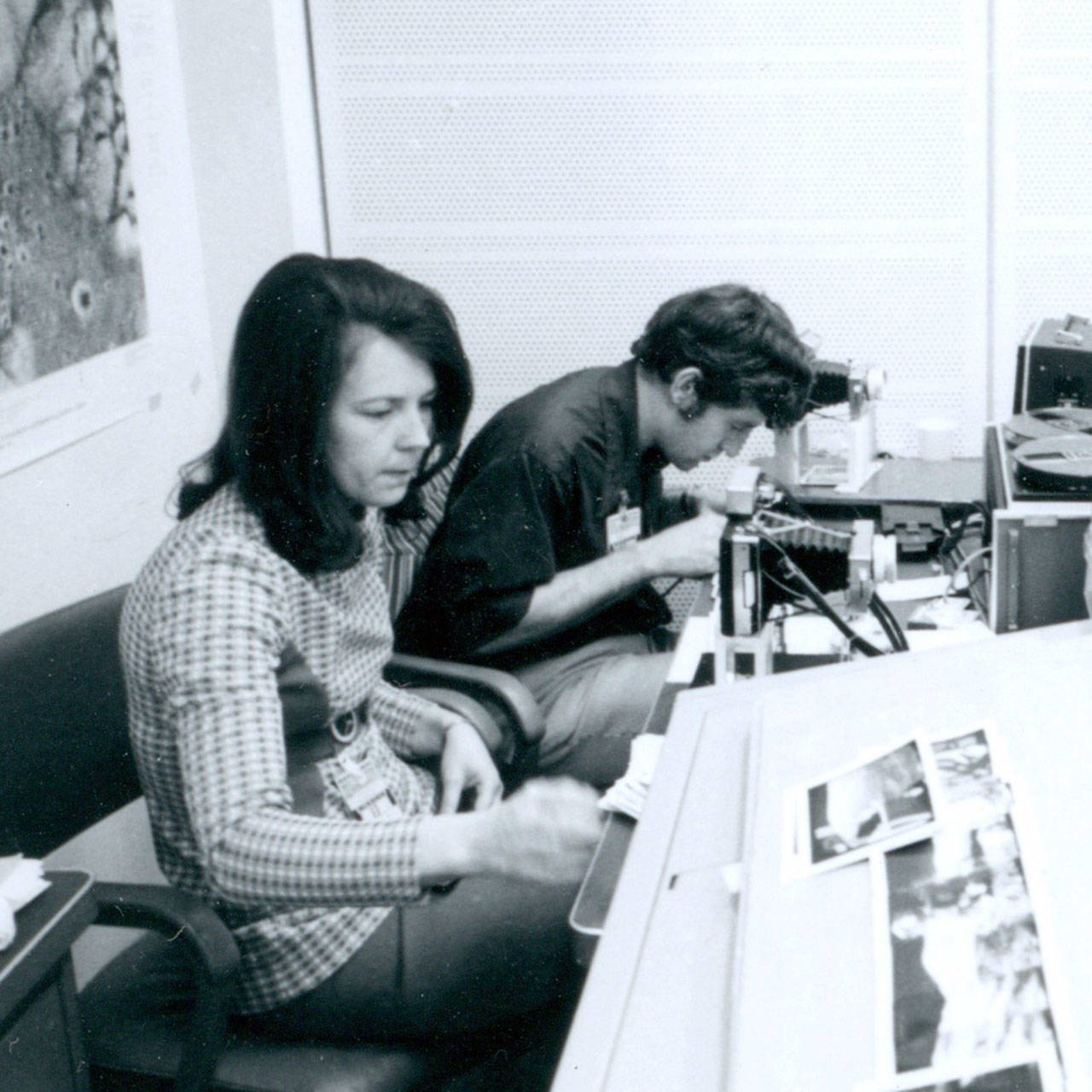
Jean Reed and her husband, Steve, are shown in the USGS geology lab at NASA in the early 1970s where they helped identify rock samples taken during lunar landings. Jean’s job was to photograph images from a television screen to document the custody of the rocks. Steve’s job was to analyze the rocks and determine their chemical composition form visuals and conversations with astronauts.
