
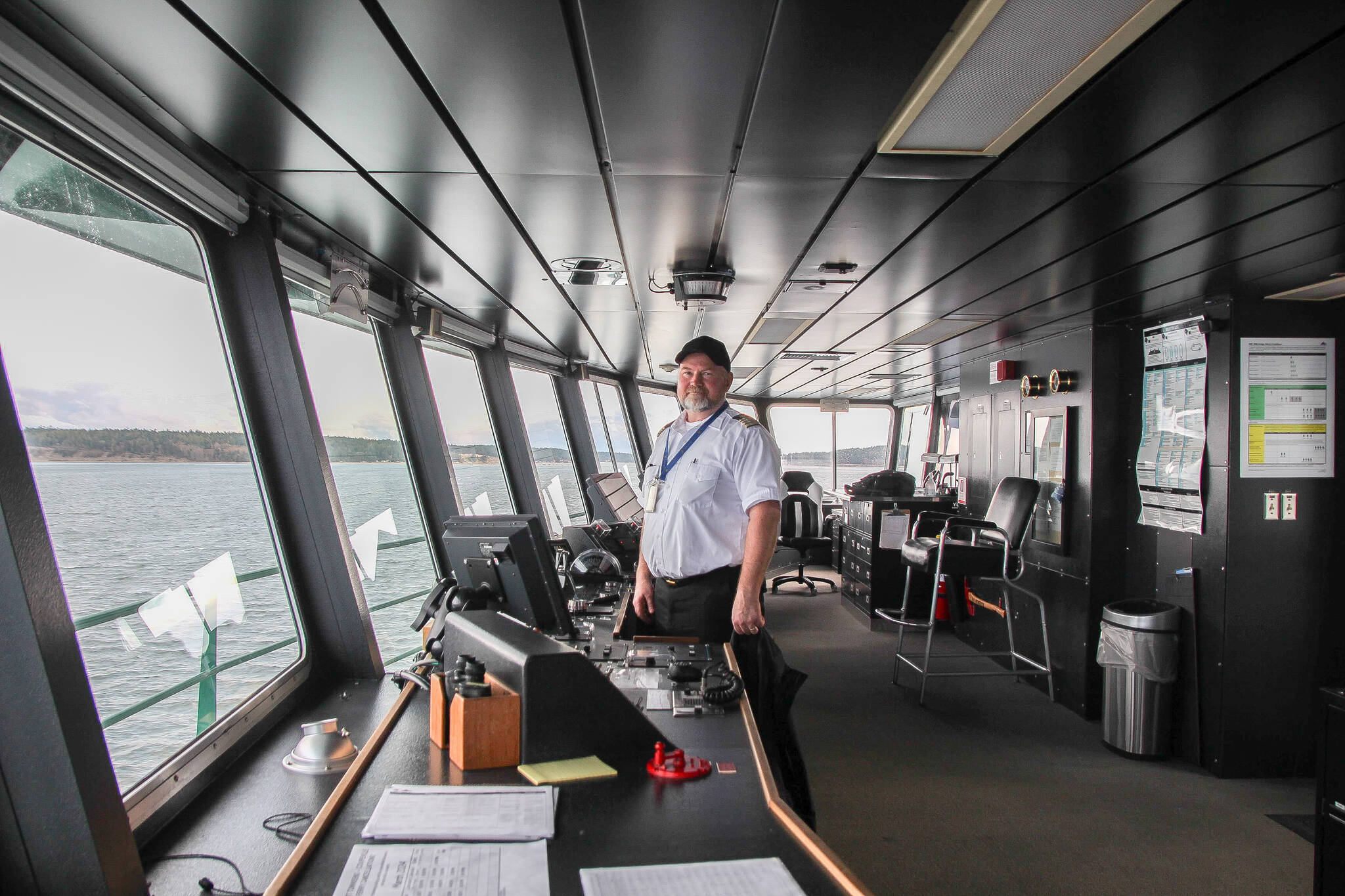
COUPEVILLE — Inside of the Kennewick’s pilothouse, Capt. Mark Gripp looked at the anemometer’s display to check the wind speed before setting sail for Port Townsend.
Seventeen knots, coming from the east. A moderate speed. Had it been over 40 knots, the vessel would have had to use all of its horsepower to leave the harbor, and not without some difficulty.
The captain and the chief mate, located on the opposite ends of the vessel, worked in tandem to position the Kennewick in a way that would prevent it from being blown over by the wind, safely maneuvering over 2,700 tons of steel out of the challenging Keystone Harbor.
As the view of Whidbey’s western coast grew smaller in the background, Gripp fixed his gaze outside of the window — his main tool — looking at the direction of the tide rip and the waves and scanning for any vessels, logs and marine mammals on a collision course before the 35-minute ride across five miles of sea.
The run between Coupeville and Port Townsend remains vital to Whidbey Island despite budget constraints, staff shortages, low tides, winds, currents and arguably the most difficult landing in the state ferry system.
With no threats in sight, Gripp can enjoy the view, one of the perks of his job. He pointed at the places where he normally sees such Pacific Northwest iconic species as puffins, porpoises, sea lions and eagles.
It took him time and hard work to get an office with such a view.
Gripp has been working for Washington State Ferries for almost 24 years, starting as an ordinary seaman and progressing to able seaman and mate, finally putting on the captain’s hat in 2007. It is also on the ferry that he got to connect with his wife.
From the very beginning, the job required patience. His initial interview was 18 months after he applied. A year and a half later, he was officially on board, and from there he began to slowly climb the career ladder.
“You have to stick with it in order for it to be a good job,” he said.
Few people make it as far as Gripp, who is one of three permanent captains who work on the Kennewick.
The agency has been struggling to find qualified staff to operate the boats as older, experienced employees retire, according to Ian Sterling, Washington State Ferries’ director of communications.
Right now, he said, ferries are particularly short on deck officers, a role for which it takes years to qualify.
The shortage of mariners has been affecting ferry systems all around the world, partially because they compete with for-profit ferry and maritime companies that tend to pay higher wages, Sterling said.
The situation was worsened by the pandemic, which forced the agency to operate with a smaller fleet and an even smaller crew to operate those boats that remained.
In hopes of meeting increased demand in the summer and finding potential replacements for senior employees, the agency tries to appeal to a younger demographic with the promise of a long-term career, which can be hard to find in a gig economy, Sterling said.
Currently, Gripp said, the Kennewick has just enough staff on board to be functional. Over time, he said, Washington State Ferries has been doing a better job in recruiting, he added.
In the past, the agency would recruit only during certain times of the year. Now, it accepts applications year-round.
“We’ve really drastically changed how we recruit and train people,” Sterling said.
Applying and getting a promotion has become easier as the agency pays for some of the training required of employees, such as Coast Guard, fire school and first aid training.
One of the chief mates, for example, was first hired three years ago and is now one step away from becoming captain. When Gripp started working on the ferries, that was unheard of.
Still, staff shortages remain an issue as they take a toll on employees. To keep the boats moving, staff members often give up days off and cancel weekend plans.
“They’ve gone through some pretty heroic efforts to make that happen,” Sterling said. “I hope that folks thank their local ferry workers for what they’ve been through the last few years.”
Gripp has had to give up his day off for three consecutive weeks. Though he works on the Kennewick, he is occasionally called to cover for an absent captain on another vessel.
“It’s kinda like this place does not operate without overtime,” he said.
Starting a career at Washington State Ferries requires versatility and strength, but it gets easier over time, Jerry Poie said.
Poie, 65, has been a naval body seaman for 20 years and has been in the maritime industry since he was 22. He works on whatever vessel needs him, often overtime.
When he’s called on the Kennewick, he drives four hours from his home in Oregon, which he doesn’t mind because he finds the job to be easy, enjoyable and providing good pay and benefits.
However, he acknowledged it may be less pleasant for younger, less experienced crew members who are more likely to work overtime.
“After you’ve worked here eight hours, if the oncoming crew is short, you might have to stay for four more hours when you didn’t plan on that,” he said. “If I had to do that, that would be unsettling for me.”
Joey Kirkman has been working on ferries for less than a year. As an ordinary seaman, he is in charge of announcements, making sure the boat is clean, and escorting passengers during emergencies. Although his plans for the day can change any moment, he said it’s a rewarding job.
The ferry fleet has seen significant reductions, making it hard to keep up with high demand, particularly in the summer.
About two decades ago, Sterling said, legislators chose not to build new ferry boats for about a decade. Building a single boat can cost $150 million to $200 million.
Washington State Ferries is now left without vessels to replace the outdated ones, and as a result, in combination with crew shortages, the agency had to reduce the number of sailings, Sterling said.
The Port Townsend-Coupeville route is one of those affected.
In 2023, Washington State Ferries announced it would restore service by this spring, but recently, it delayed that to when it gets new vessels, expected in 2028. By then, Sterling said, staff shortages are expected to be resolved.
This spring, Sterling said, the agency will bid for the construction of new large vessels. It can take two to three years to build a boat, but with some luck, it would be possible to build two or more at a time.
That, however, doesn’t mean the Kennewick will get a partner any time soon. In fact, the chances of adding a new boat to the Port Townsend-Coupeville route in the next four years are “almost zero,” Sterling said. The vessels that will be built are much larger than can maneuver in Keystone Harbor.
Furthermore, many see a greater need on “true islands,” where the only way in and out is a boat or a plane, like Vashon Island.
Sterling, who comes from Port Townsend, doesn’t believe Coupeville-Port Townsend is less important, but said the ferry isn’t the only way to get to the other side.
Despite currently operating with one boat, Sterling said the service is running as anticipated.
“Every single domestic route is operational, just maybe not at its optimum,” he said.
However, he also expects a single boat won’t be enough to accommodate an increase in tourist traffic in the summer, on top of transporting locals.
“It took a long time to get into this mess, and it’s gonna take a while to get out of it,” he said.
________
Luisa Loi writes for the Whidbey News Group, a Sound Publishing Inc. newspaper and a sister paper to the Peninsula Daily News.
