
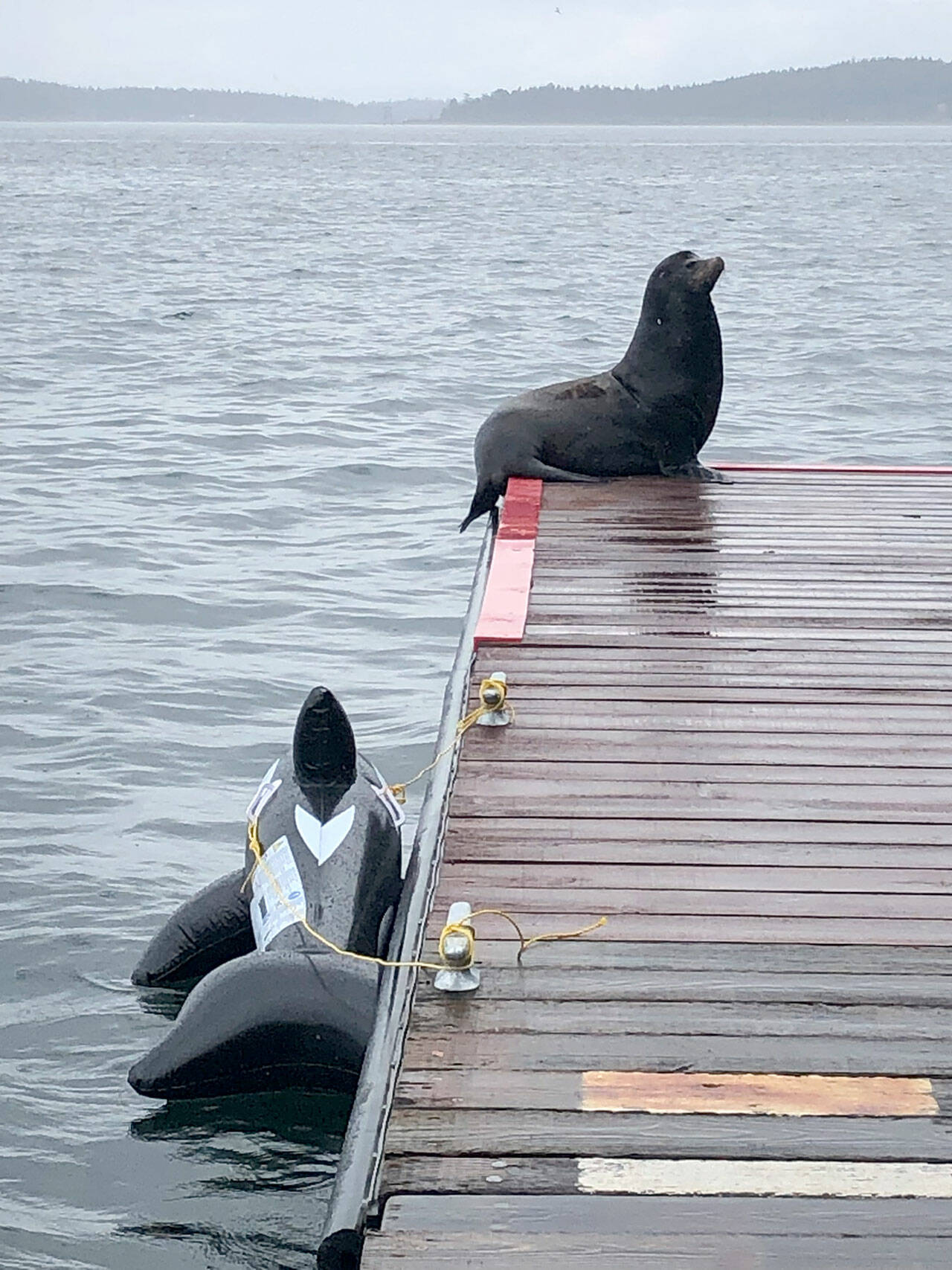
PORT TOWNSEND — The summer season has barely started, but some tourists in Port Townsend have already worn out their welcome.
The visitors arrived about 10 days ago, liked what they saw, invited some friends to join them and have shown no signs of intending to leave.
The first three California sea lions appeared on the floating docks at Union Wharf. A few days later, two more showed up at Port Hudson. One has already taken a joy ride in a skiff.
The majority of sea lions seen around the Puget Sound this time of year are males who began migrating north around September to pack on weight before heading back south in May and June to breed, said Michael Milstein, a spokesman for the West Coast Region of NOAA Fisheries.
Females and their pups tend to stay close to colonies in California, he said.
In other words, it’s a pinniped bachelor party in Port Townsend.
Strategizing a safe and legal means of shutting it down is now underway.
“They are super fun to watch. They’re barking, they’re flipping their flippers, they’re doing their thing,” said Eron Berg, executive director of the Port of Port Townsend, which owns the property the sea lions have appropriated.
“The problem becomes when they really get comfortable and they make a dock their home.”
Sea lions pose challenges for ports, harbors and marinas that provide access for fishing, recreation, cargo and trade.
The animals can cause significant damage to or even sink float docks, which are not constructed to support the concentrated loads created when three or four 700-pound sea lions lounge on them. They can block people from mooring their vessels, their poop can create a smelly slipping hazard and their barking is loud and incessant.
While sea lions generally leave humans alone, they have been known to attack if threatened, frightened or provoked.
“They can be aggressive toward pets, children and adults,” said Jake Beattie, chief executive officer of Northwest Maritime, which is working with the port on a solution to the sea lions.
Of immediate concern, Beattie said, is this weekend’s Race to Alaska. The Northwest Maritime’s event will attract thousands of people to Port Townsend’s waterfront and potentially create unwelcome human-sea lion encounters.
Beattie said Northwest Maritime also wants to protect staff and children involved with its popular youth summer sailing program that runs from the first week of July through the end of August.
Creating a solution that works for people and for the sea lions is the goal, both Berg and Beattie said.
Like all sea mammals — dolphins, manatees, polar bears, porpoises, sea otters, seals, walruses and whales — sea lions are protected under the Marine Mammal Protection Act. With some exceptions, the act prohibits the harassment, hunting, capturing, collecting or killing of these animals.
Berg and Beattie consulted with NOAA’s Office of Protected Resources Marine Mammal and Sea Turtle Conservation for guidelines on approved methods of deterrence.
“We want a good resolution to this,” Beattie said.
Their initial attempt at sea lion diversion involved tying an inflatable orca to a floating dock in the hope the sea lions would think it was a predator and scare them off. The ruse didn’t work.
The port and Northwest Maritime are now contemplating their next move. Among the approved non-lethal methods to discourage sea lions are installing low-voltage electrified mats that shock but don’t harm them; buzzing the sea lions with low-flying drones; shooting them with water hoses, water guns like Super Soakers and sling shots using nonlethal projectiles like rubber bullets; and setting off fire crackers and bird bangers.
The port and Northwest Maritime also reached out to the Port Townsend Marine Science Center for advice about how to get the sea lions off the floats and into the water.
The center loaned the port crowder boards — sheets of plywood about 5 feet high and 4 feet wide — that resemble a wall as they are carried toward the sea lion. Unsure of what is approaching, it usually jumps into the water. This method requires vigilance to keep the animals from returning, not to mention a good bit of nerve for the person holding the plywood.
Betsy Carlson, Port Townsend Marine Science Center’s citizen science coordinator and manager of the center’s Marine Mammal Stranding Network, said sea lions are not particularly compliant when it comes to removing them from places they want to be.
“They are tough, hardy animals that can handle a lot, and they’re not dumb,” Carlson said. “They’re just doing what nature has them do, and that is a challenge for humans.”
Keeping people away from sea lions when they are close to human activity also can be difficult. While it can be tempting to take a selfie, don’t do it, Carlson said. Stay at least 100 yards away.
“If an animal notices you, you’re already too close,” she said. “They have very big teeth and they do carry zoonotic diseases that transfer to humans.”
But Berg said the port and Northwest Maritime acted promptly to oust the animals because they wanted to send a message.
“Let’s work with them early to discourage Port Townsend as being a satellite operation for them,” he said. “Head back to San Francisco where there’s plenty of room, lots of ladies and the weather is nice. Just keep on swimming.”
________
Reporter Paula Hunt can be reached by email at paula.hunt@peninsuladailynews.com.
