
PORT TOWNSEND — It’s been a six-year road to environmental compliance for Port Townsend Boat Haven.
It’s been a complicated problem with elevated levels of zinc and copper being released into Puget Sound.
The state Department of Ecology didn’t like it, and neither did the federal Environmental Protection Agency (EPA).
Even worse for the Port of Port Townsend was the lack of a blueprint on how to solve it.
“There were probably 20 different solutions,” port Executive Director Jim Pivarnik said.
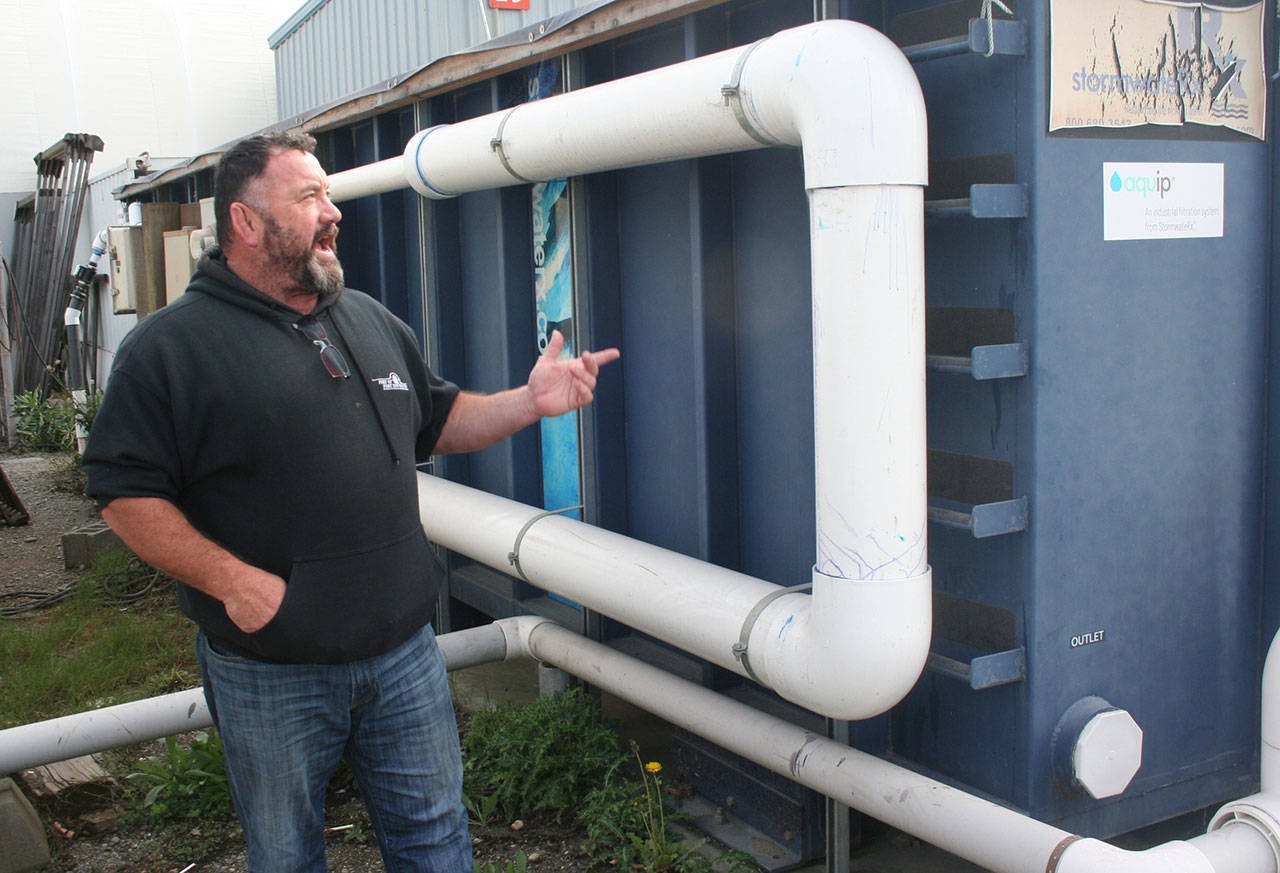
The fix — initially questioned by the Department of Ecology as unlikely to reduce pollutants — came from a layered filtration system inside a large box container, an effect Pivarnik said is similar to a Brita pitcher that filters tap water.
The port has tested within limits since the beginning of the rainy season last winter and was certified as back in compliance in June.
“That’s one of those boxes we need to celebrate,” Pivarnik said during a special commissioners meeting Sept. 10, when he shared the update.
The key is a Chitosan system with pulverized seashells that attracts metals and pulls the pollutants out of the treated water, said Terry Khile, the port’s hoist and yard manager.
“It’s about $600 a month to solve a $2 million problem,” Pivarnik said while he walked through the property on Tuesday. “That’s a pretty good deal.”
The port had been in non-compliance since the second quarter of 2013, according to an EPA water compliance inspection report signed by state Department of Ecology officials last month.
The Aug. 15 report specifies six instances of being above the benchmark tests for zinc from April through June 2013 and stated additional tests confirmed copper by the following summer.
“We were missing quite a few benchmarks, and we were struggling to find out what to do,” Pivarnik said.
Eventually, engineers identified the problem within the filtration system as clay, which binds metals together as opposed to separating them, Khile said.
Zinc and copper are common in the boatyard and can originate from paint, sawdust, chain link fences, metal rooftops and rubber vehicle tires, among other sources, he said.
On two occasions, port officials thought they had solved the problem with tests that had come back clean, Pivarnik said. But after about six months both times, the results — samples that measure the difference between the incoming water and the outgoing effluent — were too high.
The clay was getting into the system as gravel was compacted and pulverized throughout the area, particularly from one of the port’s two 300-ton boat haulers, Khile said, and the natural mixed-media filters — rocks, peat moss, biochar and sand — were not as effective at pulling out the metals because they were binding to the clay.
Pivarnik added there were “legacy” pollution problems at least 10 years old where previous boats had been restored and the area not thoroughly cleaned.
“This is basically a do-it-yourself yard,” he said. “For the most part, they’re not professional boat people.”
The port received about $900,000 in grant funding from the Department of Ecology to install the filtration boxes, and it promoted Terry Taylor from a security position at the agency to a new role last November as an environmental specialist, Pivarnik said.
Taylor’s job is to walk the boatyard and encourage workers to take care of their work space.
“Terry’s doing a great job engaging in conversation with people,” Pivarnik said. “He’s basically going out there and saying, ‘What can we do to stay clean?’”
The port also has about $80,000 in its budget annually during the next five years to replace sections of gravel within the boatyard and to enforce the use of vacuum sanders and other tools, including tarps underneath boats, to keep metals out of the water supply, he said.
“I grew up in the land of grinders and scrapers, with no vacuum cleaners,” Port Commissioner Pete Hanke said at the special meeting Sept. 10.
“It’s a very different world today, and there’s a genuine reflection of that. People are taking it to heart.
“It’s been years in the making, but it’s neat to see it happening now.”
Deputy Director Eric Toews said it’s been a collaborative effort between port staff members, the marine trades and others in the yard to keep the stormwater clean.
“There’s absolutely no cause for complacency,” Toews said as the commission reviewed the Ecology-certified letter Sept. 10.
“It will require continued hard work. There’s no time to rest.”
Many of the options the port considered had various levels of engineering costs, including one possibility that would have turned part of the yard into a $2 million stormwater retention pond, Pivarnik said.
Another solution was to get rid of the gravel throughout the boatyard and pave the 14 acres with asphalt, Khile said.
Pivarnik said that would cost between $8 million and $10 million because it would need to be 16 inches thick to handle the large haulers.
Since none of those options were viable, Pivarnik said engineers looked to newer, less-expensive technology and found a solution the Department of Ecology eventually approved.
Khile, who celebrated his 31-year anniversary of working at the port on Tuesday, said he hopes to get two to five years out of the filtration boxes, which would cost about $40,000 to replace.
“As long as I’ve been a commissioner, it’s been a top-priority issue,” Hanke said. “That’s an amazing thing.”
________
Jefferson County Managing Editor Brian McLean can be reached at 360-385-2335, ext. 6, or at bmclean@peninsuladailynews.com.
