
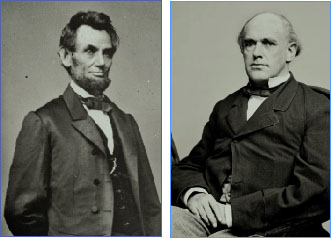
By John Kendall For Peninsula Daily News
EDITOR’S NOTE: Tuesday is Port Angeles’ 150th birthday, based on President Abraham Lincoln’s June 19, 1862, signing of an executive order declaring the townsite as a port of entry and military reservation. Port Angeles sesquicentennial events already have begun and will culminate with Heritage Days in September.
In commemoration of the sesquicentennial, the Peninsula Daily News continues a three-part series detailing the antics of the town’s founder, Victor Smith — and how he was reviled in Port Townsend.
The series is researched and written by John Kendall, a former PDN copy editor who wrote a historical series on the Elwha River dams coinciding with the beginning of their removal last fall.
When we left Part 1 on Sunday (which can be accessed below), Smith traveled to Washington, D.C., to report to Treasury Secretary Salmon P. Chase, and Lt. J.H. Merryman was appointed to temporarily assume Smith’s customs job as collector in Port Townsend.
While Victor Smith was in the nation’s capital, Lt. J.H. Merryman began to check the paperwork around the Customs House in Port Townsend.
He reported to Treasury Secretary Salmon P. Chase, his new ultimate boss, that he found “evidence of frauds and official misconduct of the most glaring nature”: overdrawn $4,354.98 (more than $100,000 in today’s dollars); government funds deposited with private firms as security for personal loans; sale of the cutter Jefferson Davis was not credited to the government; a customs inspector was paid for a port trip not verified; a lighthouse keeper was paid less money than shown on the books; unqualified persons were treated at the marine hospital while qualified persons were denied treatment.
The Abraham Lincoln administration dismissed the charges.
And there was more good news for Smith: On June 19, 1862, Congress had approved the port of entry move to Port Angeles, which would take effect in September, and Lincoln signed an executive order establishing a military and naval reserve at the new port of entry.
Before that news, Norman Smith was in the capital with his dad.
“While father was talking to the president and to Mr. Chase, who was always present at their interviews,” wrote Norman in his memoirs, “Tad Lincoln played marbles with me under and around Mr. Lincoln’s big chair.”
“The establishment of the [Port Angeles] reservation was for Victor Smith the crowning point of his life,” wrote one historian. “He had worked hard and perseveringly against a great deal of personal attack and prejudice.”
He left for San Francisco, where he boarded the revenue cutter Shubrick, bound for Port Townsend.
In “The Last Wilderness,” author Murray Morgan set the scene:
“On a warm, overcast evening early in August, a small paddlewheel steamer rounded Point Wilson and approached the town. Her running lights glinted off the bronze of her swivel guns as she jockeyed up to Fowler’s Wharf [at the foot of Adams Street]. Word spread that she was the Shubrick. A crowd gathered as she tied up. Down the gangplank came Victor Smith.
“No one stepped forward to welcome him. In silence the people of Port Townsend let him pass. In silence, he walked toward the custom house.
“Lieutenant Merryman was told that Smith was coming. He put the records in the safe, locked the safe and pocketed the key. Then he locked the custom house door and waited.
“The collector approached the deputy collector (Merryman) and announced himself ready to resume his duties.
“Merryman said he could not permit Smith to do so.
“Smith asked why.
“Merryman said Smith was a felon and an embezzler, that it had been his painful duty to write the report revealing that sad fact to their superiors.
“Oh, that! Smith said he had explained everything to Chase. Just a matter of bookkeeping. Merryman hadn’t understood his accounting system, that was all. Now the keys, please.
“ Merryman said he would await official confirmation of Smith’s clearance before letting him back into the office.
“Smith turned and walked back to the Shubrick. From the saloons came the echo of laughter.
“An hour later, Lieutenant Wilson, the skipper of the Shubrick, came to the custom house. He was a pleasant young man with a soft voice and a courteous manner. He said it was his unpleasant duty to tell Merryman that on instructions from Collector Smith, he had ordered his men to load the cutter’s twelve-pounders with double shot. They were at this moment trained on the custom house.
“If the records were not surrendered within fifteen minutes, the bombardment would begin. It would be prudent of persons residing nearby to leave their houses.
“Merryman, after a quick consultation with the City Council, gave up the keys. A party from the Shubrick loaded up the records and carried them to the cutter, which at once cast off and moved out into the bay.”
Port Townsend residents rushed to Olympia to see the governor. Warrants were issued charging Smith and Wilson with “assault with intent to kill.” A marshal boarded the Shubrick. Smith couldn’t be found and Wilson refused the warrant because Wilson was on a government vessel.
Stymied, the marshal tried again. As the rowboat approached the Shubrick, Wilson ordered the paddlewheel engaged, causing the waves’ thrust to thwart boarding.
Two days later the Shubrick entered the harbor to tow the old cutter Joe Lane. Both were bound for the new port of entry, Port Angeles.
Two days after that the Shubrick arrived in Olympia. Smith was ready to explain everything. A grand jury was empaneled, and 40 men from Port Townsend testified.
Wrote Murray: “Smith was indicted on thirteen counts involving charges of resisting a duly authorized officer, embezzlement of public funds, procuring false vouchers and assault on the people of Port Townsend. But the record was sent to Washington for review. Another special Treasury agent was dispatched to investigate; according to Smith’s enemies, he came ‘armed with lime and brush.’
“Smith was cleared of everything. The indictments were quashed.”
But complaints from Port Townsend to Olympia and Washington, D.C., increased. In Olympia, the surveyor general, his archenemy Dr. Anson Henry, a close friend of the Lincoln family since their days in Illinois, corresponded with Lincoln about Smith, including this description of him: “a swaggering, conceited egotist making himself offensive and odious to all.”
In Norman’s telling, “the only thing he was fitted to do out there was to find fault and discredit Victor Smith.”
Henry told a Port Townsend friend before going to the U. S. capital, “I’ll follow Victor Smith to hell.”
Smith was back in the capital, where Chase reassured him about his job, then Smith left for home March 14, 1863. The next day, Henry – now in the capital – met with Lincoln, who then told Chase “to listen to Dr. Henry.”
Henry told Chase that Smith was not guilty of “corrupt practices but of bad judgment and frivolous behavior,” wrote a Chase biographer. Henry wanted him fired.
Chase ignored the advice, and later Smith was removed by Lincoln, telling Chase that while the charges against Smith had not been proved, “the degree of dissatisfaction with him there is too great for him to be retained.”
Chase threatened to resign, but Lincoln convinced him to reconsider. “I had to plead with him for a long time,” Lincoln told a friend, “but I finally succeeded, and heard nothing more of that resignation.”
In Norman’s telling, Lincoln informed Chase, “When you hand Victor’s resignation to Dr. Henry, who demands it, and I can’t deny him, you give Victor the first vacancy in your department.”
Chase named Smith a special agent of the Treasury. Lincoln let Chase appoint Smith’s replacement.
“The comedy of errors reflects on the judgment of both principals,” wrote a Chase biographer. “Neither Chase nor especially Lincoln was thinking clearly, caught up as they were in the fearful aftermath of [Union Gen. Joseph] Hooker’s defeat at Chancellorsville.”
Back in Port Angeles, after Smith first arrived in the new port of entry before losing his job, he built a two-story customs house at or near the present Second and Valley streets. An office, living quarters and a military hospital were part of the complex. Curiously, what is now called Valley Creek had been dry, and by December there had been some rain and snow.
At 6 p.m. Dec. 23, 1863, in Norman’s telling, “We hear an awful roaring. . . .The flood struck the Custom House and carried it away bodily. It fell some three hundred feet downstream” thrust along by logs from a now burst, naturally formed dam in the foothills.
Smith was away on business. His wife, Caroline, was able to save her children, while two customs officials were killed by a falling chimney.
Smith had kept $700 in $20 gold pieces and $1,500 in bills in a cigar box that was in the green chest in the top floor of the customs house. The torrent of water pushed the chest into the harbor, where it was found – with no cigar box. It was never recovered while a separate strongbox containing customs revenues was found intact.
Smith’s replacement then found a new location for the customs house.
In the fall of 1864, Smith was back in the capital, seeking possibilities for political appointments. Henry followed with the same purpose.
Smith then arranged to have his family meet him on the East Coast. They saw friends and relatives; Victor and Norman met with Lincoln (Norman: “Again I played with Taddie”); attended the president’s second inauguration; saw the end of the Civil War; then mourned a martyred president.
They were ready to head home May, 22, 1865. Smith, who had been reappointed Treasury agent, would guard $3,000,000 in gold from New York City to San Francisco.
From Norman’s description, the crew of the Golden Rule could people an Agatha Christie novel. When the vessel, with 700 aboard, left port, a suspicious character, Montgomery Gibbs, was put ashore, then after the vessel was put in dock for three days, Gibbs was back on board.
“Then Victor knew that spies were on his track,” wrote Norman.
Smith stayed in his stateroom while the gold stayed in the ship’s hold. There was a tenderfoot captain, and “it seemed as if Montgomery Gibbs was really in command,” wrote Norman. The captain and Gibbs told Smith to give the gold to the purser, but Smith “drew his little derringer and said that they would have to enter the stateroom over his dead body,” continued Norman.
On the twelfth day out, near the Isthmus of Panama, the vessel struck a reef and stuck there – on purpose, according to Norman. All aboard lived on supplies salvaged from the vessel until two U. S. gunboats took them of Panama. All aboard left except “Victor [who] stood alone on the shore and waved good bye,” wrote Norman. “He stayed in his trust.”
When his rescuers arrived, Smith finally opened the chest – which was empty. Norman blamed Gibbs.
Smith’s family had crossed Panama, gone up to San Francisco, and taken the Brother Jonathan to the Northwest, four years after they first arrived.
Smith, now racked with “Panama fever,” made it to San Francisco. He arranged passage on the Brother Jonathan.
“Too ill at the time, presumably from his shipwreck experiences, to walk onto the ship, Victor Smith was carried to his stateroom on a cot,” wrote an author of a book about the vessel. “He more than likely stayed there for the length of the voyage.”
The ship left San Francisco overloaded with 249 aboard. It hit a storm near Crescent City, Calif., and sank. Smith and another passenger Henry—Smith’s nemesis—were not among the 19 saved. Their bodies were never found.
Tuesday: Port Angeles as Lincoln’s “Second National City” 150 years ago this week? Creating the military reservation at Port Angeles probably was more out of fear of British naval forces and Confederate foes in the Strait of Juan de Fuca.
