
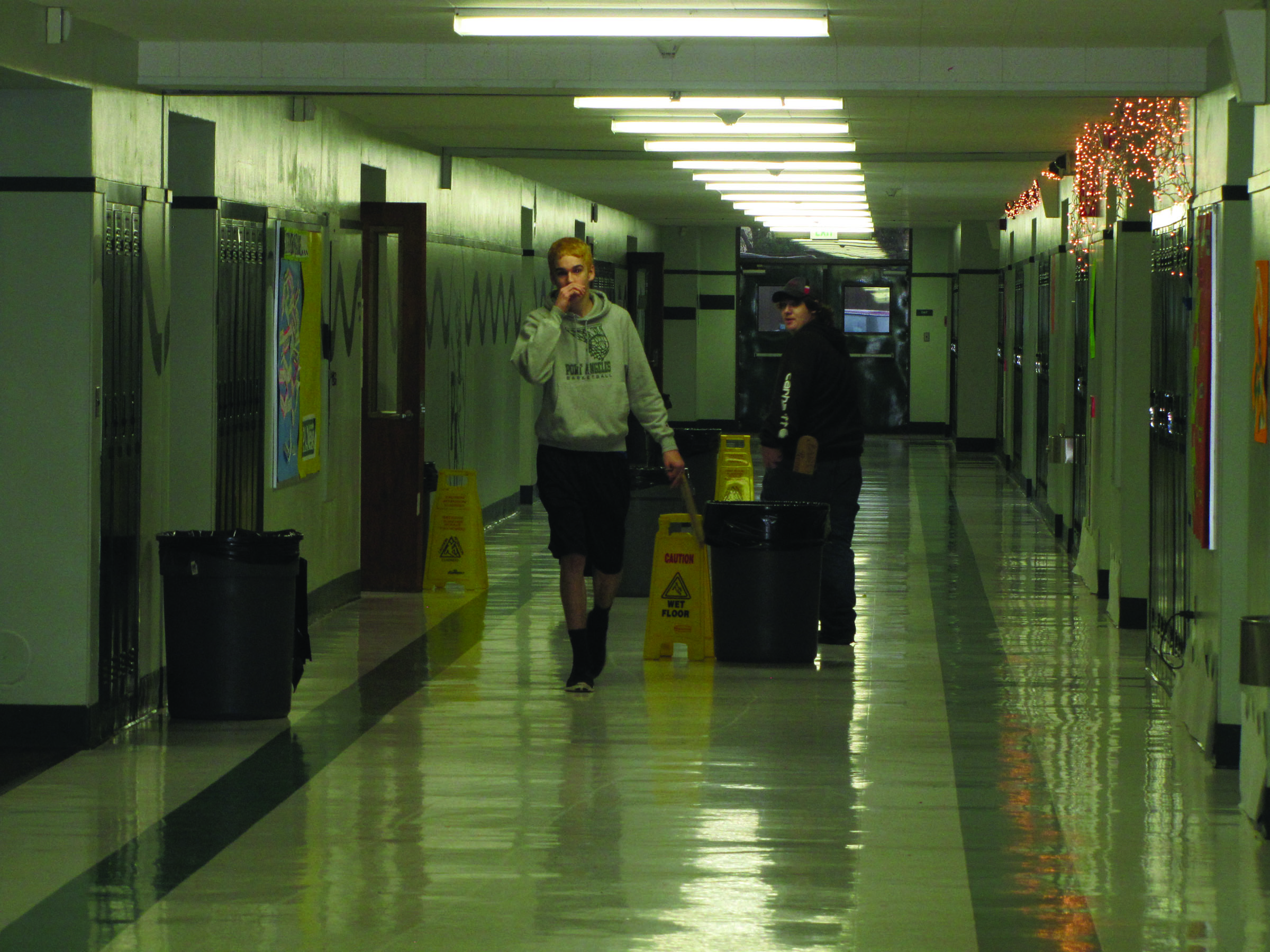
PORT ANGELES — Officials say at least $6 million is needed for the most urgent repairs at Port Angeles schools, and School Board members are considering a second try for a bond to replace Port Angeles High School.
Port Angeles School Board members will have to make decisions on what to repair and what to replace — and what to leave behind entirely.
School board members met for a workshop May 12 to review the maintenance department’s list of urgent repairs and to hear recommendations for priorities from Nolan Duce, supervisor of facilities for the Port Angeles School District.
There were no votes at the meeting, and additional discussion has not yet been scheduled.
A $98.25 million bond to rebuild most of Port Angeles High School was rejected by voters in February.
There will be no November bond, though the district may make another effort in February 2016, board members said.
Board members have said that the bond amount cannot be reduced because the board has already eliminated non-essential items, such as replacing the gymnasium and upgrades to athletic fields.
Any changes in the bond would likely be to increase the cost, due to inflation and rising interest rates, they have said.
No date has been set for a decision on the next bond measure’s amount or date.
If voters approve a replacement of the high school, long-term repairs performed before that time would be wasted, so it would be better to make repairs that would get the buildings through the five years it would take to replace them, board members said.
Six of the 10 buildings on the campus were built in 1953, two in 1958 and two in 1978.
A report prepared by the maintenance department said the cost of a single-roof replacement at the high school’s main building is nearly $500,000 for a 10- to 20-year fix, or half that to get another 5 to 10 years out of what board members and maintenance staff call a “failing building.”
One of the immediate problems facing the school is a need for more science laboratory classrooms, they said.
Impending changes to state graduation standards will require all students to take two science laboratory classes to receive a diploma.
Currently, there aren’t enough laboratory classrooms in the school to fit that many students, said Board President Sarah Methner.
Methner asked if there is a such thing as laboratory portables to address the immediate needs.
Board members discussed the option of adding a science wing built of temporary laboratory portables on the northeast corner of the school property, where a district-owned house now stands.
Duce said he would research the possibility and return to the board with a report.
Portable units have an estimated 20-year lifespan and are not covered by state school construction funds.
Duce introduced other high priorities for immediate repair or replacement.
He said the gymnasium roof at the high school is becoming a safety issue, floors at Franklin Elementary are tilting and pulling away from the walls, moisture in the carpet at Roosevelt Elementary is becoming a health issue, and the driveway and bus circle at Roosevelt is breaking down.
But there is nowhere near enough money in the district coffers to make all of the needed repairs.
The district has about $2.4 million in the district’s capital projects fund, said Kelly Pearson, director of finance and operations.
Any other money would have to come out of the district’s $4 million general fund reserve, which is kept to ensure that the district can pay its bills if the state is late with payments, Pearson said.
“If we had a disaster, there would be no way to pay our bills,” she said.
After perusing the complete list, School Board members were frustrated by the long list of failing systems and structures that have to be immediately addressed.
“It will cost more to fix the 100 Building [the high school’s main building] than we have,” said Board Member Lonnie Linn.
Linn noted that after all those repairs, the district would still have a 61-year-old building that will continue to age and other systems that will begin to fail.
According to the capital project list, the high school’s main building needs $2.16 million in urgent repairs, including a new roof, an electrical system upgrade, a new intercom system, a heating system replacement and new floors.
Every classroom building at the high school has a list of urgent repairs.
Certain repairs cannot be done without first investing in others.
A heating system replacement cannot happen until the electrical system is upgraded, Duce said.
The repairs do not include accessibility upgrades required by the Americans with Disabilities Act, seismic refitting or addressing galvanized steel plumbing buried under concrete floors that is being choked off by sediment.
A moveable wall at Dry Creek Elementary has worn out its parts and is stuck partly open, and replacement parts are no longer available from the manufacturer, which has since gone out of business, Duce said.
Another high priority is controlled access for security at all schools, he said.
Controlled access points would funnel visitors into a single entrance, and all other entrances would have access card entry.
Duce said it is impossible to have full controlled access at the high school due to the many buildings with many entrances.
________
Reporter Arwyn Rice can be reached at 360-452-2345, ext. 5070, or at arice@peninsuladailynews.com.
