
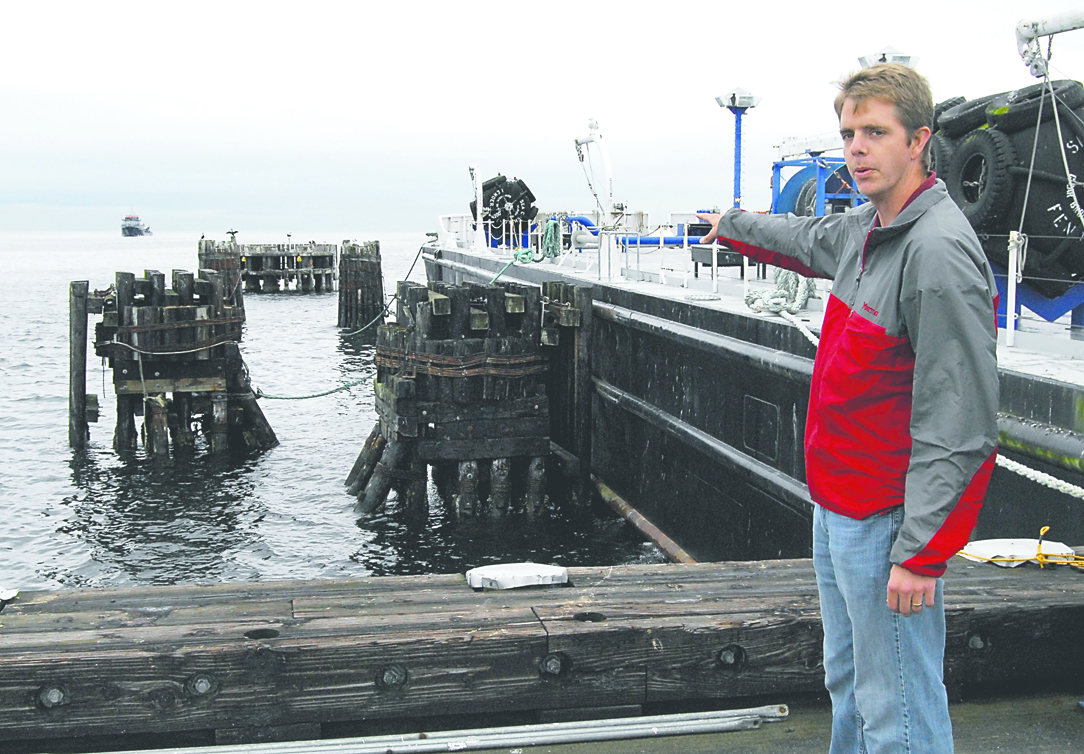
PORT ANGELES — A 1,160-foot dock that has anchored Port of Port Angeles marine operations for 87 years is due to become more environmentally friendly.
It’s part of a $3 million project jointly funded by the federal government and the port in which toxic creosote piles will be replaced and the pier strengthened.
Port officials received notice last week that they obtained preliminary approval for a $1.5 million U.S. Economic Development Agency, or EDA, investment assistance grant to redevelop the giant pier, known as Terminal 1.
It’s where 900-foot-plus ships tie up to be unloaded and serviced.
Final approval from the EDA’s Washington, D.C., office — it would be the first grant of its kind ever awarded to the port — is expected by late September, said Brian Parker, project officer for the EDA’s Seattle office.
“Unless something catastrophic happens, it’s very likely to go through,” Parker said.
“In terms of real life, it’s kind of a situation where two people get engaged but aren’t quite married yet.”
Combined with $1.5 million in port capital improvement funds, the dock will be redeveloped by replacing the pier’s creosote-covered timber pilings with steel piles, port Director of Engineering Chris Hartman said.
“From an environmental standpoint, this is kind of taking the poison out of the water,” he said Friday.
The redevelopment project also will address load-capacity issues.
The dock will be opened up, piles replaced and portions of the pier rebuilt.
“The worry is that we are running into structural deficiencies on the dock where cranes can’t operate,” Hartman said.
“This is restoring load capacity on the dock so cranes can continue to service the ships.
“This improves the load-carrying capacity of the structure and provides the companies that operate there with more confidence in the long-term future of the pier.”
Timber mooring dolphins that barges sidle up to and rest against also will be replaced with concrete piles, Hartman added.
“Terminal 1 was the whole reason the port was established to begin with,” he said.
“It’s our oldest structure, our main structure.”
The grant award has sped up the timetable for improvements, he added.
Construction on the first phase of the project will not begin until July 2014 and will last until February 2015 because of “fish window” restrictions that protect marine life, Hartman said.
The second phase will last from July 2015 to February 2016.
Notice of the grant was received in the form of a non-binding commitment to award the grant.
The notice was issued after an agency investment review committee recommended approval as part of a competitive process against other applicants, and regional director A. Leonard Smith concurred, Parker said.
“We support projects in communities and regions that lead to creation of jobs and overall economic vitality of those regions,” Parker said.
“This fits that.”
Businesses that rely on the terminal also supported the grant.
“Their response was gratifying,” Marine Terminal Manager Mike Nimmo said in a statement from the port.
“Waterfront-dependent businesses are a huge focus for the future of the port and its ability to build economic infrastructure.”
Nimmo said tankers were berthed for 118 days at Terminal 1 in 2012.
“That meant work for teams of people applying their skills to make repairs or improvements on the ships.”
The terminal also supports marine spill-response vessels that are maintained around the clock.
“It’s all about jobs,” Nimmo said.
A 2006 economic study determined that for every job at the marine terminal, 2½ indirect jobs are created in the community, Hartman said.
Senior Staff Writer Paul Gottlieb can be reached at 360-452-2345, ext. 5060, or at paul.gottlieb@peninsuladailynews.com.
