
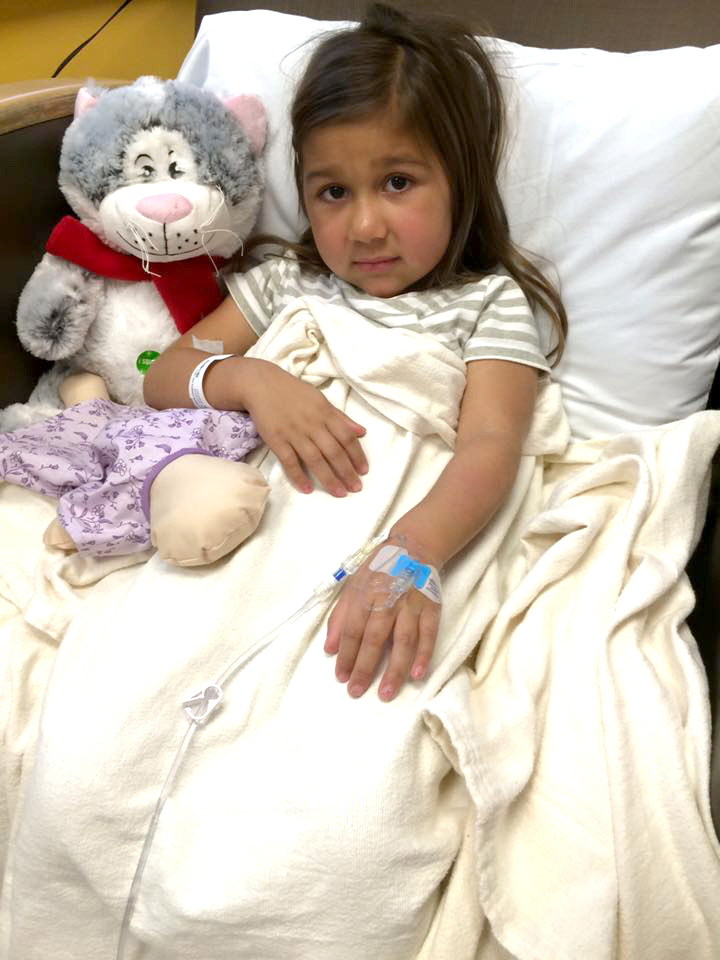
PORT ANGELES — Five-year-old Hartlyn Flores is known to her family as their “diva warrior,” since she approaches medical appointments armed with high heels, lipstick and coordinated outfits.
Two years ago, Hartlyn was diagnosed with a rare and life-threatening autoimmune disease called juvenile dermatomyositis, known as JM, in which the immune system attacks skin and muscles, resulting in skin rashes and muscle weakness, fatigue, fever and stiff joints.
Serious complications include the inability to walk, ongoing pain, disfigurement and even death, according to the Cure JM Foundation.
On June 16, 2013, the family was gathering berries and having a day outside, and found that Hartlyn, then 2 ½ years old, couldn’t walk without falling and was extremely fatigued, said her mother, Marnae Flores.
Tumbled over
“She would tumble over, like a baby just learning to walk,” Flores said.
The next morning she was worse. The family’s doctor told them to take the toddler to the Olympic Medical Center emergency room in Port Angeles, Flores said.
Blood tests showed her daughter’s muscle enzyme levels were “catastrophically high” and she was taken by ambulance to Seattle Children’s Hospital.
Two days later, Marnae and Hartlyn’s father, Jeromiah, had the
diagnosis.
Hartlyn had level three juvenile dermatomyositis, the most severe and life-threatening form of the disease.
According to the Cure JM Foundation’s website, www.curejm.org, the illness has a genetic base and bacteria, viruses, ultraviolet radiation from either sunlight or certain indoor lighting fixtures, can trigger the runaway immune response.
Severity of the disease varies though time, with periods of remission alternating with flare-ups that can range from mild to severe or life-threatening.
About half of children diagnosed with the illness eventually go into a permanent remission and live normal adult lives, the website said.
About 3 in 1 million
Only about three in a million have the disease, with two to four new cases diagnosed each year in the U.S.
However, Marnae Flores feels that estimate is low, saying some die in their first flare-up before they can be diagnosed.
One of the early signs in Hartlyn’s case was a facial rash doctors initially diagnosed as eczema, and an unexplained virus at age 18 months, she said.
Many types of treatments have been used to help Hartlyn and children like her. These include steroids and chemotherapy, and some medications cost $1,000 for a month’s supply.
Drug trial
Her mother said Hartlyn is taking part in a drug trial to try to determine if adult medications for rheumatoid arthritis are effective in children with JM.
Every two weeks Hartlyn visits Seattle Children’s Hospital for an infusion.
So far, the new treatment seems to be effective, her mother said, although on Christmas Day she said she had seen some symptoms that led her to believe Hartlyn may be headed into a fifth flare-up in three years.
Hartlyn has had many different emotional reactions to undergoing treatments, she said, from physical resistance against doctors and nurses to stoically preparing by putting on lipstick, play heels and dressing up.
“She is battling the acceptance of being different,” she said.
School challenges
Hartlyn currently attends a preschool, is in ballet, excels in art and is learning to take responsibility for knowing what she can and cannot do.
She can’t go out for recess in the sun, and even indoors must apply sunscreen to protect herself from ultraviolet light emitted by light bulbs, her mother said.
Next year she will attend kindergarten, and the family is already in talks with the Port Angeles School District on how to protect Hartlyn’s health and her needs in the classroom setting, she said.
Flores said Hartlyn’s brothers, Leighton, 4, and Phoenix, 8, are protective of their sister, and push her to stay engaged and active through her illness.
They are “very sensitive” when people show signs of illness near her, she said, and when she is weakened they will adjust their play to include her in their games.
Hartlyns’s grandmother is Vivian Hansen, marketing representative for the Peninsula Daily News, Sequim Gazette and Forks Forum.
For more information on juvenile dermatomyositis or to donate for research for the illness, visit Cure JM Foundation’s website, www.curejm.org.
________
Reporter Arwyn Rice can be reached at 360-452-2345, ext. 5070, or at arice@peninsuladailynews.com.
