
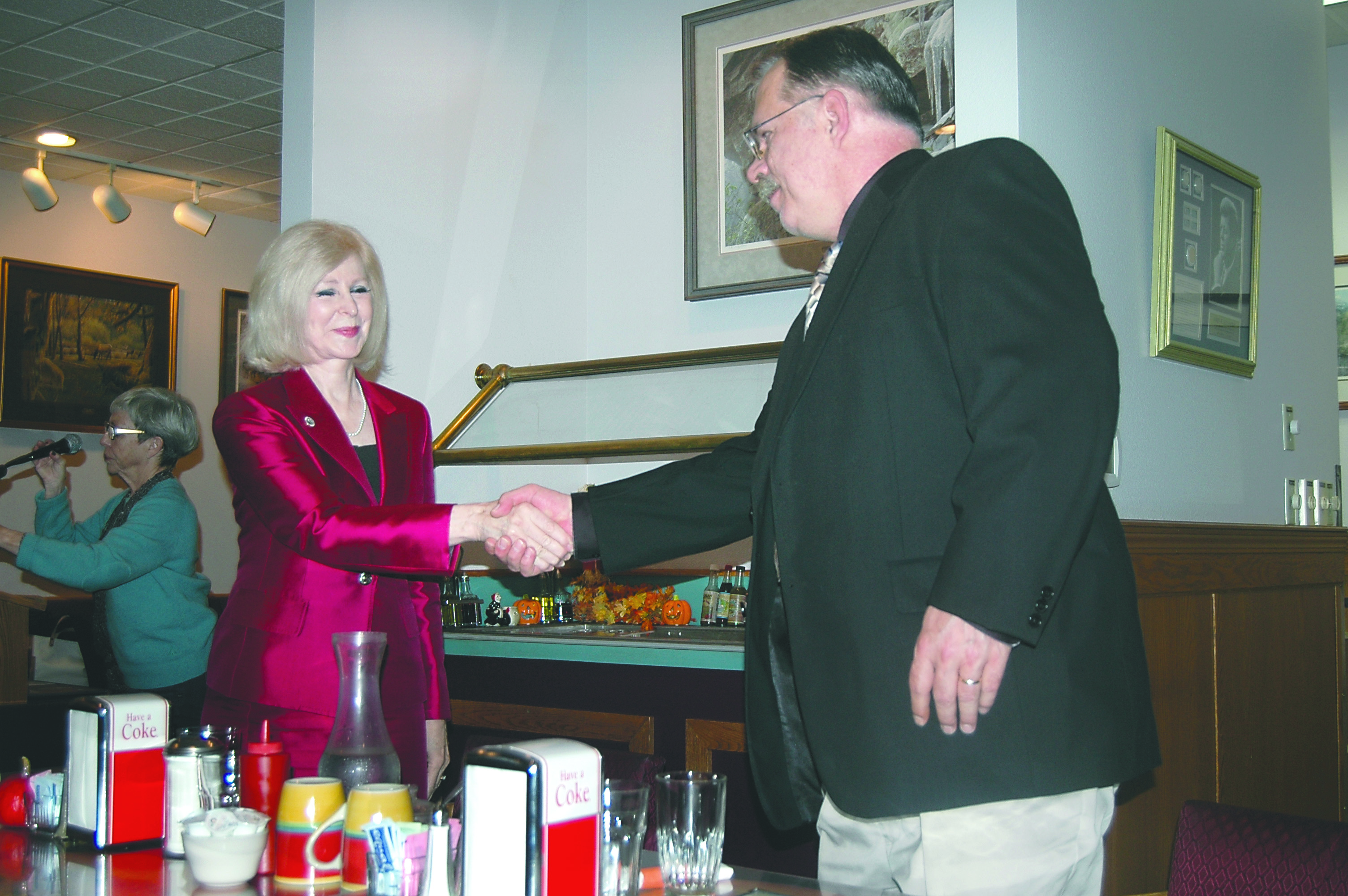
PORT ANGELES — City Council candidates Cherie Kidd and Dan Bateham debated topics ranging from fluoridation to Bateham’s decisions to run, drop out and, last week, restart his campaign during a lively Port Angeles Business Association breakfast meeting Tuesday.
Position 7 incumbent Kidd, 69, a Port Angeles High School graduate and owner of AAA Affordable Storage and U-Haul, is seeking her third four-year council term.
Bateham, 58 — a fluoridation opponent, veterans advocate and retired Army staff sergeant — dropped out of the race Sept. 9, four months after the withdrawal deadline, for personal and health reasons that he said Tuesday, without elaborating, have been resolved.
‘Can’t make up his mind’
He responded to one questioner who asked for “one good reason why I and others should vote for a person who can’t make up his mind if he wants to be a candidate.”
“We all have issues sometimes” that are “unplanned for and unexpected that we have to deal with,” Bateham responded.
“I’m not a quitter, as I’ve heard the word said; I’ve just had a temporary setback.
“I can be counted on.”
In pledging not to increase the city’s debt, Bateham said he had “not been to all the City Council meetings.”
Kidd ran with that.
“If you are not informed, how can you serve the people, how can you understand the issues?” Kidd said, reminding him he had “quit the race.”
“He comes to City Council [meetings], makes a comment and leaves, but not to study the issues, to hear and study the issues,” she said.
Bateham said he had missed two council meetings.
Kidd, who touted her résumé of involvement on community groups and as chairwoman of the city Planning Commission, said she had stood up for residents by voting against electric rate increases and the controversial “smart meter” program, and had championed the continued operation of William Shore Memorial Pool when it was in danger of closing.
“I do listen to people, and that’s why things are getting done,” said Kidd, also a former Port Angeles mayor.
“I do my job, and I fight for the people.”
Bateham, a veterans affairs advocate, said he has 20 years of leadership experience in the military.
“I’m experienced in pulling diverse groups, organizations and resources together for a common cause,” he said.
Bateham said he is not a business owner but that city business leaders have “pent-up frustration” with such issues as downtown parking.
New downtown beaches are great, but more is needed, he said.
Bateham: Disconnect
“We need a City Council that will actually listen to folks,” Bateham said, asserting there is a “disconnect” between the City Council and residents.
Asked about his views on incorporating land from the urban growth area (UGA) east of the city limit into the city, Bateham said he needed to study the issue.
“This topic has been around for years,” Kidd shot back.
Kidd said the city derives a portion of sales tax revenue from the urban growth area but added there are no plans to incorporate portions of the UGA into the city.
Water fluoridation
Kidd would not take a stand on citywide water fluoridation.
A public comment forum on whether the city should continue fluoridating water to prevent tooth decay after May 18 is at 6 p.m. Thursday at City Hall, 321 E. Fifth St.
It will be the topic of a Nov. 6 yes-or-no advisory survey to approximately 8,500 city water users inside the city limit and 1,500 east of the city where homes and businesses are connected to the city water system.
“We created a process of discussion,” Kidd said.
“Until we finish the process, I will respect the process and will make comments after we have finished the process.”
Bateham told breakfast-goers that “toxic waste” and “industrial waste” are used to fluoridate city water.
“That is an assertion that has been made that is completely inaccurate,” Dr. Thomas Locke, deputy Clallam County public health officer, said in a later interview.
He said the fluorosilicic acid that is used to fluoridate city water is a federally licensed water additive that is a coproduct of a manufacturing process.
That process uses naturally occurring calcium deposits that contain fluoride to produce gypsum, phosphoric acid and fluorine gas.
The fluorine gas is mixed with water to make fluorosilicic acid.
Fluorosilicic acid “is created deliberately so it can be captured and used for its intended purpose,” Locke added.
In a later interview, Bateham said the terminology he used may be “a little off” but there also may be a more important consideration.
“Maybe it’s more about our rights to choose whether or not we want fluoride in the water,” he said.
“To me, that’s the main issue.”
________
Senior Staff Writer Paul Gottlieb can be reached at 360-452-2345, ext. 5060, or at pgottlieb@peninsuladailynews.com.
