
PORT ANGELES — What’s in store for Civic Field and the city’s network of streets and alleys over the next six years?
City Council members will mull the future at their regular meeting today when they review the proposed 2016-2021 capital facilities and transportation-improvement plans.
They will conduct their first reading of the plans and a public hearing at a meeting that begins at 6 p.m. at City Hall, 321 E. Fifth St.
A second reading and continuation of the public hearing will be followed by the scheduled adoption of the plan at the council’s regular meeting June 16.
The transportation improvement plan calls for spending of $49.2 million over six years and $1.5 million in 2016.
The largest single transportation project for 2016 is $500,000 for the Marine Drive channel bridge abutment repair.
The capital facilities plan calls for $98 million in spending over six years and $8.1 million in 2016.
The largest single capital facilities project for 2016 is $4.4 million for the city’s ongoing combined sewer overflow (CSO) Phase 2 project that would be drawn from the city’s $20 million CSO Fund.
Public Works and Utilities Director Craig Fulton said last week that grant funding is key to realizing some of the projects, including new lighting for Civic Field pegged at $453,000, the largest parks and facilities-recreation project planned for 2016.
That’s also true for a $2.5 million Race Street project that would be designed for $461,000 in 2016 to make the arterial into a “complete street,” Fulton said.
“We wouldn’t do the design unless [the money] came from the state,” he said.
“100 percent is the best way to go.”
Race would be improved from First Street south past Civic Field and the Lauridsen Boulevard bridge to Park Street near the turnoff road to Olympic National Park.
The street would be paved, bicycle lanes would be added, street parking adjusted and possibly a median built to divide the northbound and southbound lanes.
Race Street in recent years has been discussed by city residents and officials as an option for a truck bypass.
Such a bypass would begin at Front Street, go up Race and connect with Lauridsen Boulevard to U.S. Highway 101 as a possible alternative to the more congested Front Street-Lincoln Street-Highway 101 connection downtown.
But Fulton said a potential truck bypass is not part of the current equation.
“It wouldn’t make it more convenient; it wouldn’t make it less convenient,” Fulton said.
“We haven’t been talking about that recently.”
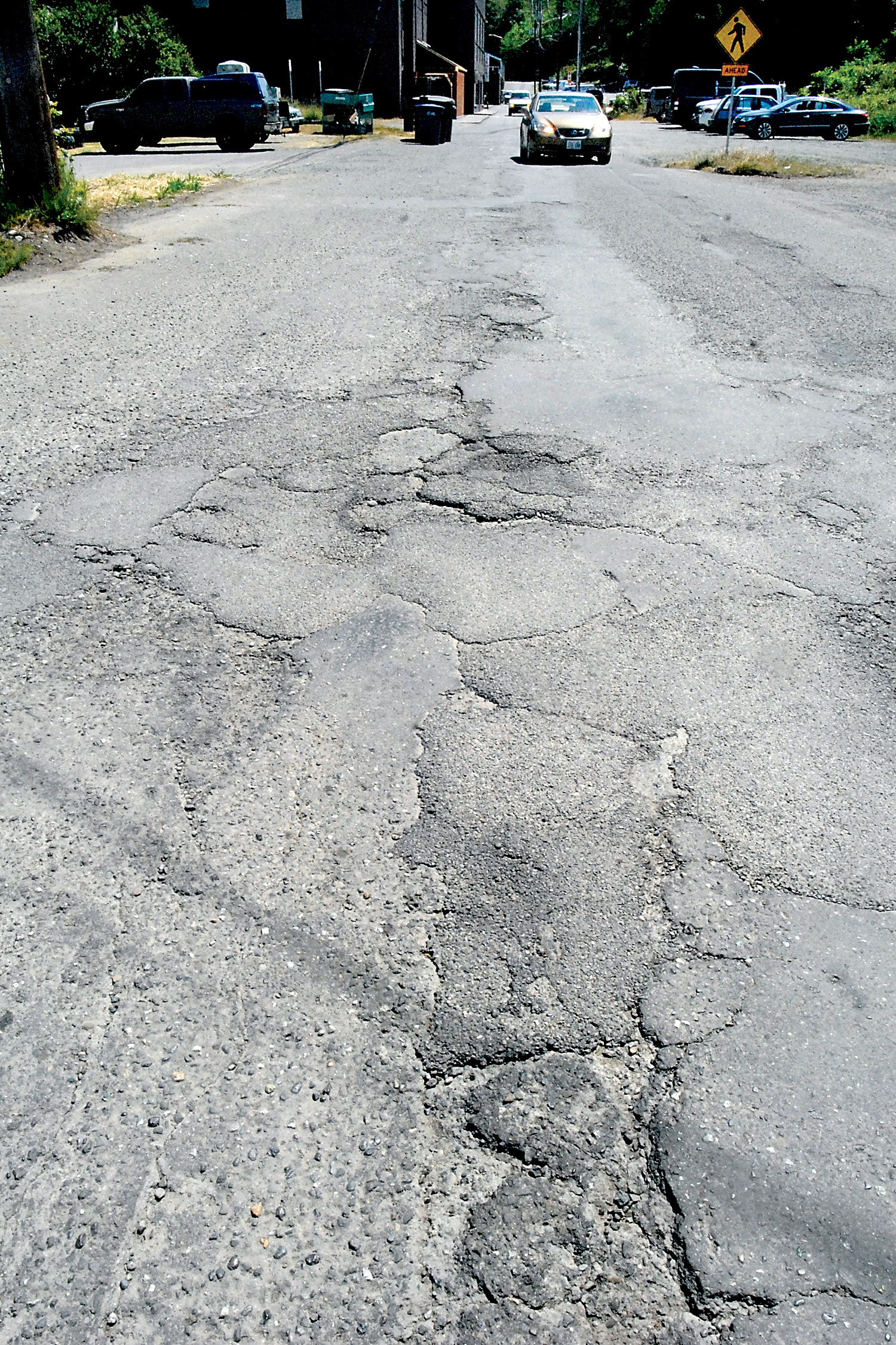
Alleys are a different story in terms of funding, although Fulton said residents should not expect to see a concerted effort for two or three years to repair the plethora of pockmarked, single-lane alleys that grid the city.
“I describe them as poor,” Fulton said.
Quite poor, in fact, according to the Pavement Condition Index developed by the U.S. Army Corps of Engineers.
Fulton said that according to the index, the city’s alleys are rated at 5 on a scale of zero to 100.
“There are some alleys that are so torn up they have to be dug up and replaced,” he said.
The alleys on the east side of town, especially downtown, are the oldest.
The transportation plan foresees a total alley-improvement project cost of $876,000 over the next six years, with $125,000 projected for spending in 2016, with $125,000 set aside in each year from 2016-2021.
Fulton said alley repairs would begin after the city builds up $300,000-$400,000.
“$125,000 is not a whole lot of money to do paving with,” he said.
Just performing the recent spot repairs on Peabody Street that periodically blocked off traffic cost $80,000, Fulton added.
________
Senior Staff Writer Paul Gottlieb can be reached at 360-452-2345, ext. 5060, or at pgottlieb@peninsuladailynews.com.
