
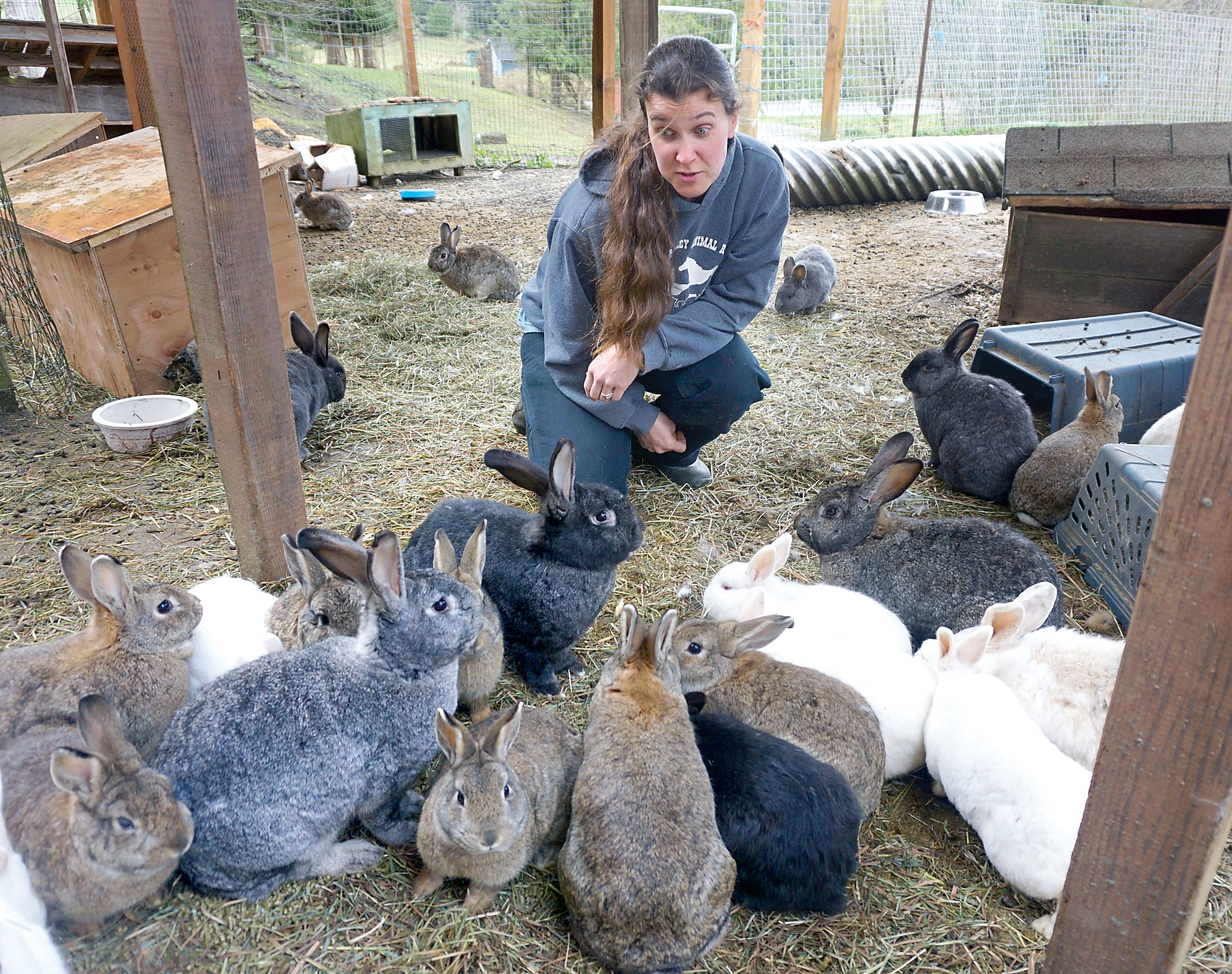
QUILCENE — Giving or receiving a live rabbit for Easter can either be the gift that keeps on giving or end up as a miserable experience for both the person and the pet, say those who care for rabbits.
“It is always busier this [time of] year because people are interested in rabbits and chicks because of the holiday,” said Brandon Montoya, co-director of North Olympic Rabbit Rescue in Sequim.
“Unfortunately, 95 percent of these animals never make it to their first birthday.”
Montoya said it is common for people to dump rabbits that no longer interest them in a field. After just a few months, two rabbits can evolve into a colony of 150 “that just tear up the neighborhood,” she said.
Rabbits are prolific breeders but do not often breed the responsibility in human children that some parents expect, Montoya said.
“A lot of people who get rabbits as pets don’t know what they’re doing,” said Sara Penhallegon, director of Center Valley Animal Rescue in Quilcene.
“They don’t realize they need to be spayed or neutered, they don’t know what to feed them and, too often, they [the rabbits] end up in a cage for the rest of their lives.”
While rabbits can be great pets for adults, they are not always appropriate for children, because they can be lifted incorrectly in a way that breaks their back, Penhallegon said.
Like many other pets, when a child loses interest in a pet or gift, the responsibility for care falls to the adult, she added.
According to a joint news release from state rabbit rescue organizations, there are almost 400 “cast-off Easter bunnies” in shelters across the state.
The Gig Harbor Rabbit Haven has the most with 99 animals, while Center Valley and Kenmore’s Rabbit Meadows tie for second with 43 each.
About half of those at Center Valley came from John Dashti in Sequim. In June, law enforcement officials confiscated nearly all of Dashti’s livestock, which included 20 rabbits.
Penhallegon said the center has yet to place any of Dashti’s rabbits because they are less fashionable than the type often sought.
“They are pretty cool little brown rabbits, but they aren’t the fancy purebreds that so many people want,” she said.
“A lot of people are looking for little tiny ones that I call ‘designer rabbits.’ ”
Dashti’s rabbits were added to a group of about 20 and were accepted by the group without incident.
“When you introduce new rabbits, it needs to be done in a group,” she said.
“If you just send one in, they’ll be killed.”
While rabbits are often characterized as cute, warm and fuzzy, they can actually be quite vicious to each other, Penhallegon said.
They are not known for attacking humans and have a better nature once they have been spayed or neutered, she said.
Rabbit intelligence
The news release said spayed or neutered rabbits can be box trained, “can get to the intelligence level of a 3-year-old child” and need constant supervision.
“I can see how someone would say that,” Penhallegon said.
“My rabbit, Jasamine, can be making noise in the litter box and I’ll yell from downstairs and tell her to stop and she’ll ignore me. As soon as I come downstairs, she bolts out of the box because she knows she did something wrong.”
Penhallegon said Jasamine gnawed through an aquarium air hose; with no oxygen getting to the water, two fish died.
Olympic Peninsula Humane Society Executive Director Mary Beth Wegener said the Port Angeles shelter has only six rabbits at present but has seen an increase because rabbit rescue organizations are at capacity.
Montoya said numbers usually increase about a month after Easter, adding that that is when the dumping of Easter gift rabbits usually begins.
Center Valley Animal Rescue at 11900 Center Road is open to the public from 11 a.m. to 3 p.m. Fridays, Saturdays and Sundays.
For more information, go to www.centervalleyanimalrescue.org or call 360-765-0598.
To contact North Olympic Rabbit Rescue, go to olympicrabbit.org.
________
Jefferson County Editor Charlie Bermant can be reached at 360-385-2335 or cbermant@peninsuladailynews.com.
