
OLYMPIC NATIONAL PARK — You can’t separate this place from the people any more than you could keep people out of this place.
That’s not talking about Olympic National Park admission prices or permits; it’s about the Native Americans, homesteaders, timber beasts, gandy dancers, coast-watchers and others who were so deeply rooted in the land, they might have grown right from it.
Their stories weave a rich and deeply colored tapestry of history that’s still being rediscovered, from the Lower Elwha Klallam’s creation site laid bare by draining Lake Aldwell to the caches of legendary mountain man/cinematographer Herb Crisler to the banks of the Spruce Railroad.
Finding those places and telling their people’s stories was Jacilee Wray’s job at Olympic National Park for 25 years.
She and her husband, Larry Nickey, ONP fire management officer, retired at the end of last year.
Wray had worked for Washington state parks until she joined the national system in 1984, working first at Katmai National Park in Alaska, then North Cascades National Park, Chaco Canyon National Historic Park in New Mexico and, nearly finally, Grand Canyon National Park in Arizona.
By then, she was pursuing a graduate anthropology degree at Northern Arizona University.
She wrote her master’s thesis on the Native American tribes who live on the canyon’s South Rim.
In 1990, Nickey took a job at ONP, and Wray inquired if the park could use her skills, which included law enforcement training.
She wound up conducting an ethnographic overview of the 1,442-square-mile park so its managers “could understand the relationship the tribes had with the land, the spiritual significance of the landscapes, how important the mountains were to the Indians.”
The project, which Wray pursued on and off, took seven years to complete.
Early during her efforts, anthropologists held the notions that Salish tribes along the Strait of Juan de Fuca never ventured far into the mountains.
That was before a park visitor discovered a fragment of a 2,900-year-old basket at Obstruction Point near Hurricane Ridge — and park officials began asking local elders if their ancestors had visited the high country.
Of course they had, came the ready answer, every summer and autumn to harvest berries and other plants and to hunt.
“The relationship hasn’t stopped,” Wray recalled on New Year’s Eve, her final day at work, “and it’s very important to the tribes.”
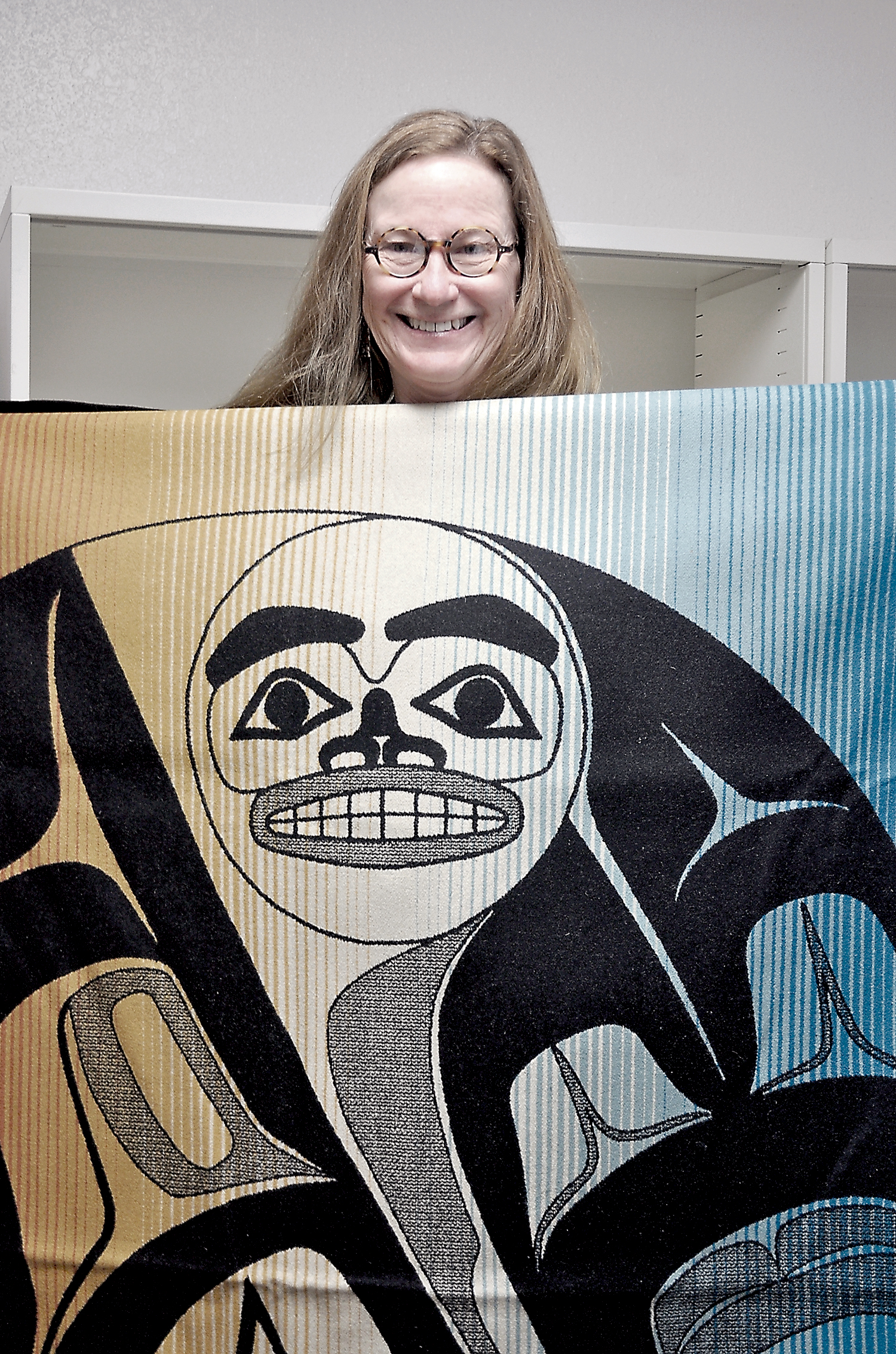
Wray took home with her a blanket that pictures legendary Raven, a gift from all the tribes with roots in the park — the Lower Elwha Klallam, Jamestown S’Klallam, Port Gamble S’Klallam, Quileute, Skokomish, Makah, Quinault and Hoh — but she didn’t limit her studies to Native Americans.
She recently completed River Near the Sea, a history of all the inhabitants of the Queets Valley, 642 pages replete with color and black-and-white photographs, maps and charts — even an engineer’s plan for the Queets bridge and a stock certificate of the Queets Clearwater Telephone Co. that was issued in 1922.
Most of the Queets River settlements were condemned in the 1940s and demolished in 1953, when the park annexed the Queets Corridor and Coastal Strip.
Wray’s work wasn’t a catalog of dead people and vanished settlements, however.
“I work with the living people,” she said, listing tribal elders, homesteaders’ descendants, veterans of the Civilian Conservation Corps and men who served in the Coast Guard Aircraft Warning Service and beach patrol units of the World War II Northwest Sea Frontier.
She also memorialized Fanny Taylor, postmistress at Mora whose diaries recounted a white woman’s life among the Quileute from 1914 to 1922 and whose collection of Native basketry now resides in the Smithsonian Institution.
“I just fell in love with her story,” Wray recalled. “She must have had 1,000 baskets.”
At the age of 57, Wray accepted an “early out” retirement along with about 900 other National Park Service employees.
There are no immediate plans to replace her.
Deputy Park Superintendent Todd Suess told the Peninsula Daily News her position “could be refilled in a different type of function that would do possibly similar things or completely different things.”
Wray said the future of the post of park anthropologist would depend on a strategic plan for the park that officials currently are formulating.
She and Nickey plan to divide their retirement time between Port Angeles and Twentynine Palms, Calf., near Joshua Tree National Park, where they hope to restore an old adobe house and where she’ll also conduct anthropological research “because I can’t stop myself.”
Her immediate plans are “to get back into shape for hiking.”
Wray listed among the highlights of her career:
■ Helping establish the Olympic Peninsula Intertribal Advisory Committee, which guides park officials’ decisions regarding Native sites.
■ Working to write a memorandum of understanding with the park’s tribes and the Northwest Indian Fisheries Commission.
■ Helping record in tribal languages the flood stories — probably dating from a 1770 tsunami — of the Quileute, Makah and Lower Elwha.
■ Contributing to the Community Museum project of oral and photographic history at the University of Washington.
■ Writing her other books — Postmistress (2006) and The Salmon Book: An Ethnohistoric Compilation (2003); compiling From the Hands of a Weaver: Olympic Peninsula Basketry Through Time (2014); editing the groundbreaking Native Peoples of the Olympic Peninsula: Who We Are; and contributing to an upcoming tabletop book on the history of the Elwha River, its people and its restoration.
She said she’d leave with a deep sense of satisfaction, although “there’s so much I could do here. There’s just so much history.”
Still, she said, “I’ve accomplished everything I wanted to do. I helped preserve things. That’s very gratifying.”
________
Reporter James Casey can be reached at 360-452-2345, ext. 5074, or at jcasey@peninsuladailynews.com
