
By Libby Wennstrom
Special to Peninsula Daily News
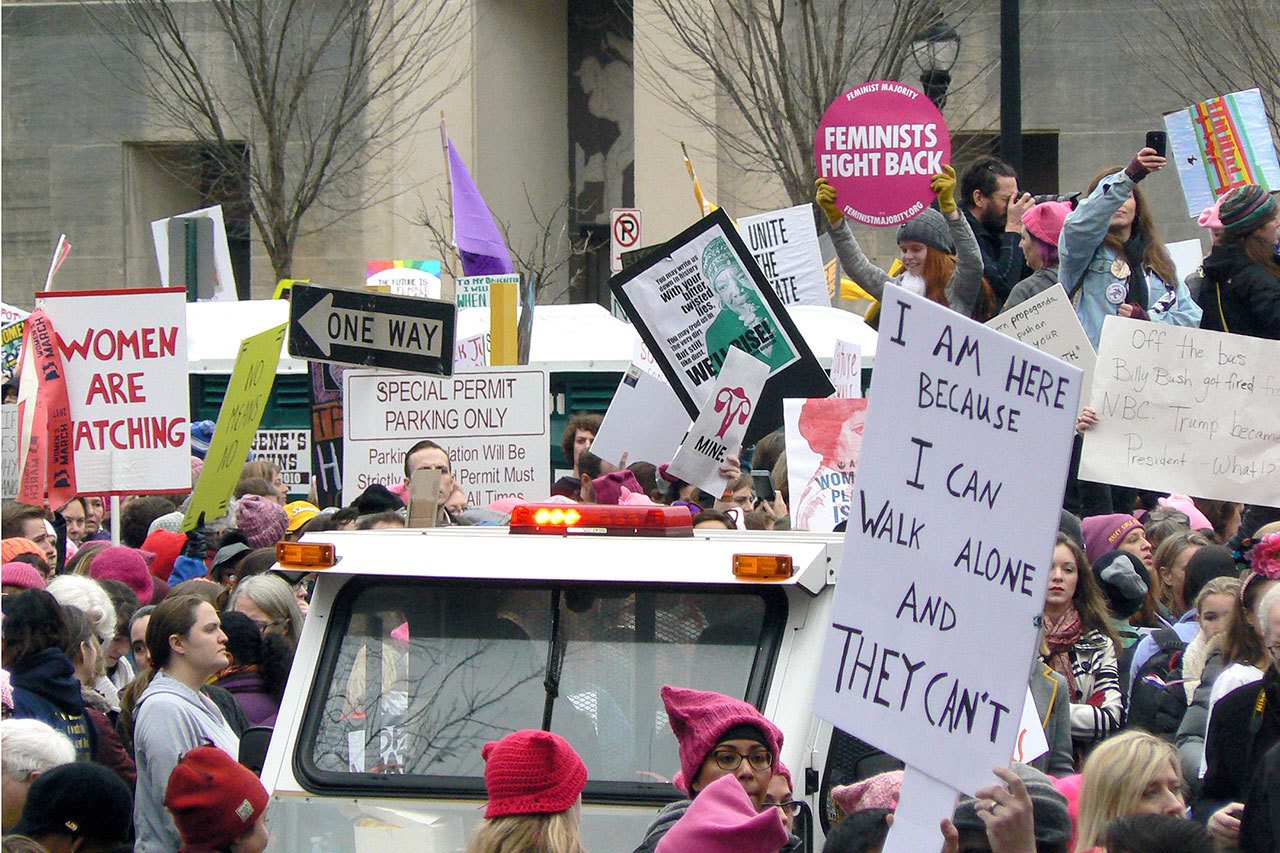
WASHINGTON — Half a million people from across America and around the world came together for the Jan. 21 Women’s March in our nation’s capital the day after Donald Trump was inaugurated the 45th president of the United States.
The crowd celebrated shared strengths and protested what many see as the Trump administration’s plans to actively dismantle a century of civil rights progress.
More than 35 marchers from Jefferson and Clallam counties made the long journey to D.C. We ranged in age from our early 20s to our late 70s and were mostly women.
We marched for dozens of reasons, but underlying them all was a shared sense of “I will not be silent” and a desire to speak up for those whose voices might otherwise go unheard.
The loosely organized group, pulled together just for this event, also sponsored travel costs for three young people from Port Townsend: Mollie West, Dylan Nichol and Josh Kelety. All three are aspiring journalists in their early 20s.
I’ve been to a number of marches over the past 40-odd years, from small church-led civil rights gatherings as a small child in the 1960s to beachfront candlelight vigils in Port Townsend at the start of the 2003 Iraq War.
I even marched on Washington in 1979 in the wake of the Three Mile Island nuclear accident.
But I have never seen anything remotely like Saturday’s protest.
Huge crowd
Reports by crowd scientists suggest that this was one of the largest protest marches ever held in the District of Columbia, with at least 500,000 people marching. More than 2 million are estimated to have marched that day worldwide.
Words don’t do justice to the powerful feeling of standing amid a sea of pink hats stretching several miles, marchers standing shoulder to shoulder for blocks in every direction.
What’s even harder to convey is the warm smiles, the helping hands, the shared chocolate and toilet paper and water bottles, the overall sense of common purpose.
I’m honored at being able to be a part of making it a reality.
Peninsula group
The North Olympic Peninsula group made plans to meet before the official start about a block from the planned assembly area.
Almost none of us made it to the rendezvous point. An hour before the speakers began at 10 a.m., the entire area was packed in an impenetrable crush of people.
We were literally across the street from where the group had planned to meet, but there was no possible way of getting across, the people were packed so tightly.
And still they came — on metro trains, on foot, on more than 1,200 tour buses chartered for the event.
At about 8:30 a.m., we boarded a metro train at Reagan National Airport, near the end of the line, and the train was already packed to capacity before it reached us.
Exiting the metro train, the crowd on the platform was so thick, it was difficult to move, and the bottleneck as the crowd exited through the turnstiles was crushing.
But the mood was buoyant, with people singing and chanting and laughing as they helped each other around trip hazards and kept parents and kids together in the crowd.
Metro employees helped people with the unfamiliar card system and patiently got overcrowded train doors to shut.
While large turnout had been expected, the sheer numbers overwhelmed the planning.
The National Mall — normally the main area for a large protest like this — was to have been closed to marchers.
Security eventually opened barricades for crowd safety; all those aerial images of marchers packing the entire mall are the overflow from the primary march areas on the streets.
The area next to where we initially stood had been planned as a held-open area for disability and emergency vehicle access. But the crowd — filling the street outside the open area to capacity for blocks — had to part like a school of fish to let ambulances through.
Yet despite the crowding and the long waits, the crowd remained cheerful, even exuberant. I saw zero incidents of rudeness all day, much less actual violence.
I saw only one lone “counter-protester” — really just a regular “repent-and-be-saved” religious speaker with a powered megaphone, exercising his First Amendment rights just as I was exercising mine.
Pussy hats
Around Thanksgiving, two women from Los Angeles, Krista Suh and Jayna Zweiman, had the idea to “paint the Mall pink” by enlisting women to knit thousands of cat-eared “pussy hats,” a snarky commentary on Trump’s recorded comments about grabbing women.
They launched the PussyHat Project, and the crafty women of the USA did the rest. Pussy hats were everywhere; even the D.C. police were wearing them by the end of the day.
Easily half of the marchers in D.C. — men as well women — sported some variation on the kitty ears, from paper headbands to crocheted masterpieces. So many hats were made in recent weeks that yarn retailers are reporting shortages of pink yarn.
Unlike the mass-produced “Make America Great Again” hats, virtually all of the pink hats seen in marches across the country and around the world were handmade, one-of-a-kind and not available in stores.
I personally knit six hats and sewed six more fleece ones, and gave them all away to family and friends. The iconic pink-eared hat even made a guest appearance on this week’s Saturday Night Live.
What’s next?
Like many historic marches, the real work is what happens once the crowds have gone home.
Several grass-roots Peninsula groups have sprung up to tackle local-level organizing and to help coordinate efforts to contact state and local lawmakers about emerging and proposed issues such as elimination of the Affordable Care Act, mass deportations and a “Muslim registry.”
A large crowd turned out for Port Townsend’s own Womxn’s March, though hundreds of marchers from the Peninsula also went to Seattle for the march there.
Indivisible has created a site for finding or forming groups in your area that oppose Trump’s goals. The site is at www.indivisible guide.com/groups-nav.
________
Libby Wennstrom is a freelance writer and photographer living in Port Townsend.
