
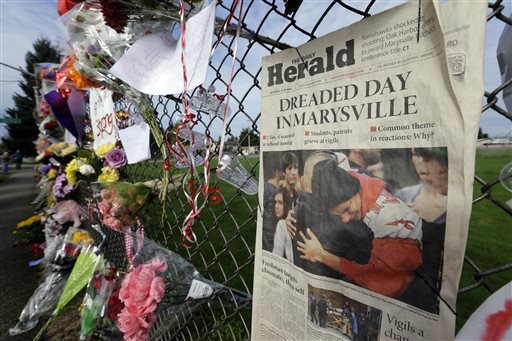
PORT TOWNSEND — North Olympic Peninsula school administrators are reviewing their safety protocols and explaining a tragedy to students in the wake of Friday’s high school shooting in Marysville that left three people dead and three wounded.
The shooting held an additional shock for administrators because the popular shooter didn’t fit the profile for the crime.
“He wasn’t the usual suspect. From all indications, he was a well-adjusted, happy kid,” said Port Townsend School District Superintendent David Engle.
“This a new twist on the situation. Now we have to worry about all of humanity.”
Investigators said 15-year-old Jaylen Fryberg invited his victims to lunch at Marysville Pilchuck High School by text message, then shot them at their table with a handgun.
Engle said the frequency of school shootings is leaving the public “shellshocked” and not knowing how to react to a shooting, especially one so close to home.
“Nearly everyone has a gun now, so anyone with a peeve can go out and commit a fatal act,” he said.
“No one has the answer, although there is the hope that by developing a better relationship with students, you can head these things off.”
Engle ties the apparent inability to take preventive action on school shootings to budget cuts, especially in the mental health area.
“We will never know the price we pay for not funding certain programs,” he said.
“There is some money available, although it’s a drop in the bucket when you compare it to what we really need.”
Port Angeles School District Superintendent Marc Jackson has distributed a handout from the National Association of School Psychologists with advice about what to do for kids who are concerned about a shooting, whether it is nearby or across the country.
The most important message is to reassure the children they are safe and keep the explanations age-appropriate, positioning the message for different grade levels.
Both districts utilize school resource officers — Port Angeles Police Officer Erik Smith and Port Townsend Police Sgt. Troy Surber — to maintain peace in the schools.
“We participate in active shooter training and are prepared for an event,” Surber said.
“We have plans to work with this and have trained with the Jefferson County Sheriff’s office, so we are ready.”
Surber has an office in the high school, and the police station is minutes away from all three local schools, but that may not provide a great advantage as “most of these events happen within two to five minutes,” Surber said.
Should an incident occur, the strategy is “to move toward the incident and attempt to defuse it,” Surber said.
Surber said that more than 50 percent of kids have their own cell phones, and any incident will lead to lots of cellular chatter.
He added both students and parents should limit their phone use during an emergency.
“If the phone lines get jammed up, it could make it hard for us to get accurate information in a timely way,” he said.
“So if you have something to report, you should report it.
“Otherwise you should communicate through text messages that use smaller communication packets.”
In Chimacum, the school district is currently reconfiguring the door system to control access into the schools and has changed the elementary school’s floor plan so entry is restricted to a single point, according to Assistant Superintendent Art Clarke.
In Quilcene, the district is providing staff with guidelines similar to those used in Port Angeles about how to talk to students and re-examining security around and within the school, according to Superintendent Wally Lis.
Lis said Quilcene’s small size makes it easier for school personnel to know the student body, but the isolation will be a drawback should an incident occur.
“We don’t have any police nearby, so it will take a while for them to get out here,” he said.
“Being isolated is one of the challenges because we have a lot of remote districts in Washington,” said Greg Lynch, superintendent for the Olympic Educational Service District 114, one of nine regional education associations.
“Part of the training we offer school districts who don’t have a short first responder time is for districts to determine what they can do to protect life and limb until the responders arrive,” he said.
“If you are small and remote, you have a bigger burden because you need to plan what to do during that time.”
On Oct. 20, the Olympic Educational Service District held a safety and security seminar which discussed responses to both natural disasters and other catastrophes, such as shootings.
“We want to help districts prepare for anything that will cause a delay in education,” Lynch said.
The agency represents school districts in Jefferson, Clallam, Kitsap and Mason Counties.
Lynch said his organization strives to provide resources that can be shared, from training exercises to equipment that can be purchased at a group discount.
Those schools who conduct disaster training can actually prevent a disaster through proactive effort, he said.
“When you prepare for a catastrophe or a disaster, part of the focus is to figure out who is at risk,” he said.
“The responsibility of the school district is to find a way to help the kids who normally wouldn’t be helped, in areas such as mental health.”
________
Port Townsend-Jefferson County Editor Charlie Bermant can be reached at 360-385-2335 or cbermant@peninsuladailynews.com.
