
Six of nine North Olympic Peninsula school districts spent a higher percentage of their budgets on classroom instruction than the state or national averages during the 2008-09 school year, a state audit of school district spending said.
Six districts also spent less on central administration than other districts of the same size during the study period, according to a state auditor’s report released last week.
Port Angeles, Port Townsend, Quillayute Valley, Quilcene and Crescent school districts each spent a higher percentage of their budgets in classroom instruction and less on administration, the report said.
Sequim School district spent a higher percentage on classroom instruction, and Brinnon spent less on central administration, than other districts of their size, according to the report released Wednesday.
“It didn’t happen just yesterday,” said Gale Frick, interim finance director for Port Angeles School District.
The result of voters’ choices on levies over the last few years had made it clear that the voters’ priority is in the classroom, so the district began making efforts to shift as much funding as possible to the classroom, Frick said.
That included not replacing retiring employees at the district office and closing programs that weren’t working, she said.
Frick said that five or six fewer employees at the district represent more teachers in classrooms.
She gave credit for the shift in funding to a number of people.
“It wasn’t one person. It was the board, the superintendent and many others,” she said.
For the last decade, the state Office of Superintendent of Public Instruction has made an effort to increase the proportion of money spent in the classroom, with less going to administration and other non-classroom costs, the report said.
As of 2008-09 school year, the state average for classroom spending was 60.2 percent of district annual budgets — less than 1 percent below the national average of 61 percent.
Each district was compared with about 10 other districts of similar size and demographics, which are called their “peer districts.”
The percentage of budget spending on classrooms in those districts, and their comparison peer district averages are 78.9 percent in Quillayute Valley, compared with 62.2 percent; 65.9 percent in Quilcene, compared with 60.9 percent; 64.9 in Crescent, compared with 59.1 percent; 63.4 percent in Port Angeles, compared with 61.8 percent; and 62.3 percent in Port Townsend, compared with 61.2.
Sequim spent more in classroom instruction than the national average, but less than its peers — 61.4 percent in Sequim, compared with 61.6 percent.
Brinnon spent less than the national and state average on classroom education — 48.7 percent — but more than peer districts, who spent an average of 48.5 percent.
Two districts spent less than the state and national averages and their peers: 56.5 percent in Chimacum, compared with 62.1 percent; and 55.1 percent in Cape Flattery, compared with 60.8 percent.
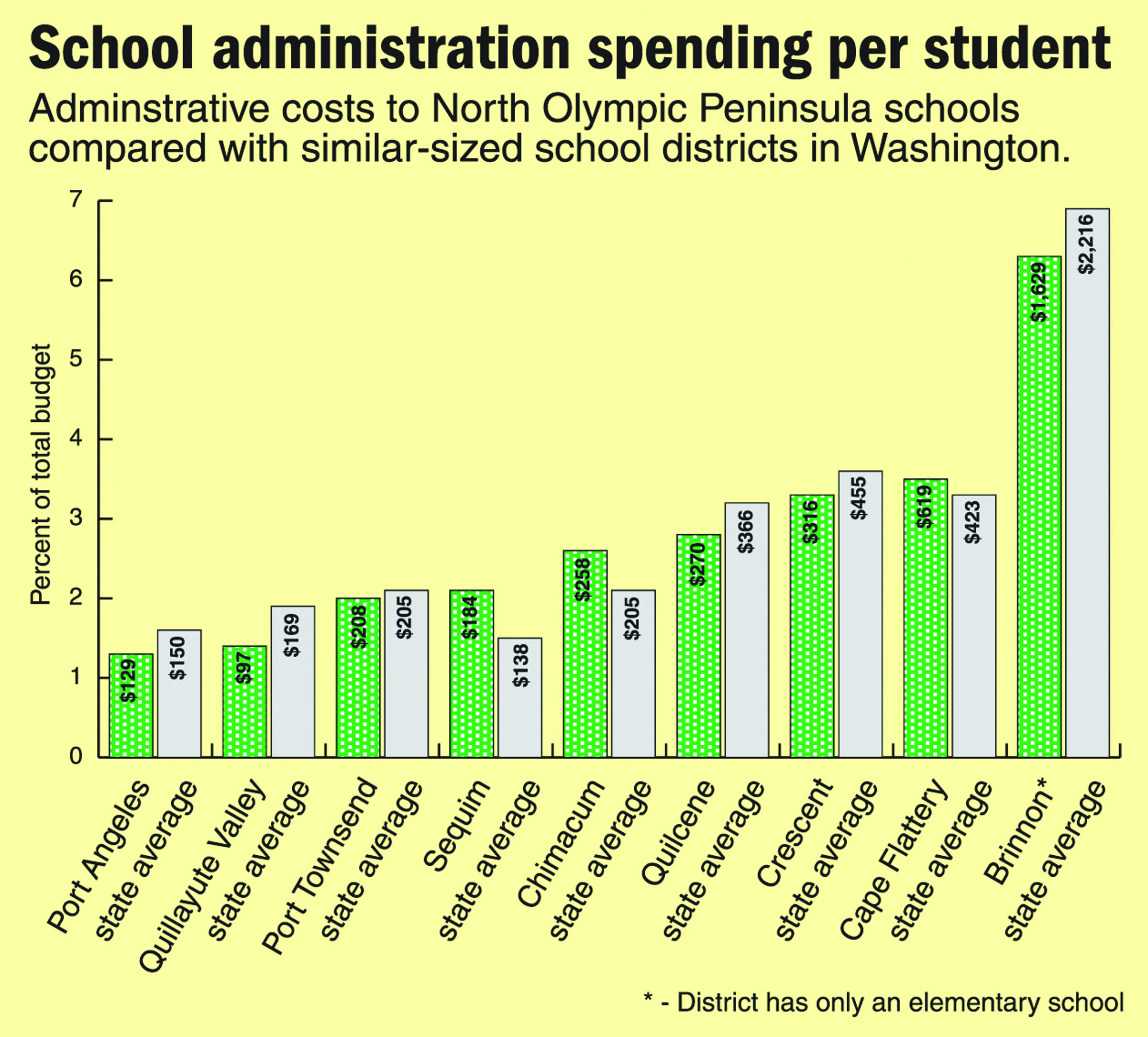
Six districts spent less on central administrative budgets than their peer districts.
Percentages of the budgets spent on administrative costs, and their comparison peer district averages were 2 percent in Port Townsend, compared with 2.1 percent; 1.3 percent in Port Angeles, compared with 1.6 percent; 1.4 in Quillayute Valley, compared with 1.9 percent; 2.6 percent in Chimacum, compared with 2.1 percent; 2.8 percent in Quilcene, compared with 3.2 percent; 3.3 percent in Crescent, compared with 3.6 percent; and 6.3 percent in Brinnon, compared with 6.9 percent.
“Of course, we’re pleased,” said Anne Burkart, a member of the School Board for the Port Townsend District.
“We need to focus on the children,” she said. “It’s what we’re all about.”
“Education is the most important thing schools do,” Burkart said.
Three districts spent more than their peers’ average; 2.1 percent in Sequim compared with 1.5 percent; 2.6 in Chimacum compared with 2.1 percent, and 3.5 percent in Cape Flattery compared with 3.3 percent.
Of all Peninsula schools, Quillayute Valley School District, in Forks, has the lowest cost for central administration and the highest percentage of its budget spent directly on instruction spending, but the district’s numbers are deceptive, according to the audit.
The small West End district’s high spending per student is affected by having 67 percent of students enrolled in “alternative learning experience” off-campus education options.
That number represents the third highest rate of alternative learning experience students in the state.
The district’s instructional budget is spread between fewer students in the classrooms, making the school look more efficient, the audit said.
Quillayute Valley district representatives were not available for comment Friday.
Similarly, Quilcene schools is sixth in the state for percentage of alternative learning students, with 56.4 percent of enrolled students in such programs.
The state audit considers 10 percent to be enough to skew the district’s spending statistics.
The Brinnon School District is an unusual case, with a total enrollment of 35 elementary school students who live in widely spread-out area.
The district spends 6.3 percent of its budget on administration, and only 48.7 percent on classroom instruction, numbers that are similar to its peer districts.
“We are different, what can we say?” said Betty Johnson, business manager for Brinnon.
The tiny district has only four classrooms but must still have an administrator, business manager and a secretary and maintain the building and a fleet of school buses, which skew the district’s numbers.
In a larger district, the cost of a single school secretary could spread the cost to hundreds of students, reducing the percentage of the budget spent on administrative costs, Johnson said.
Quilcene and Brinnon share a superintendent to reduce costs, and many others who work at the school work part-time or are volunteers, she said.
Superintendent Wally Lis works two days a week at Brinnon and three at Quilcene, working as a separately employed part-time superintendent at each district.
The remainder of the district’s budgets is divided among building administration (administrators and support employees who work directly with students), instructional support, student support, operations and maintenance, transportation and food services.
The state audit recommended changes in spending in these areas by increasing efforts to hire employees who have multiple qualifications, weatherize school buildings, update heating systems to increase efficiency, make bulk purchases of fuel for buses and to charge more for school meals or find a way to decrease the cost of meals.
________
Reporter Arwyn Rice can be reached at 360-452-2345, ext. 5070, or at arwyn.rice@peninsuladailynews.com.
