
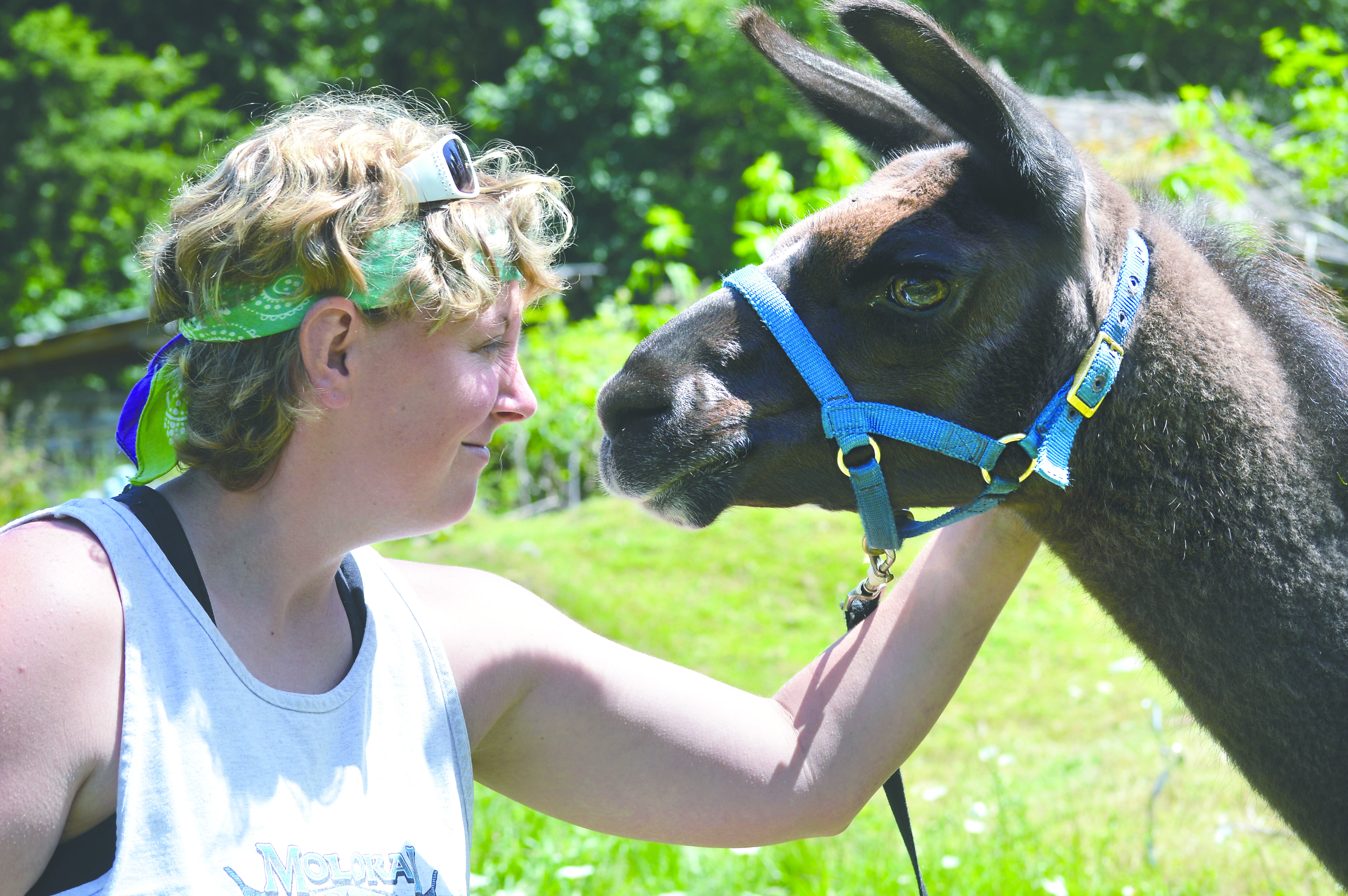
PORT ANGELES — At 18, Sara Woodard wanted to work in the wilderness. She’d grown up in Joyce, got her general equivalency diploma from high school and cast around for a steady job. She was a baker’s apprentice for a while, but knew that wasn’t her calling.
So she quit, and lived in a tent on the beach.
When Woodard heard of a job at Olympak Llamas, she called owner Ernie Vail. And called again. Vail didn’t call back.
Annoyed, she went to his other business, High Tide Seafoods, and confronted the guy.
This turned out well. Vail and Woodard gave each other a chance. On pack trips high into the mountains, they got to know each other.
For the past 15 years now, Woodard and her man have led back country treks with llamas, those sure-footed members of the camel family. Together, they travel across Olympic National Park: into the Enchanted Valley, up the Cameron, Queets and Gray Wolf rivers trails, to Mount Olympus and many other high points.
After working side by side for a decade, Vail and Woodard married in 2008. They live, with a herd of 28 llamas, on 100 acres west of Port Angeles in a home they built together.
“I planed every board on the house,” Woodard says, squinting up at the sun-bathed place.
She also rescued many of the llamas. People know to call her when one of the beasts needs a home.
And while a few of the animals have retired after a good 15 to 18 years, the Olympak couple is just hitting its summer stride.
“We average 400 miles a season,” says Woodard. This year’s Olympak trips began Memorial Day weekend with a jaunt to Humes Ranch on the Elwha River.
Some clients want to charge across the park in a few days while others want to linger at every waterfall. Whichever it is, Olympak’s motto is “no pack = no pain.” Each human carries a water bottle while the llamas can haul a combined 400 pounds.
“Every trip is totally customized,” Woodard says, with up to eight llamas walking the trail for five, seven, even nine days. And in the case of trails like the Queets River route, the way has to be cleared first. That’s what Woodard and Vail do in the spring. They recently finished clearing 10 miles of the Queets River trail.
Woodard’s favorite trip involves resupplying the youth programs that take teenagers into Olympic National Park’s backcountry. She and the llamas bring fresh fruits and vegetables, mail from family and clean clothes to the youngsters halfway through their treks.
“They just freak out,” Woodard says, when she appears on the trail.
While these youth programs are usually for kids from urban places, Woodard’s dream is to start a program to get local young people into the back country. Step One would be to develop a gear library: outfitters could donate tents, sleeping bags and stuff. Parents might be able to send their kids on a backpacking trek.
But buying all the equipment gets expensive quick. A library offering gear for checkout, Woodard says, could remove that barrier.
When asked what the challenges of llama packing are, Woodard replies that she sees bears now and again.
“The llamas get fidgety,” when that happens. They make their own kind of alarm noises. So not only are they agile beasts of burden; they’re also like guard dogs.
“They love to go,” Woodard adds. “If they’re having a good time, then it’s a good trip.”
Woodard and Vail love life on the trail, too. But their season is short — the last trip comes in September, which is when they take Pat Willits, a longtime client and dear friend, up the Queets.
Vail used to work on the Olympic National Park trail crew, so he knows the mountains like a cardiologist knows the heart’s ventricles.
And while Vail is Woodard’s traveling companion and business partner — he credits her with running the company — Woodard hails a group called the Goat Girls for teaching her about life.
Sandy Steigerwald, Gladys Pearce, Elee Cameron, Carol Tidyman, Bonny Collins, Vivian Senz, Gayle Webster and Jo Wichary were part of the group Woodard got to know in the late 1990s. They did the Press Expedition route from Quinault to Whiskey Bend, and have made many an epic trek since.
A few of the things Woodard has learned from the Goats: How to pace herself, to walk the walk without looking at the top of the hill. How to dry, not melt, her wet shoes: Use shoe rocks and keep rotating them. The names of all those wildflowers. How to just sit, sit and take it all in.
And how yes, she could quit smoking.
“They showed me what true friends are,” Woodard says, adding that she was honored to be named an official Baby Goat.
Tidyman, now 82, has fond memories of those Goat Girls hikes.
“Sara knows how to handle animals. She understands them.
“She is a strong personality, but she still shows empathy. She’s very willing to help with hikers who aren’t all that experienced,” Tidyman said.
Collins, who’ll be 77 this year, also remembers meeting the 18-year-old Woodard.
“She was so young. We were so impressed,” Collins said, “with the way she handled everything,” not least the team of llamas.
That’s borne out by the photographs on Olympak Llamas’ Facebook profile. Woodard’s longtime friend Jeanne Dalgardno, owner of Pixel Perfect in Port Angeles, helped her create the pages.
They’re replete with images of Woodard and Vail, leading their animals across creeks and rivers.
“I’ve never known such a dynamic person,” Dalgardno said. To watch her in action is to see a woman who’s not afraid of anything, or if she is, she goes forward anyway.
The thing lots of people believe about llamas, though, are that they are mean, ornery spitters. And Woodard, in her decade and a half working with these creatures, has experienced their spitting.
They do it, Woodard says, when they’re annoyed. And they mostly do it at each other. If you’re worried about a llama spitting on you, just be mellow and don’t provoke him or her.
Tidyman, for her part, says some of the Goat Girls got to the point where they wanted to go on a pack trip just to be around the llamas.
“They’re smart. They don’t smell. And they don’t attract flies,” she said. “They’re quiet, but they talk to each other.”
Llamas “hum,” Woodard says. And Tidyman remembers one time when, upon arrival at their campsite after a long day of trekking, all of the animals were humming.
“They’re happy,” Vail explained.
The llamas, along with Woodard and Vail’s dogs Neah, Echo and Trek — all rescued Catahoulas from across the country — are like family. So it was heartbreaking when their llama Melinda disappeared in November 2011. Woodard fears she was stolen.
“We had so many calls and dead-end leads on her,” Woodard said. “It really was torture.”
She still looks for the llama when she’s out driving around.
“She was such a sweetheart,” Woodard said of Melinda, who was the sister of her llamas Fez, Ken and Dylan.
For the next couple of months, Woodard and Vail will be going out for a week at a time, coming home for a day or two and then heading out again. Come October, back-country hiking ceases to be something out-of-towners want to do.
For Woodard and her family, though, the onset of wintry weather is no deterrent. She and her husband have celebrated Thanksgiving in the mountains, toting in a feast complete with homemade pumpkin cheesecake.
Then there’s Woodard’s birthday in March. That’s an excellent time to celebrate life here among the Olympic Mountains. Woodard and family do it in style: Last time, they packed up some sweet seafood, hiked up and, once a suitable perch was found, sat back to enjoy lobster on a stick.
