
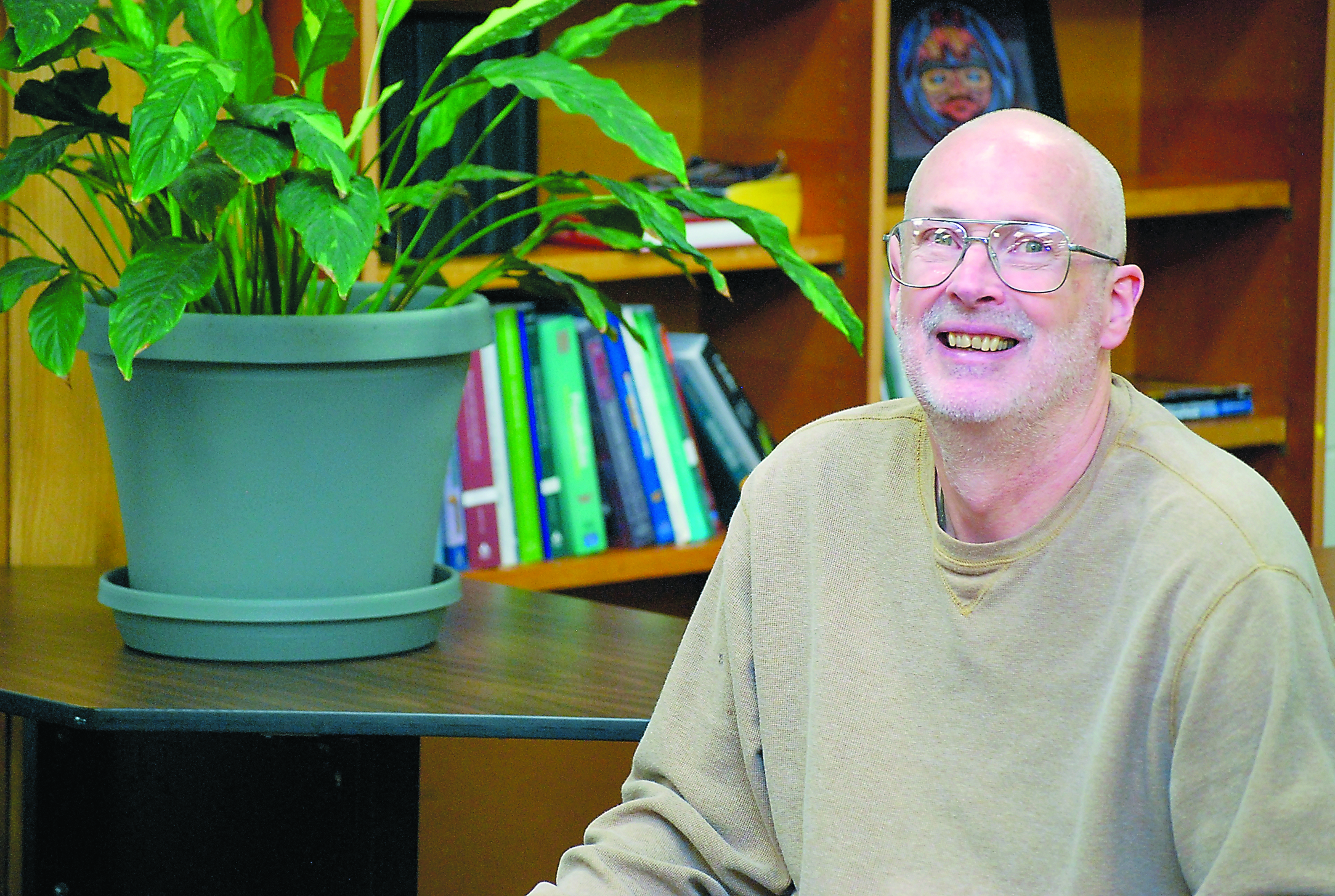
On these rainy winter afternoons in Forks, Scott Seaman helps people navigate fearsome waters.
He knows this journey well, but understands why others loathe it.
The journey is algebra: the kind you must master to get into college.
While coping with a crippling illness, Seaman tutors and teaches students who, stymied by high school math, are giving themselves a second chance. Passing his Peninsula College algebra class means they will qualify for the next math course, which will help propel them toward a college degree.
Seaman moved to the West End in 1980 to teach math at Forks High School. After 30 years of teaching, he retired from paying work, but he still has plenty of students.
Seaman also has multiple sclerosis. He received his diagnosis in 1990, and though he does not have a swiftly progressing type, over the years he’s had to give up activities such as coaching volleyball at Forks High.
Seaman has all but stopped driving his own car, though he does it twice a year, heading to Bothell to visit his daughter at the holidays and on her birthday.
So Seaman, 62, zips around town on a motorized scooter, often with a large umbrella deployed above. He comes in to Peninsula College’s Forks Extension Site on Monday through Thursday to teach his algebra class and to be there for students who need tutoring, from noon till early evening.
After all these decades, Seaman loves to teach.
“It is so nice to have students who really want to be here,” he says.
To the Peninsula College site — where it’s possible to complete an associate degree without leaving Forks — pupils come ready to move toward their goals.
Seaman also works with the occasional high school student and tutored one all last summer.
“He is very dedicated,” said Deborah Scannell, Peninsula College’s West End coordinator. “He spends hours and hours with students, one on one and in small groups.”
Watch Seaman at work, and “the patience factor really comes through.”
For many students, “math is such an impediment. He sees them through it.”
Donates time
Seaman has received no pay for some four years now. If he did, he says, it could interfere with his Social Security benefits. So Seaman comes in, day after day, to give his time to the students.
Living with a yet-incurable neurological disease, as anyone close to an MS sufferer knows, causes pain beyond the physical. The Northwest has the highest rate of MS diagnoses in the United States: twice the national rate, according to Dr. James Bowen at the Swedish Neuroscience Institute’s Multiple Sclerosis Center in Seattle.
Some 8,500 cases have been reported west of Washington’s Cascade Mountains, Bowen noted.
“I get depressed,” Seaman acknowledges.
But “when I start feeling down, I remember that I could have it so much worse.” Seaman knows of two people who were diagnosed with MS more recently than he was and who have since lost their battle with the disease.
He used to be an avid golfer, but now Seaman swims at the Forks community pool. With the water lifting him, the pool is one of the few places where he can stretch out his long legs and walk. Seaman tries to work out six days a week, and then rests Sunday.
Seaman has won a battle with weight control: At 6-foot-6, he’s a big man who used to be too big: 340 pounds. Today, he’s under 240.
How did he do it? “By eating less,” he says with a smile.
One day last summer, Seaman defied his illness publicly — and with difficulty. He attended the Forks Relay for Life at Forks High School on Aug. 4, and, abandoning his scooter, walked all the way around the track.
Friends told him: You can do it.
But to Seaman, that track looked impossibly long. He strolled around it anyway.
The walk was tiring — “extremely. And it had to be one of the hottest days of the whole year,” he recalls. A friend cooled him by pouring a bottle of water over his head.
Seaman has devoted all of his life to small communities. He grew up in Leavenworth, then went to Central Washington University in Ellensburg while coming home on weekends to help his father, who owned the hardware store.
He started teaching at just 22 in tiny Wilson Creek, about 25 miles from Moses Lake. In 1980, he came to Forks, when logging was still the community’s lifeblood.
He watched the rise of another industry, Stephenie Meyer’s Twilight novels, while volunteering at the Forks Chamber of Commerce.
“We went from 10 or 20 people a day to 10 or 20 people at a time,” in small herds, coming through the door in search of Bella’s truck and Edward’s sparkle.
When asked about his hopes for the new year, Seaman didn’t hesitate.
He has a bucket list — not written down, but fiercely desired. Seaman’s yen is for travel. His eyes shine when he speaks about it.
Destination No. 1: Washington, D.C., and the Smithsonian Institution. The problem was that Mandy Cantwell, his friend and caregiver, doesn’t do air travel. And for Seaman, driving for days across the nation isn’t practical.
But then, “out of the blue, my brother calls. He says he and his wife wanted to go to Washington, D.C.”
This was last summer. They planned, they booked the flights, and they took off on a family trip Sept. 5.
And though Seaman wondered how this multi-leg trip would go for him — Forks to Sea-Tac to Dallas to the District of Columbia — he sailed through.
Next on the list is to take a cruise to Alaska, and since that won’t require a plane, he hopes to go with Cantwell this time.
The bucket list continues: “I want to see EPCOT Center [in Florida]; I don’t know how I’m going to do that. But I’m going to do it. I have to do it,” says Seaman.
He also wants to take a train trip somewhere, perhaps across Canada. And he dreams of a dip in the warm Caribbean Sea.
For now, though, he has math problems to solve and people to teach. They’re waiting for him in the front room of the college site on Forks Avenue. And so away he goes in his scooter, to sit at the table with his students.
