
PORT TOWNSEND — At the front gate, the colors are muted, all grays and olive greens. It’s winter out here, with all things waiting.
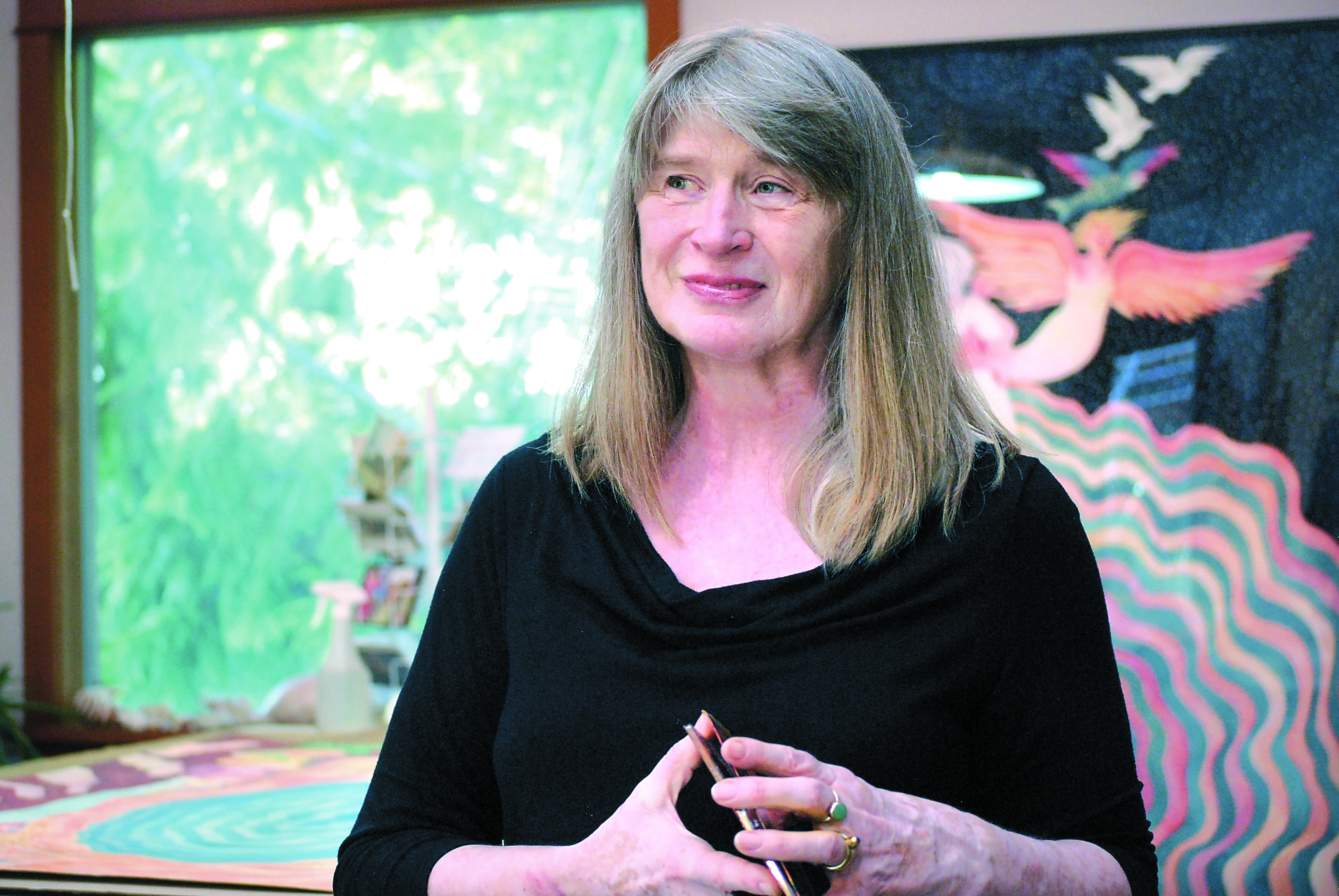
But then Linda Okazaki opens the door to her studio. It’s as though the sun has come up, lighting the land, sky, water and a world of creatures. Across the walls are winged things — kingfishers, ravens and fish — and women, women who reflect Okazaki’s visions.
“Fire Inside the Heart,” one of the works dominating this place, has lent its name to the artist’s new show at the Max Grover Gallery on Water Street.
This title, Okazaki says, means passion — “not necessarily romantic in nature, though it could be.” The 30 canvases in the exhibition come from what she calls “the fire of the imagination.”
“Fire,” she adds, has much more color than her January show at Max Grover. Titled “Night Visitor,” it was replete with black-and-white images, scenes of the wee hours.
It’s time now for light. Okazaki shines her artist’s beam into her dreams, and out into the world. She has used art as a form of journaling since she was a child in the Grays Harbor mill town of McCleary.
Sketching, drawing, painting — they became a way to explore herself, and to “transcend and transform,” as Okazaki’s friend Rikki Ducornet writes.
Ducornet, an artist and novelist who lives in Port Townsend, published “The Egyptian Portal,” an essay illustrated by Okazaki’s paintings, that is part of the Max Grover Gallery show.
In it, Ducornet writes about the power of art, and about surviving trauma.
When Okazaki was 6 years old, her mother was murdered. Her mother’s dog, a Basenji, was killed soon afterward because, Okazaki said, nobody else wanted that dog.
Okazaki’s father sent her to live with relatives; as a girl she moved from McCleary to Kennewick, then to Medford, Ore., before starting college at Pepperdine University in California.
She spent just a year there. Nearby Watts was burning, the scene of riots that drove the young art student out, in search of open space. She found it in her home state, where she earned a bachelor’s and a Master of Fine Arts degree at Washington State University.
She married art history and photography professor Arthur Okazaki, and together they had a son, Miles.
The first marriage did not last.
Okazaki moved to Port Townsend in 1980, and met her husband Raymond Weber, and together they built their home in 1987. They raised Miles and two more children, Eva and Luke, here.
Over the past four decades, Okazaki’s work has traveled far, to high-profile collections, museums and galleries; she also has created the posters for the Port Townsend Film Festival, the Wooden Boat Festival and for Bumbershoot, Seattle’s music and art extravaganza. Her exhibitions have ranged from “The Languid and the Loathsome” at the University of Colorado at Boulder in 1977 to “Bumbershoot Turns 20” in Seattle in 1990 to the Northwest Art 50th Anniversary Project in Bellevue in 2010.
Okazaki continues to be a ferocious explorer of worlds interior and exterior. Her paintings are large and small, fanciful and disturbing; they seem to overflow with the symbols of passion: flames, flight, music.
Also seen again and again is a Basenji, that ancient African dog with the curling tail and coyote-like nose — “a trickster and shape shifter,” as Ducornet writes in “The Egyptian Portal.” The dog “appears as a protective spirit and accompanies the painter on a series of water crossings,” standing beside her and a tempest-tossed sea.
This Basenji, both Okazaki and Ducornet note, also resembles Anubis, the Egyptian god who escorted people into the netherworld.
Often, Okazaki’s paintings contain elements from Egypt and Africa, hence the title of Ducornet’s essay. Okazaki herself is an artist who views the world from various portals. These days she is stepping into them, like a traveler through time.
Okazaki’s daughter Eva Weber has curated the “Night Visitor” and “Fire Inside the Heart” shows. In many cases, the paintings tell her family story, and help her understand who her mother is.
“But there are certain archetypal elements that resonate with most people,” Weber adds.
These elements — water and fire, the forces of emotion and nature — essentially leap out at the viewer.
Okazaki travels to locales near and far; her paintings go to Egypt, “one of those mysterious, powerful places our soul visits,” as she says. They also explore waters, real and imagined, from a ferry trip across a turbulent Puget Sound in “Last Run,” to “Pond Woman,” an image of a peaceful pool close to home.
“In the summer, I do some painting outdoors, to reconnect with the landscape,” Okazaki says. The artist loves to hear the sound of ravens calling, and of the sea’s waves. All of these sensations inspire.
She also loves the city, loves to visit a grand museum or a district loaded with galleries. She recalls visiting New York City’s Museum of Modern Art and spending hours looking, sketching and, as she puts it, being “luxurious with the art.”
Give yourself permission to do that at a gallery, Okazaki says, and you might have the experience she did, of going inside a painting, and feeling what the artist felt.
On another day, Okazaki gave herself permission to go “tromping through the galleries in Chelsea,” the Manhattan neighborhood.
The kaleidoscopic array of art there, she says, gave her a fresh sense of confidence. There’s room in the world for all kinds of perspectives and styles, those galleries showed her.
“Seeing the diversity of other artists,” she says with a smile, “gave me a feeling that what I’m doing is just fine.”
And after all these years, Port Townsend continues to suit this artist. “I like the activity center, and the options in an urban environment,” she says. Returning home, though, she can continue another kind of travel.
“I am fond of the sense of space here.”
“I haven’t gone to the full depth, yet, of what I want to say.”
