
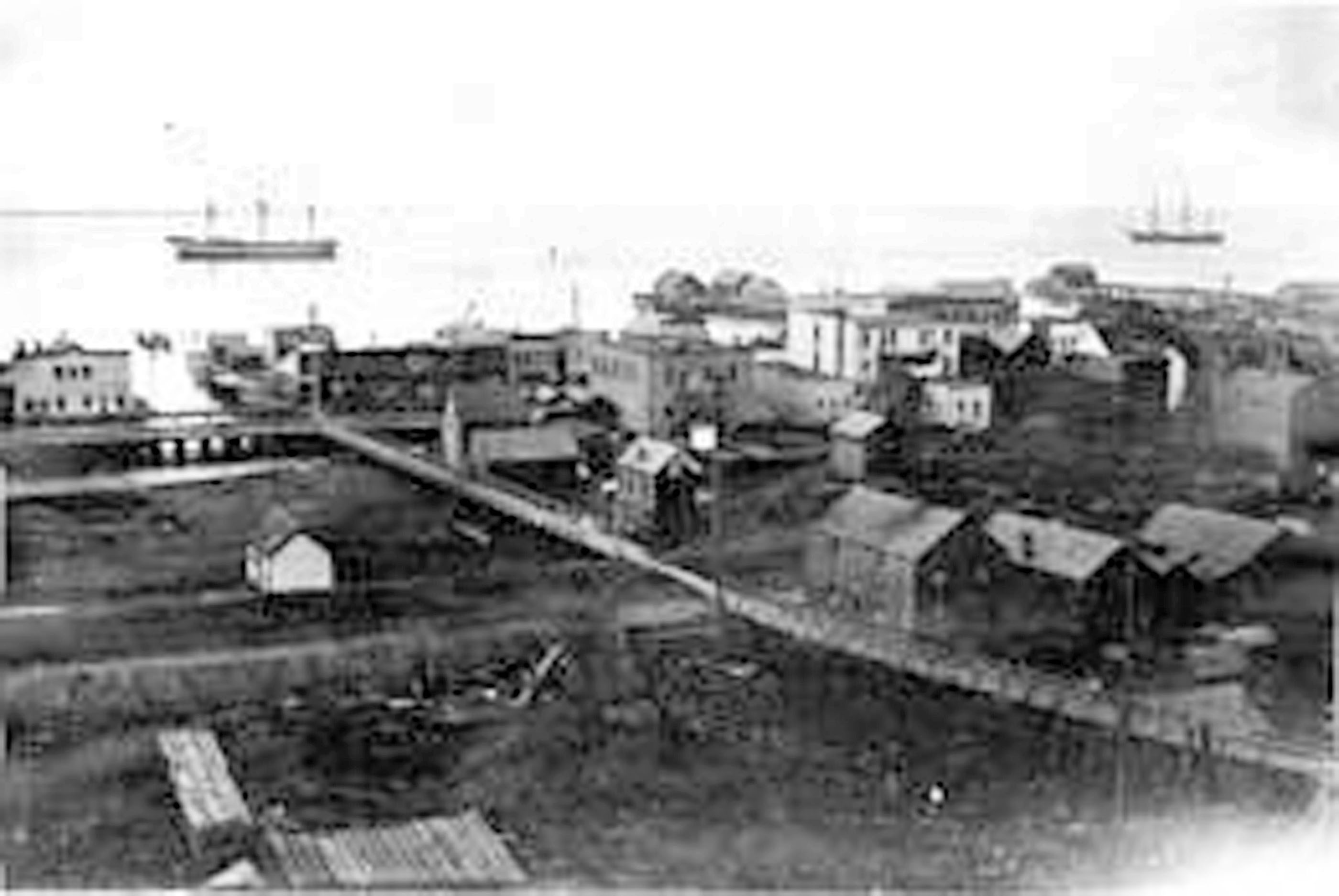
By Jack Henson Port Angeles Evening News
EDITOR’S NOTE: This memoir appeared exactly 50 years ago in the Port Angeles Evening News, predecessor to the Peninsula Daily News.
It was written by Jack Henson, a retired editor of the Evening News and the Port Angeles Olympic Tribune, which published weekly after the turn of the 20th century.
Henson came out from behind his nom de plume of “The Wandering Scribe” to write this recollection of Port Angeles and the North Olympic Peninsula at Christmas 1903. It was published in December 1963.
Sixty or more years ago, there was no mail delivery here to homes or offices.
To get mail, it was necessary to walk to the post office on Front Street and get mail either from the general delivery window or lock boxes.
The volume of mail was not great, as Christmas gifts usually were delivered by the giver. This also held good for Christmas cards, to a great extent.
I cannot remember getting any Christmas cards by mail. This went for packages, also.
We either got our presents at Sunday school Christmas trees or in our stocking at home Christmas morning.
As I remember it, many of the gifts for boys were homemade sleds or knitted stockings or mittens.
The girls usually got dolls, if they were young, and if older, there were games or articles of clothing.
In those real early days of 60 or more years ago, there were no expensive mechanical toys.
The biggest gift I remember was a pair of leather boots with red tops and copper or brass toe guards.
Port Angeles was a great Christmas tree town. Evergreen trees could be cut on the townsite or immediately adjacent to it.
Churches and homes all had Christmas trees. There was no electricity, so the trees were lighted with small wax candles of various colors.
At the churches, Santa signaled his coming by jingling the bells on his sleigh and yelling “Whoa” very loudly as he drove up to the church door.
When the candles were lit on the big church tree, Santa started unloading gifts from his pack.
Always there were the Christmas stockings filled with candy, nuts and oranges.
As names were called, each child went forward and was given his Christmas stocking and other gifts.
There was a program of Christmas songs and recitations.
Usually there was a scene illuminated by flash powder. It usually was a pantomime featuring angels.
The churches were the center of Christmas activity. All Sunday school children participated.
Homes were the center of Christmas Day activities.
Always there was the big Christmas dinner featuring mostly homegrown food.
Instead of the turkeys that are common now as part of the Christmas feast, homegrown chickens were the headliners.
The home Christmas trees were trimmed with homemade ornaments, which included popcorn strings.
Christmas gifts were exchanged from the tree if they had not already been put into the stockings that were hung up on Christmas Eve.
Those were what we called “hard times.” Many of the men of the community had gone to other parts of the state to get employment.
The families remained home to cultivate the gardens and “prove up” on the federal reservation lots.
Christmastime was the time for men to come back here for the family gatherings.
They came by boats: the Garland or Evangel, which each made a couple of trips a week from Seattle.
Christmas was the time for visiting. There were no automobiles or electric lights in the residential districts.
There were narrow wooden sidewalks. Folks traveling the streets at night carried kerosene lanterns.
If it happened to be a white Christmas, sleigh-riding parties were in order.
The horse-drawn vehicles traveled over the rough streets, usually to the jingle of sleigh bells.
The most popular ride for the youngsters was what was known as a hay ride in a big farm wagon drawn by a team of horses.
At the close of the ride, there was a party at some home where usually sweet cider was served.
