
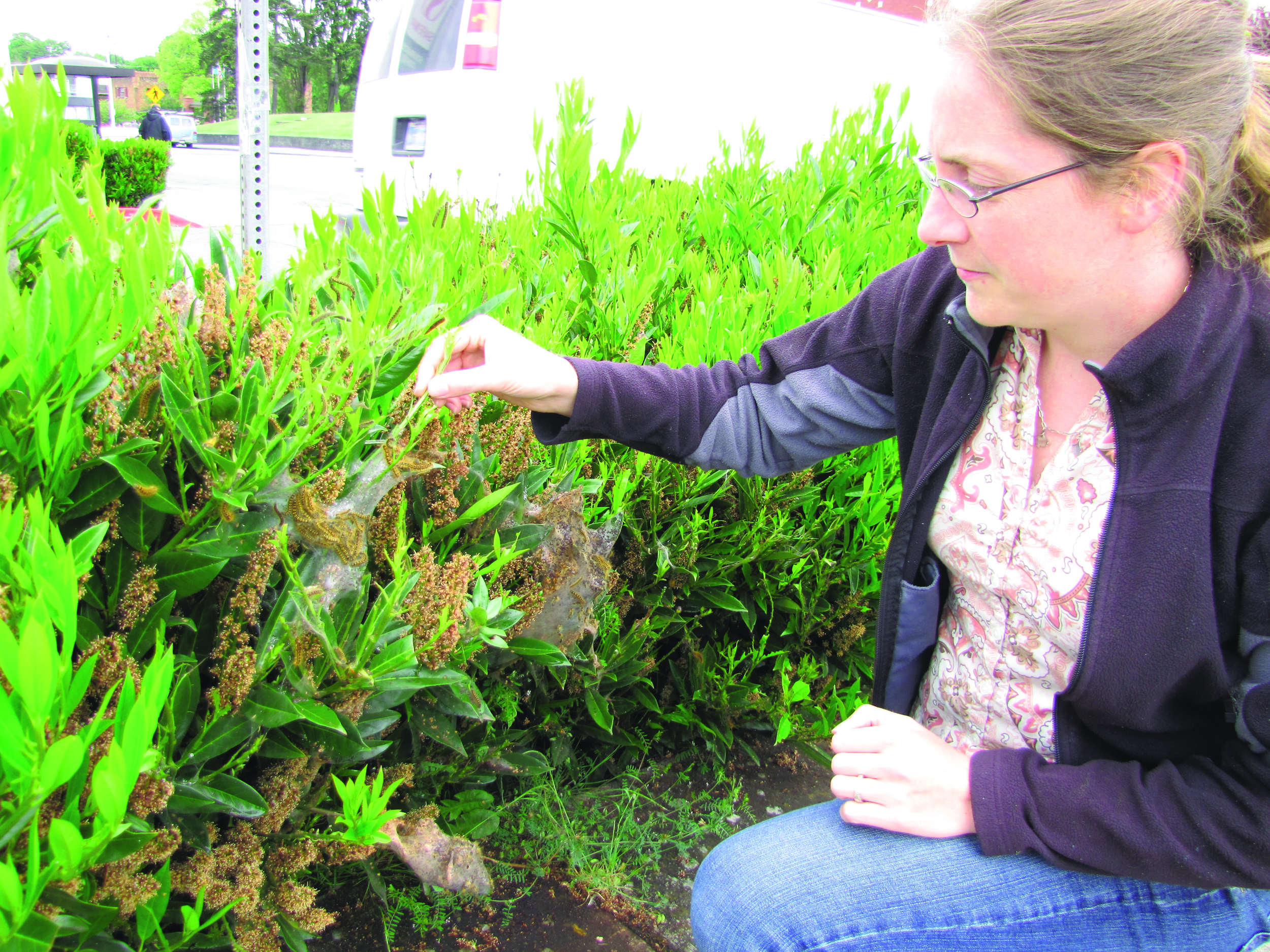
PORT ANGELES — Foamy caterpillar “tents” have infested trees and plants on the North Olympic Peninsula as the vegetation has been attacked with what look like webs of giant spiders.
Experts say it’s a good idea to remove the nests to prevent leaf loss.
Clallam County Master Gardeners, which is part of the Washington State University Extension office, issued a tent-caterpillar alert last week.
It called the infestation moderate to severe, with reported outbreaks from Joyce to Sequim. But the geography is broader.
Andrew May, a professional ornamental horticulturist and Peninsula Daily News gardening columnist, said the infestation extends across the Peninsula.
Tent-caterpillar outbreaks are a normal phenomenon and rarely cause permanent damage to trees and shrubs. But heavy infestation can reduce a tree’s fruit harvest.
It also may cause a complete loss of leaves, according to the Master Gardeners’ alert.
May said this year’s infestation was caused by the combination of a mild winter and natural predator-prey cycles.
“You could expect every 10 to 15 years to get nailed big time,” May said.
“But they’re always present every year.”
May said this is the second “huge infestation” he has seen since moving to the North Olympic Peninsula 17 years ago.
Laurel Moulton, Clallam County Master Gardeners program coordinator, said her office has been inundated with inquiries about tent caterpillars.
“It’s just something that happens every few years, and people get really concerned,” Moulton said.
“We’re getting about five calls a day on them,” added Clallam County WSU Extension Director Clea Rome.
Removing the frothy egg masses during winter pruning is the best way to prevent a spring infestation.
Once hatched, the nests can be pruned or sprayed with chemicals.
May said he often uses a glove to squish the insects by hand.
Moulton and Master Gardener Bob Cain compiled information from academic journals and included the following recommendations for removing the pests in their tent caterpillar alert:
— Prune out affected branches and smash the tents or dip them in a bucket of soapy water to kill the larvae.
It’s best to do this in the early morning or evening because foraging larvae tend to return at night.
— Spray the caterpillar blobs with insecticides or an organic spray containing Bacillus thuringiensis sp. Kurstaki, or BT.
Generally, the tan-colored caterpillars stop eating in June and turn into moths in July and August.
“At this point, a lot of them are getting so big that it’s just time for them to kind of move on and find a place to turn into a cocoon,” Moulton said.
Tent caterpillars can attack alder, ash, birch and cottonwood trees; roses; and cherry, apple and other kinds of fruit trees.
“Once the caterpillars grow large and start migrating, they are ready to stop feeding and will cause little further damage,” the alert said.
Moulton said in a follow-up interview that the caterpillars are in different stages and that it’s still advisable to remove the nests to prevent the insects from migrating to other branches or nearby plants.
“We generally advocate using pesticides, even if they’re organic, cautiously,” Moulton added.
More information about tent caterpillars can be obtained at weekly Master Gardener clinics at the Clallam County Courthouse, 223 E. Fourth St., Port Angeles, on Thursdays from 9 a.m. to 1 p.m. or at the Master Gardener Demonstration Garden at 2711 Woodcock Road near Sequim on Saturdays from 9 a.m. to 1 p.m.
For the Jefferson County Extension office, phone 360-379-5610.
Master Gardeners are trained volunteers who teach home gardeners about sustainable gardening practices, including pest management, watering systems, soil improvement and picking the right types of plants.
Reporter Rob Ollikainen can be reached at 360-452-2345, ext. 5072, or at rollikainen@peninsuladailynews.com.
