
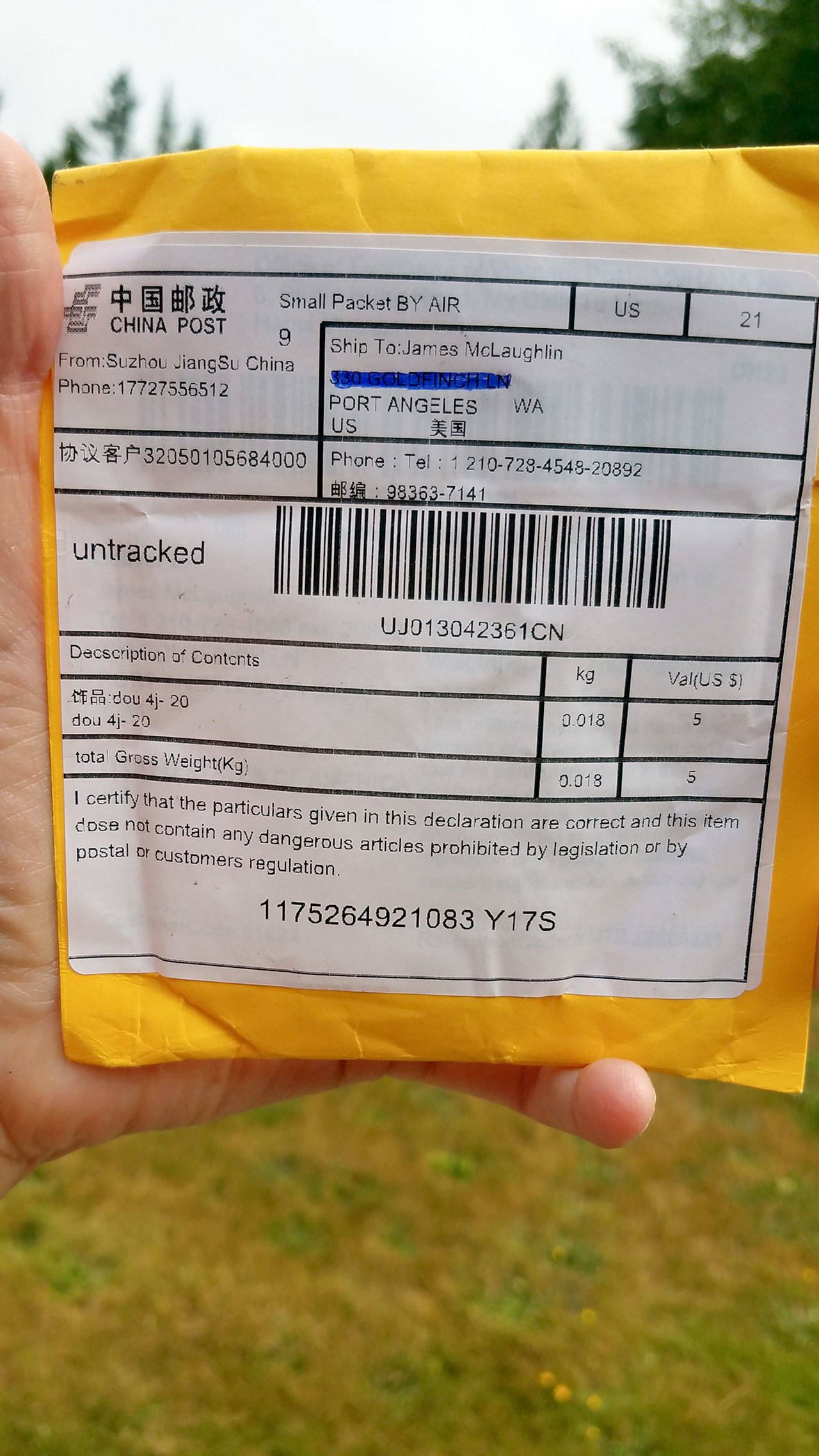
PORT ANGELES — When Jim McLaughlin handed the package of seeds last week to his wife, Ricki, she did a double take.
The McLaughlins have a garden, but the 3-inch-by-3-inch envelope he found in their mailbox came out of the blue, especially for a couple self-isolating during the COVID-19 pandemic.
They do a lot of online ordering, but China is not on their list.
“This looks like the seeds we’re not supposed to get from China,” she recalled saying.
“We had heard about the seeds.
“We did not order them at all.”
The Port Angeles couple became unwitting participants in what the U.S. Department of Agriculture said last week is a sweeping distribution of unwanted seed packets to U.S. addresses.
“USDA is aware that people across the country have received suspicious, unsolicited packages of seed that appear to be coming from China,” the agency said Friday on its website (https://tinyurl.com/PDN-ChinaSeeds).
“USDA’s Animal and Plant Health Inspection Service (APHIS) is working closely with the Department of Homeland Security’s Customs and Border Protection, other federal agencies, and state departments of agriculture to investigate the situation.”
The agency urges Washington state residents who receive the seeds to contact the state Department of Agriculture at 360-902-1907 or by email at www.agr.wa.gov.
“Please hold onto the seeds and packaging, including the mailing label, until someone from your State department of agriculture or APHIS contacts you with further instructions,” the USDA urges, adding a general warning:” Do not plant seeds from unknown origins.”
McLaughlin, 67, a retired special education teacher, said she contacted the state Department of Agriculture on Tuesday right after the package arrived.
The agency refers to what happened to the couple as “agricultural smuggling,” the Orlando, Fla., native said.
“They told me to hold onto it until you hear from us.”
The envelope was in the kitchen Friday, McLaughlin’s curiosity building about what was inside the package.
The return address is in Suzhou, the Jiangsu province, China, although the package spells it JiangSu.
The city west of Shanghai has a population of 10.7 million — and is known for its gardens, two of which are listed as world heritage sites.
The tightly sealed package looked like what other recipients have been receiving, McLaughlin said.
She suspects that someone may have hacked into the couple’s Amazon account because the package was addressed to her husband as James, which Amazon uses, not Jim, which he uses.
McLaughlin is in the at-risk population for COVID-19, and her husband have been self-isolating since Feb. 24.
They order everything they need online, driving to Walmart for groceries and wiping down the hatch of their vehicle after making pick-ups.
She’s been on a ventilator before — not from the coronavirus — and doesn’t want to go through that again, she said, although she feels safe with the package in her house even though she doesn’t know exactly what it contains.
McLaughlin is curious about what might happen if she planted the seeds.
The couple grows peas, beets, carrots, squash, pumpkins, tomatoes, “usually stuff that grows in Port Angeles,” she said.
“It could be a beanstalk that grows up to the sky,” McLaughlin quipped.
“All that’s going through my head.”
________
Senior Staff Writer Paul Gottlieb can be reached at 360-452-2345, ext. 55650, or at pgottlieb@peninsuladailynews.com.
