
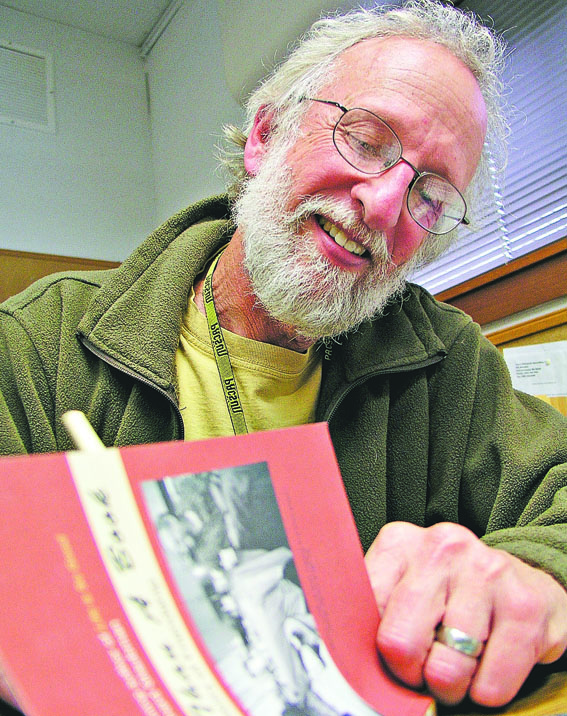
PORT TOWNSEND — Richard Glaubman is a P.E. teacher at Blue Heron Middle School — and a nationally known writer thanks to a twist of fate.
Glaubman is author of Life Is So Good, the story of George Dawson, grandson of a slave, illiterate until age 98, a man who lived through more than a century of this nation’s struggle and change.
In recent years, Glaubman has joined in discussions and presentations around the United States — but not in his hometown.
That changed this spring, when Life Is So Good was chosen as Port Townsend’s third annual Teen Community Read.
The Port Townsend Library distributed 400 free copies, hosted discussions and, this week, will round out the program with three public events.
A discussion of Life will be open to the public, Wednesday from 1 p.m. to 2 p.m. at the Library Learning Center, 1256 Lawrence St.
Then Glaubman will give two last presentations, Thursday from 9:40 a.m. to 10:30 a.m. and again from 11:10 a.m. to noon in the Port Townsend High School auditorium, 1500 Van Ness. The public is invited to those programs, too.
To find out more about the teen read, reserve a copy of Life Is So Good or learn about other library activities, see www.PTPublicLibrary.org or phone 360-385-3181.
Glaubman first learned of Dawson one Sunday while reading the newspaper with his wife, Jody.
“You’ve got to read this,” she said, handing him an article about Dawson’s celebrating his 100th birthday.
Dawson had worked on farms as a kid, and didn’t get to go to school until he was 98 and living in Dallas. He went to an adult education center there and learned to read.
Glaubman, a fourth-grade teacher at the time, showed the story to his students, then set it aside. But he couldn’t forget Dawson.
He decided to call the Dallas adult education center to inquire about the old man.
Within a few weeks, Glaubman had flown to Dallas, where he and Dawson spent days getting to know each other. Dawson eventually invited Glaubman to write his memoir.
Life Is So Good was published in 2000 by Random House.
Glaubman, when he’s had time off from teaching, has given presentations at book festivals and schools — including George Dawson Middle School in Southlake, Texas.
Dawson died in July 2001 at the age of 103.
But his story is alive in the pages of this book, told in his own Southern African-American dialect.
That’s how Glaubman wanted it: in Dawson’s voice, the way he recounted his stories of growing from boy to man.
The title reflects Dawson’s philosophy — although he had cause to not see things this way.
The book begins when Dawson as a 10-year-old witnesses the lynching of a 17-year-old boy for a crime he didn’t commit.
It’s 1908, and young George is about to make up his mind that all white people are cruel and hate-driven.
“Pete was still young. He should of grown to be a man,” George says to his father.
But Dawson’s father teaches him how to move through the world with respect for others, and what it means to be a man.
Other family members inspire him, too. Early on, Dawson’s great-grandma Sylvie tells him about the day she got news of the end of the Civil War. The Mississippi plantation owner she worked for, Master Lester, came out to the field.
“The Confederacy has lost the war,” he told the workers.
“Under the terms of our defeat, according to President Lincoln, slavery is abolished. You are free.”
Their former owner, however, cooked up a balance sheet showing Grandma Sylvie and her family owed money to his store — so they stayed on his farm and worked off the debt. It was 10 years before they left — to walk 100 miles to Marshall, Texas, where as freed slaves they were given 40 acres and a mule.
Dawson worked on his family’s farm and as a hired hand for white farmers. At age 12, he went to work, making about $1.15 a week.
That’s only the beginning of Dawson’s story — set against the backdrop of 100 years of American history and culture.
Across seven decades, Dawson trains horses, drives spikes for the railroads, builds levees on the Mississippi and works in a sawmill. Then, at the end of his life, he becomes a full-time student in Dallas.
“Life Is So Good is about character, soul and spirit . . . the pride in standing his ground is matched — maybe even exceeded — by the accomplishment of [Dawson’s] hard-won education,” a Washington Post critic wrote.
Jean-Marie Tarascio, youth services manager at the Port Townsend Library, agrees.
Life is “one of the most inspiring books I have ever read,” she said.
As it happens, Port Townsend’s teen librarian, the one who chooses the Teen Community Read title, is Jody Glaubman, Richard Glaubman’s wife.
Aware that observers might cry nepotism, she was reluctant to choose his book for the community read.
Tarascio, though, lobbied hard for Life.
“This is the library’s 100th anniversary,” she said. Tarascio believes Life, the story of man who lived to be 100 and then some, is exactly the right book.
“This man,” Dawson, she said, “has an incredible story to tell.”
During the last week of March, eighth-graders at Blue Heron and all students at Port Townsend High School were invited to participate in the Teen Community Read and given access to a free copy to keep.
The Port Townsend Library, located at Mountain View Commons at 1925 Blaine St., also has copies available for teens and adults to check out now.
And although the teen read concept started in 2011 with a two-year, $50,000 grant from the Paul Allen Foundation, this year is slimmer: First Federal provided a $1,000 grant, while the Friends of the Port Townsend Library added some funding for buying books.
Jody Glaubman, for her part, hopes teenagers will read and talk about the book with their parents and grandparents.
“This is American history that you probably won’t find in your history book,” she said. “Richard wanted [readers] to see history from a black man’s point of view, in Texas.
“It is really powerful.”
Features Editor Diane Urbani de la Paz can be reached at 360-452-2345, ext. 5062, or at diane.urbani@peninsuladailynews.com.
