
By Wyatt Anthony
Navy Public Affairs
SEQUIM — Today, Roy Carter lives at the Sherwood Assisted Living facility in Sequim and is looking forward to his 99th birthday in January.
But 77 years ago, Carter was serving aboard the battleship USS Oklahoma at Pearl Harbor when the Imperial Japanese Navy Air Service conducted one of the most damaging and deadly military attacks ever against the United States.
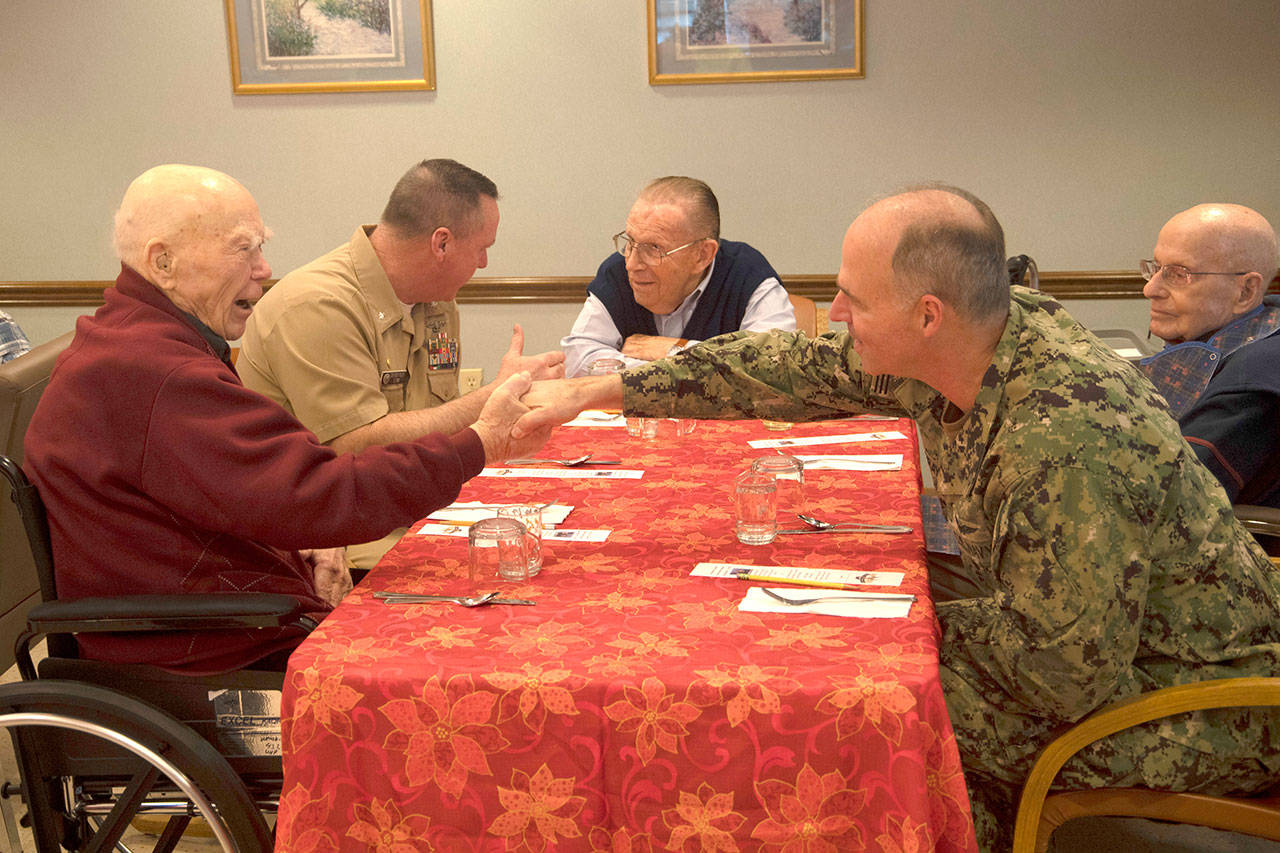
Sailors from Naval Magazine Indian Island and Naval Base Kitsap-Bangor traveled to Sequim on Friday to have lunch with veterans living at Sherwood Assisted Living in honor of Pearl Harbor Day.
Carter was among the residents there who sailors spoke with, and he shared vivid memories of that day and his naval career.
The attack
On Dec. 7, 1941, a day that President Franklin D. Roosevelt famously said will live in infamy, the surprise military strike at Naval Base Pearl Harbor-Hickam began a 7:48 a.m. Hawaii-Aleutian Standard Time and was over in two hours.
In that time, 2,403 Americans were killed and 1,178 others were wounded.
The attack was conducted by 353 Japanese aircraft launched in two waves from six aircraft carriers.
All eight U.S. Navy battleships on Battleship Row were damaged, with four being sunk.
All but the USS Arizona were later raised, with six being returned to service to fight in the war.
The attack also resulted in the sinking and damaging of three cruisers, three destroyers, an anti-aircraft training ship and a minelayer. The aircraft destroyed numbered 188.
Survivor in Sequim
Carter, serving aboard the Oklahoma that morning, was one of the lucky ones who escaped the surprise attack, not only with his life but also without serious injury.
Carter, who grew up in Iowa during the Great Depression, joined the Navy out of high school because there were no good paying jobs at that time.
“There were no jobs, whatsoever, so when I got out of high school I figured the best thing to do was to join the Navy and do something meaningful,” said Carter. “I certainly didn’t expect a great war to happen at that time.”
When he enlisted in the Navy, the pay for a seaman apprentice at the time was a mere $21 a month, but Carter said that $21 was more pay than any job back in his home state at the time.
Following boot camp, Carter was assigned to the Oklahoma, a 583-foot long, 27,900-ton Nevada class battleship that was the largest ship he had ever seen up to that point.
“When I first saw [Oklahoma] I just thought to myself, ‘That is a big boat,’ ” said Carter. “The biggest boat I had ever seen growing up in Iowa was a sailboat.”
Early life aboard Oklahoma for him was mostly spent swabbing the deck, painting and doing a lot of “grunt” work, but after several months he requested to be transferred to an opening in Oklahoma’s repair division.
His transfer request was accepted and Carter became a carpenter’s mate, whose main responsibilities included maintaining ship ventilation, watertight control, painting, drainage and damage control efforts.
Any other morning
Carter, a 2nd class petty officer at the time of Pearl Harbor, described the morning of Dec. 7 to be like any other morning aboard Oklahoma.
“On Dec. 7, I had been up, had breakfast and was in the [berthing] when the [1 Main Circuit] announced an air attack. We were ordered, ‘All hands man your battle stations.’ ”
Oklahoma was struck amidships by two torpedoes at 7:56 a.m. causing oil to spill from the fuel bunkers, but not penetrating the hull.
Four minutes later, a torpedo hit near the 65th frame, penetrating the hull. Carter describes the attack and the events that took place with a shaky voice.
“We were all surprised by the attack. I don’t think that I had time to be scared, I only had time to do my job,” said Carter. “I was manning my battle station on the third deck and running around trying to close [water-tight] hatches and doors.”
With torpedoes still striking Oklahoma, Carter was attempting to make his way out of the ship through darkness due to the electricity being out. At this time, the ship was starting to roll causing debris and unsecured items to fall over in the compartments.
As the exhaust trunk he crawled out of began to fill with water, Carter made it out of Oklahoma just as the ship rolled over to 90 degrees, but the centrifugal force of the trunk filling with water caused him to be pulled back under.
On rising from underneath the water again, Carter said that he was, “covered in oil from head to toe.”
As he began swimming away from Oklahoma, he could still hear the sounds of the Imperial Japanese in the skies above him.
“When I looked up there were still planes everywhere. They were circling high above Hickam Field and buzzing over very low as well,” said Carter. “All I could think was, ‘save yourself.’ ”
And save himself he did.
Carter was pulled aboard a motor launch that was on its way over to the submarine base.
While aboard the motor launch, Carter said that he saw the USS Arizona burning and exuding large plumes of black smoke.
After the motor launch arrived at the submarine base, Carter was scrubbed clean of the oil and spent the rest of the day there.
In all, Oklahoma was the second-most damaged battleship that day.
It had rolled over and capsized in 11 minutes, sustained nine torpedo hits, had 429 crew members killed in action and 32 crew members cut free from the hull.
Some men were not lucky enough to escape and perished underneath the waterline, trapped inside of water-tight compartments.
Next steps
After three months, Carter’s record was reviewed and he was offered the chance to receive flight training.
On his graduation from flight school, Roy was commissioned as an ensign and sent to Dunkeswell, England, where he flew 12-hour surveillance and submarine hunting missions in PB4Y-2 aircraft.
A profile in history, Carter went on to enjoy a lustrous 22-year naval career and retired as a lieutenant commander with 39 flight missions under his belt.
Petty Officer 2nd Class Wyatt Anthony is part of Navy Public Affairs Support Element, Detachment Northwest.
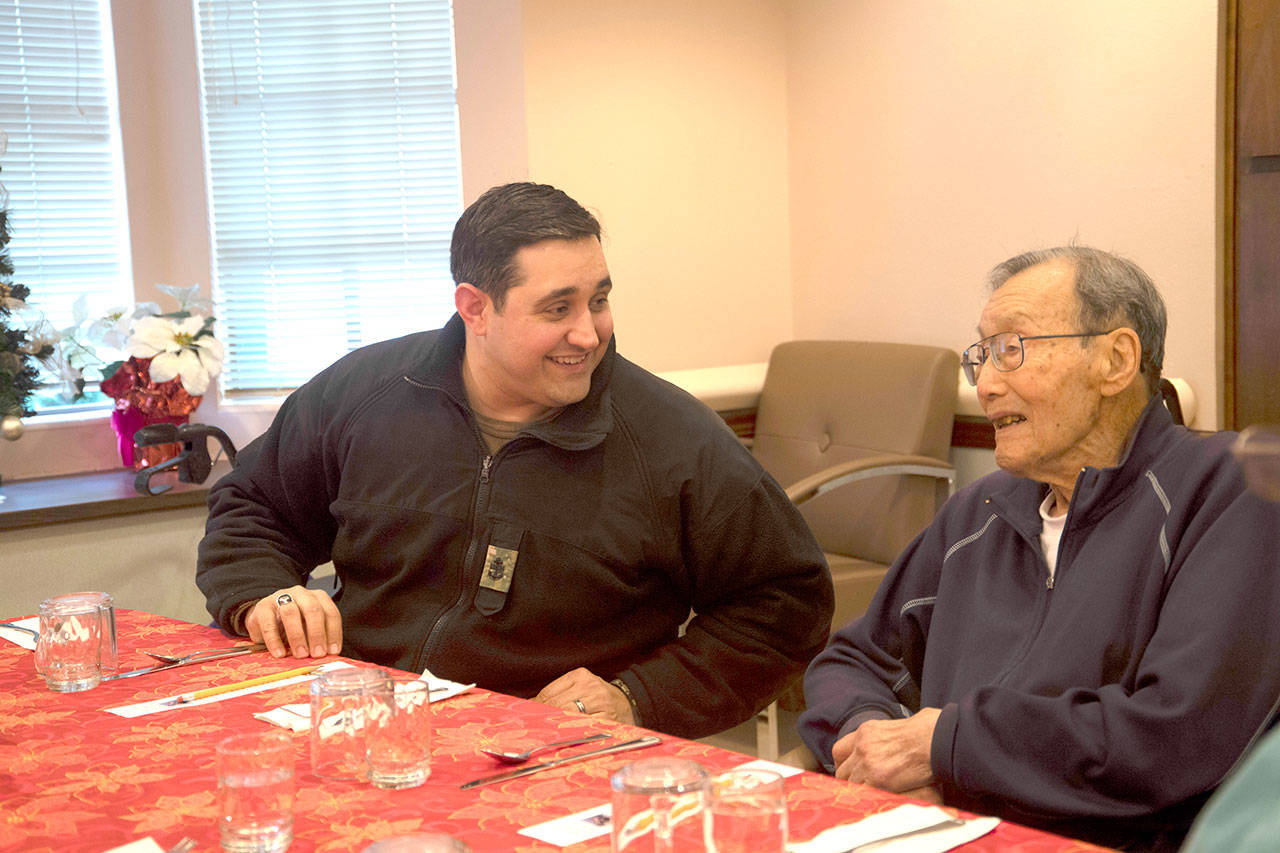
Chief Master at Arms Chris Noeth, a native of Camdenton, Mo., and assigned to Naval Magazine Indian Island, talks with veteran Richard Isawka, during a luncheon at the Sherwood Assisted Living facility. Sailors from Naval Magazine Indian Island and Naval Base Kitsap-Bangor traveled to Sequim to have lunch with veterans living in Sherwood Assisted Living in remembrance of Pearl Harbor. (Mass Communication Specialist 2nd Class Wyatt L. Anthony/U.S. Navy)
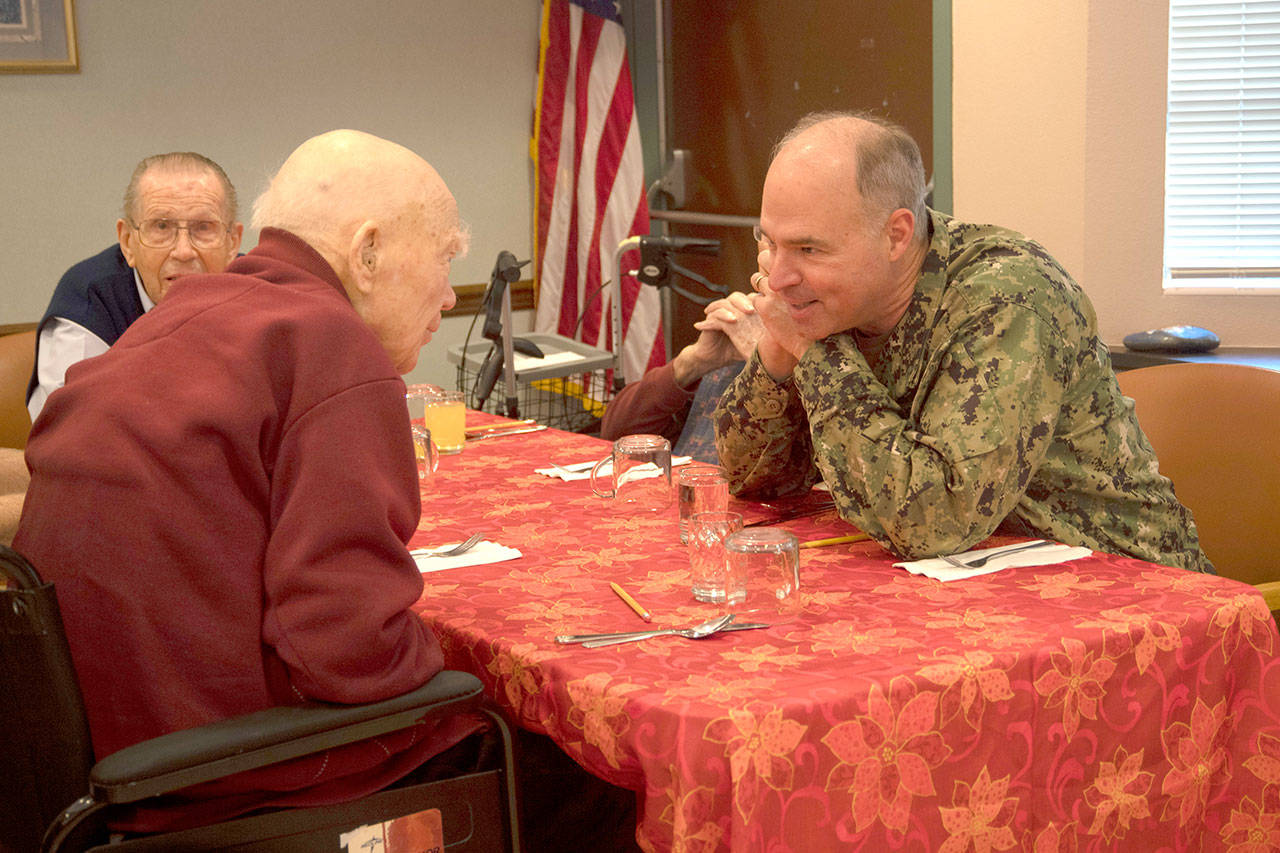
Rear Admiral Scott Gray, commander, Navy Region Northwest, talks with Roy Carter, a Navy veteran and survivor of Pearl Harbor, during a lunch with veterans at the Sherwood Assisted Living facility. (Mass Communication Specialist 2nd Class Wyatt L. Anthony/U.S. Navy)
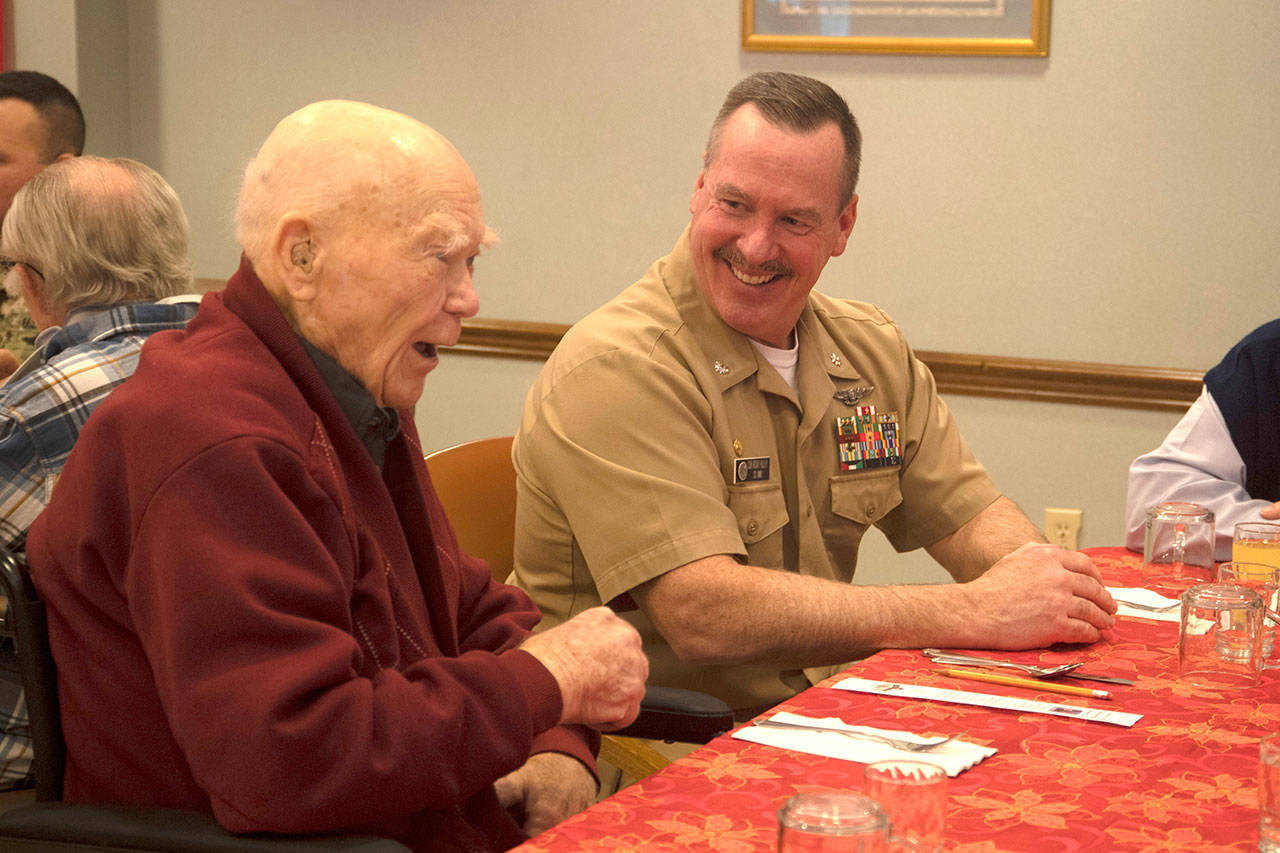
Cmdr. Rocky Pulley, commanding officer, Naval Magazine Indian Island, speaks with Roy Carter, a Navy veteran and survivor of Pearl Harbor, during a luncheon with veterans at the Sherwood Assisted Living facility. (Mass Communication Specialist 2nd Class Wyatt L. Anthony/U.S. Navy)
