
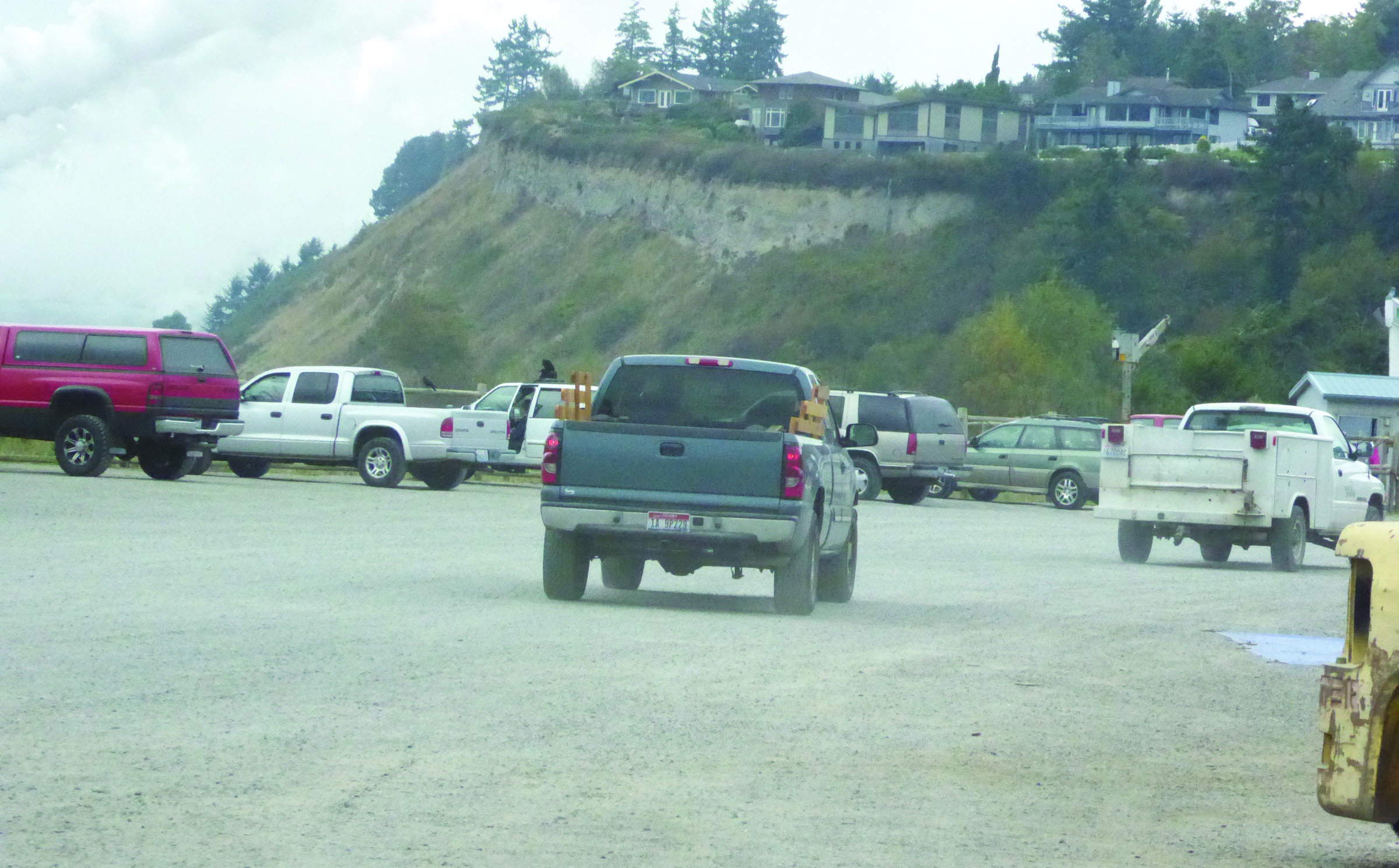
PORT TOWNSEND — Several Port of Port Townsend officials agree the Boat Haven has a dust problem, but they are divided as to what solutions will be the most effective and economical.
At issue is whether several acres in two portions of the Boat Haven — an area abutting the water on the south side of the port and a yard used for repair and storage of boats — should be paved or left covered with gravel.
Port management, along with commission chairman Steve Tucker, are opposed to paving because of the expense — an estimated $10 million — and the idea that the dust can be mitigated by treating the existing gravel surface with liquids and polymers.
Those who favor some version of paving as a serious option are Commissioner Brad Klinefelter and candidate Diana Talley, who is opposing Tucker in his bid for a second term in the Nov. 3 general election.
The topic has been a point of conversation during public comment at commissioner meetings and public comment periods since Clinefelter took office in January 2014.
Commissioners have taken no action on it.
The topic has emerged as a campaign issue between Tucker and Talley and is the subject of a letter-writing campaign by Mike Galmukoff, a former Boat Haven tenant.
He said that port management “is turning a deaf ear” on a problem.
Port Director Larry Crockett said paving the Boat Haven has “never been a front-burner idea,” and has no explanation for why it is surfacing now.
“We are spending too much time on a dumb idea,” he said of the plan.
“Toxic dust is not an issue. We’ve controlled it for years by spraying the yard with water and polymers that keep the dust in place,” Crockett said.
Each side says its solution is best for cleaning up toxic spills.
Crockett said that a toxic spill on gravel is easier to clean up while those on an asphalt surface “go right through and get into the stormwater system.”
His main objection is the cost, which an engineer estimated as about $8 million for paving; digging up and re-balancing the current surface could cost another $2 million, Crockett said.
Resurfacing all the gravel areas would take btween two and three years, he said, because it would have to be done in sections.
Galmukoff said he provided a list of grant sources to port management two years ago.
Crockett said that grant support is not available.
“There are grants for infrastructure that create jobs but this doesn’t qualify,” he said.
“This isn’t free money. Grants need to be matched.”
Crockett said the port doesn’t have the debt service to cover a $10 million loan. To do so would require the port to generate an additional $64,000 per month for 20 years.
Clinefelter acknowledges the high cost, but feels that paving the boat yard, or developing a plan to do so, is something the port can’t afford to not do.
“We really need to be thinking long term,” he said.
“We need to develop a plan that considers all the options. There are lots of new technologies that won’t be as expensive as you might think.”
Clinefelter said the dust situation in the yard could put the port out of compliance with expected new regulations from the state Department of Ecology.
He said that during high winds the dust is churned up and taken out to sea, spreading around any toxic materials that may have spilled.
The boat loader also crushes the substrate every time it goes through the yard which crushes down its level. That could create a long-term problem as global warming causes a rise in sea level, he said.
Galmukoff said that port management needs to consider different solutions, such as paving only the boat loader’s regular path.
“We can properly manage gravel,” Tucker said at a Sept. 21 forum.
“The contamination of the yards primarily come from spills, and if you have asphalt, it will go down the little hole, go into the groundwater and out to the bay.”
Tucker said a properly managed gravel yard can handle spills; the contaminated material is dug out and replaced with fresh gravel.
At the same forum, Talley said the Boat haven has a toxic dust problem.
“If you have a spill on gravel you need to move the boats, dig up the gravel and move them back, which takes a lot of time and costs a lot of money,” she said.
“If you pave the yard with a permeable surface and a slight slope, it will be easier to clean.”
Boat Haven tenant Tupper Griffith said he had mixed feelings about paving.
For his current project he needed to set the boat a little lower than it was and dug a small hole to accomplish this.
That wouldn’t have been possible on an asphalt surface.
“In the long run, it would be great,” he said.
“But in the short term, I want to keep the yard open and be able to bring my boat here.”
________
Jefferson County Editor Charlie Bermant can be reached at 360-385-2335 or cbermant@peninsuladailynews.com.
