
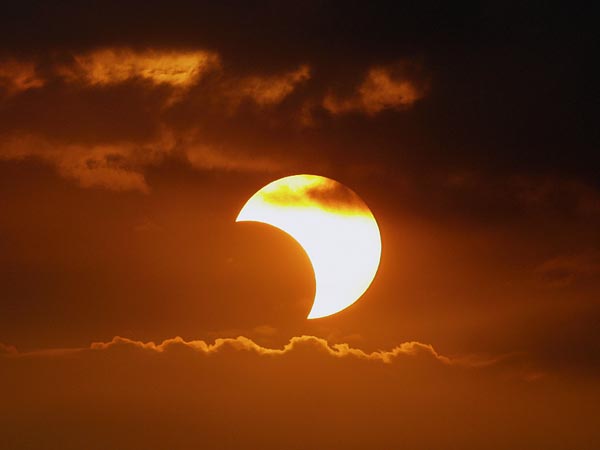
NORTH OLYMPIC PENINSULA residents get cosmic treats this week — the Orionids meteor shower followed by a partial eclipse of the sun Thursday afternoon.
The International Space Station, now carrying the six crew members of Expedition 41, is also in our evening skies.
■ Clouds permitting, look for the Orionids — up to 20 meteors an hour — streaming from the south late Monday night and early Tuesday morning.
There will be some Tuesday night and early Wednesday morning, too.
These shooting stars are produced by dust grains left behind by Halley’s Comet.
Striking Earth’s atmosphere at 148,000 mph, “meteors from the Orionids produce yellow and green colors and have been known to produce an odd fireball from time to time,” according to NASA’s website.
■ Thursday’s partial solar eclipse begins at 1:34 p.m. when the moon begins to move across the face of the sun.
Maximum eclipse is at 2:59 p.m., when almost 52 percent of the sun’s face will be covered.
The eclipse ends at 4:18 p.m., about two hours before the sun sets.
When watching any solar eclipse, do not observe it directly without protection.
This can cause permanent eye damage or blindness.
In some ways, a partial eclipse is the most dangerous to observe.
People naturally want to look at it, and this defeats our normal reflex to look away from the sun.
Sunglasses won’t work. Wear welder’s goggles rated 14 or higher.
The safest way to view a solar eclipse is by using a pinhole in a piece of cardboard to project the sun.
Punch a hole a couple of millimeters in diameter in the middle of a piece of cardboard, and tape it against a west-facing window.
This will project an image of the eclipsed sun on a wall that’s opposite.
Do not use binoculars or a telescope to view the sun unless you have a properly designed solar filter.
ISS fly-by tonight
■ Unless obscured by clouds, the International Space Station will be easy to see with the naked eye in our evening skies all this week.
One of the fly-bys will be a five-minute pass tonight (Sunday, Oct. 19) beginning at 7:01 p.m.
It will cross from west-northwest to east-northeast at a maximum height of 44 degrees.
The ISS is very bright and looks like a fast-moving plane — but it’s the size of a football field, dozens of times higher than any jet and thousands of miles an hour faster.
For exact times and locations in our sky, visit the ISS section of the NASA website, http://tinyurl.com/pdn-spacestation.
You can also sign up there for email alerts on local ISS fly-bys.
