
By Jeff Barnard
The Associated Press
GRANTS PASS, Ore. — When a fire filled the Cascade Range’s rugged canyons in southwestern Oregon with smoke in 2011, firefighters started thinking an unmanned aircraft might help them get a look beneath the cover that a conventional scout plane could not.
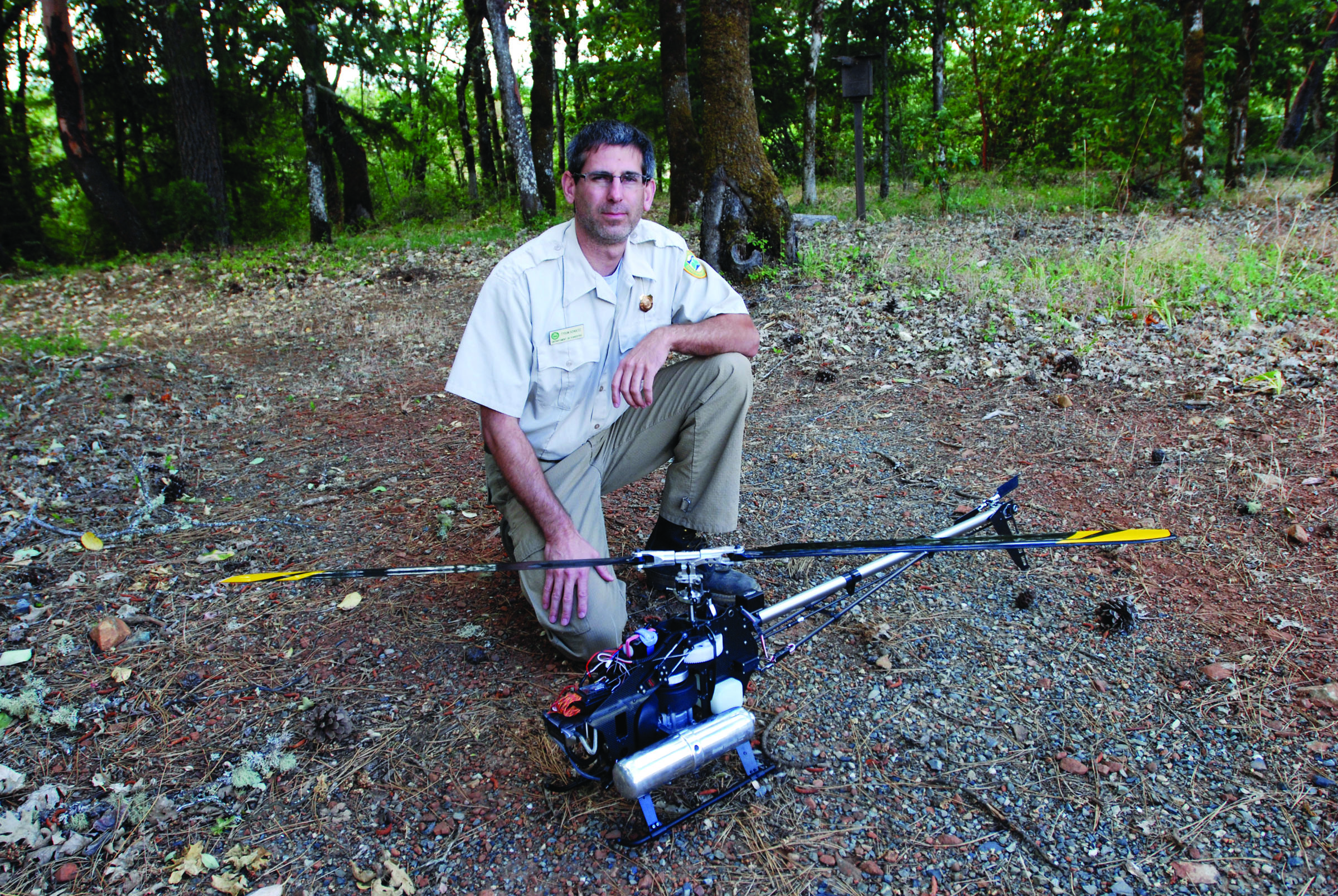
The state’s Department of Forestry will get the chance this summer to use a small remote-controlled helicopter equipped with video, infrared cameras and a GPS locator to get a better look in tight smoky places before incident commanders send in fire crews.
“You are always looking for improved visibility of your fire,” said department fire prevention specialist Brian Ballou. “It just cuts down on the unknowns.”
Covered by a federal grant, the off-the-shelf Century model G30 cost about $1,800.
The cost will total about $5,000 once it is outfitted it with video and infrared cameras, and GPS, said Tyson Shultz, a department stewardship forester assembling the craft and getting qualified to fly it.
It is only cleared by the Federal Aviation Administration to fly 400 above the ground, and the current gas tanks only allow it to be in the air for 30 minutes, though that can be extended.
At just five feet long, the helicopter is too small to take the place of manned aircraft that produce infrared maps, and drop water and fire retardant.
The hope is that it will fill a very specific niche in the constant demand for more and better information on a wildfire by providing easy access to an overhead view of places manned aircraft cannot go, Ballou said.
With privacy concerns dampening the enthusiasm over drones, Oregon is ahead of the curve in actually buying its own aircraft.
Firefighting agencies in Washington and Montana have not gone much beyond looking at the issue.
Cal Fire took advantage of a drone operated by the California National Guard on last summer’s massive Rim fire outside Yosemite, but has no plans to get its own.
Alaska used one on a fire this year that the University of Alaska Fairbanks flies as part of the FAA’s evaluation of how to integrate unmanned aircraft into U.S. airspace.
The National Institute of Standards and Technology has been using drones to gather data to feed into wildfire behavior computer models.
The U.S. Forest Service, the nation’s biggest wildfire-fighting agency, has been actively evaluating NASA drones on wildfires since 2007, but is taking a slow and cautious approach, carefully considering a range of issues, including privacy, costs and ownership.
“A lot of people are jumping to conclusions that we should or shouldn’t use unmanned aircraft,” said Bob Roth, an aviation management specialist with the U.S. Forest Service who is leading an evaluation of the future use of unmanned aircraft systems by the agency.
The panel’s conclusions may be ready next year.
“The value-added or benefit it is providing to a fire is really the imagery. The same camera could be put on a manned aircraft just the same as you put it on a manned aircraft,” Roth said.
A manned aircraft just can’t fly in zero-visibility conditions like a drone can, said Marty Rogers, director of the University of Alaska Fairbanks Center for Unmanned Aircraft Systems Integration.
He took a team to fly the center’s Scan Eagle drone to the Funny River fire on the Kenai Peninsula last month.
And if you buy used, drones are cheaper, though operational costs may be higher due to the numbers of people currently needed to operate them, he added.
“I tell people if the job is dull, dirty or dangerous, it probably is good for unmanned aircraft,” he said.
The Forest Service and Cal Fire both got a good look at just what a drone can do in real world conditions on last summer’s Rim fire, which burned 400 square miles on the outskirts of Yosemite National Park.
The fire was moving fast on four different fronts, so that infrared aerial maps produced the night before by manned aircraft were out of date, said Mike Wilkins, a district ranger on the Nantahala National Forest in North Carolina and incident commander on an interagency team called in to fight the Rim fire.
The drone was able to fly high overhead for long hours at a stretch and quickly turn its high resolution video and infrared cameras on a remote location where it would take hours to send in people on the ground.
At one point, it verified flames had slopped over a line, so crews were dispatched, stopping it before it threatened a populated area.
The crew also tested the drone as a communications platform, carrying aloft repeaters to extend the range of radios on the ground.
“It’s not going to be needed on a routine fire,” said Wilkins. “But (it could be helpful) on these bigger, faster fires that just keep growing on you.
“I think all agencies think we need a little more testing. And it has some potential to keep people safe.”
