
By Michael Dashiell
Olympic Peninsula News Group
SEQUIM — Call it a reprieve in a storm of controversy.
While the release of thousands of Atlantic salmon from a fish farm near Cypress Island on Aug. 19 has prompted the postponement of an upcoming public hearing about Cooke Aquaculture’s plans to build a fish farm near Port Angeles, Peninsula residents opposing the project seem convinced the incident merely delays the business’ efforts.
Clallam County officials have indefinitely postponed a Sept. 7 hearing on the net-pen project 1.8 miles north of Morse Creek after Cooke officials requested the delay Monday, said Steve Gray, planning manager for the county Department of Community Development.
“We don’t want them to open this in six months after this [fish release incident] dies down,” said Chris Wilke, executive director of Puget Soundkeeper Alliance.
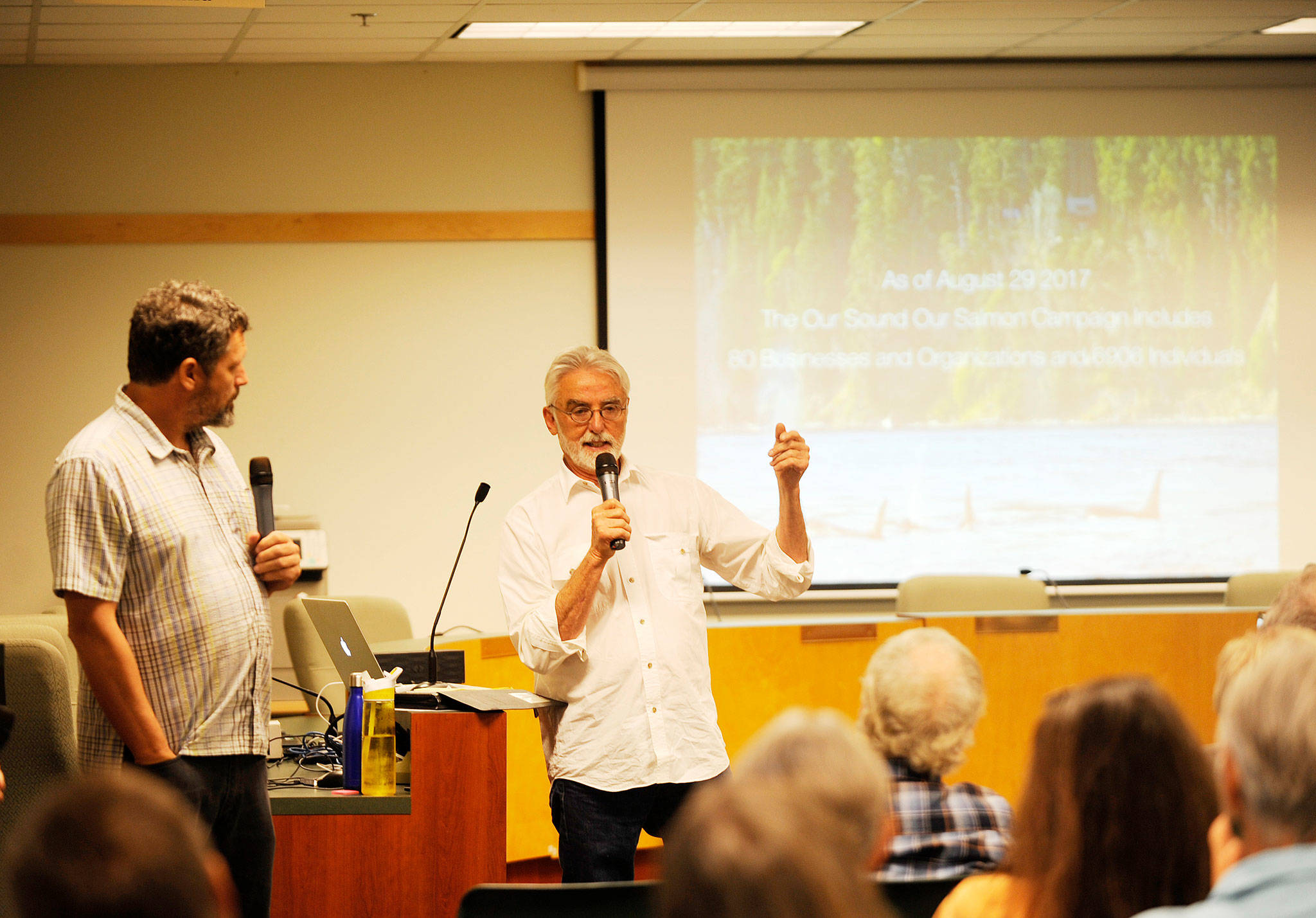
Wilke and Kurt Beardslee, executive director of Wild Fish Conservancy, joined about 90 residents in Sequim on Tuesday to talk about the environmental impacts of Atlantic salmon net pens.
Hosted by the Sierra Club North Olympic Group, Tuesday’s meeting was spurred by Cooke’s proposed $9 million project that would replace Cooke net pens off Ediz Hook. The farm is being removed to make way for the Navy’s construction of a 425-foot pier and trestle at the U.S. Coast Guard base at Ediz Hook.
“The [Navy] project will have a negative impact on the farm, on fish health and on the health and safety of our people,” Nell Halse, vice president of communications for Cooke, told SeafoodSource.com in April. “Remaining at the existing site at current scale is not feasible due to risks associated with nearby Navy operations. We need a safe location for this farm.”
Wilke, who gave an overview of the variety of salmon in Western Washington waterways at the Sequim meeting Tuesday, said the Atlantic salmon that Cooke Aquaculture and other industry businesses use in fish net pens are on average less aggressive and grow faster and more efficiently than Pacific salmon.
Atlantic salmon have been found to have higher levels of polychlorinated biphenyls (PCBs), Wilke said. Critics of similar projects also said fish farms act as a kind of unnatural reservoir for parasite populations such as sea lice, which can harm both farmed and wild salmon alike.
“There is nothing wrong with the Atlantic salmon,” Wilke said. “[But] it should be swimming in Norway and Scotland and Maine. They are not suited to our environment.”
Disease brought about by fish pens can be detrimental to runs of Pacific salmon in local waters, he said.
Case in point: In 2012, infectious hematopoietic necrosis virus (IHNV) swept through Icicle Seafoods pens off Bainbridge Island. To control the disease, the company slaughtered and sold the fish (the disease was found not to be dangerous to humans) and moved the pens.
“We don’t need Atlantic salmon here,” Wilke said.
Although California and Alaska have banned fish farms and they are basically non-existent in Oregon, Beardslee said, the Puget Sound area has a number of fish farm pens like Cooke’s — including three on the south end of Bainbridge Island. Meanwhile, British Columbia has more than 70 salmon aquaculture operations.
“They [Cooke and businesses like them] are here. They mean business and they mean to expand,” Beardslee said. “As soon as one gets approved in the Strait [of Juan de Fuca], the whole strait is going to open up.”
“It isn’t Cooke’s hearing; this is the public’s hearing,” Beardslee said. “This is our salmon. This is our sound.”
Despite needing 10 authorizations or permits from state agencies such as the Department of Natural Resources and Department of Ecology, that kind of oversight hasn’t helped with deterring fish pen projects in the past, Beardslee noted.
“All this oversight doesn’t turn out to be what you think it would be; it’s more recommendations, not regulations,” he said.
A prime example is Bainbridge Island, he said, where two of that region’s three sets of fish farm pens are located, at the eastern periphery of the Orchard Rocks Conservation Area.
“These are places we’ve decided as a society we want to protect,” Beardslee said. “And we drop net pens in the middle of them.
“Something is broken.”
There are alternatives to fish net pens, Beardslee said, such as land-based facilities raising Atlantic salmon that companies such as Kuterra (Northern Vancouver Island) and Sustainable Blue (Nova Scotia) utilize. While the salmon costs more to the consumer — about $2 per pound more, he said — the practice cuts out the danger to wild salmon.
On Aug. 19, thousands of farmed Atlantic salmon accidentally were released into the waters between Anacortes and the San Juan Islands, the results of a damaged net pen holding 305,000 fish at a Cooke Aquaculture fish farm near Cypress Island.
The net-pen breach was followed by a moratorium on state permits for new salmon farms that Gov. Jay Inslee announced last Saturday.
“We still felt it was important to have the meeting, to address the issue,” said Darlene Schanfald, vice chair of the Sierra Club North Olympic Group.
James Karr of Sequim, retired University of Washington aquatic sciences and biology professor, asked the crowd to consider other wildlife that may be affected by fish net pen practices.
“We’re doing a disservice to future generations,” he said.
Sequim resident Greg Madsen noted that a group of First Nations leaders and activists are occupying a salmon farm on Swanson Island just off of North Vancouver Island, calling on federal and provincial governments to put an end open-net fish farming on the Pacific coast.
“Write your letters, but I think they have the idea,” he said.
________
Michael Dashiell is the editor of the Sequim Gazette of the Olympic Peninsula News Group, which also is composed of other Sound Publishing newspapers Peninsula Daily News and Forks Forum. Reach him at editor@sequimgazette.com.
