
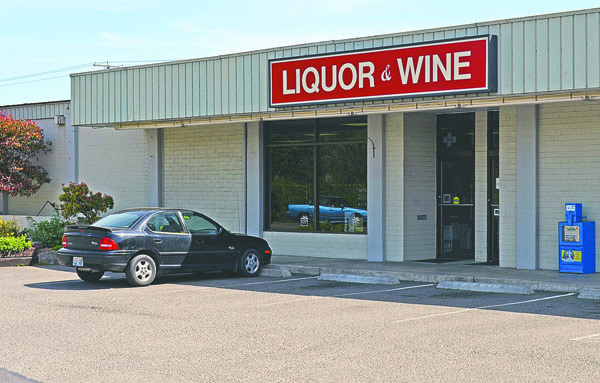
The representative of a man who bought eight liquor licenses from the state this year and then closed the operations — including two on the North Olympic Peninsula — blamed a flawed transfer process for his financial losses, while a Washington State Liquor Board spokesman said the process was outlined in the initiative voters approved last year.
Kulbir Singh of Brazil, Ind., shuttered the Port Townsend Liquor Store at 2005 W. Sims Way last week and the Sequim store, at 1400 Washington St., in August.
In addition to those two stores, Singh also closed his six other Washington businesses in Federal Way, Renton, Tacoma, Bellevue, Oak Harbor and Spokane, said Byron Roselli, a Vancouver, Wash.-based real estate developer who worked with Singh on the purchases.
Singh, who paid $1.4 million at auction for the licenses, including $63,200 for the Sequim license and $54,900 for the Port Townsend license, invested another $3.5 million into the ventures, said Roselli, who said Singh authorized him to speak on his behalf.
Singh, an Indian immigrant, has been ruined financially, Roselli said. “He lost his life savings. He borrowed money from everywhere to raise the funds.
“He borrowed from his family, and with some of the leases, he was forced to make a personal guarantee, for which he is now liable,” Roselli said.
Voters last fall approved Initiative 1183, which led to the state’s dismantling its liquor business.
The privatization resulted in liquor’s availability in supermarkets and other stores when previously its sale was restricted to small state-run stores whose number was determined by the size of the local population.
While competition from larger stores was expected, those taking over local stores saw a potential for profit.
“People who entered into these auctions saw it as a great business opportunity,” Roselli said.
“But all the regulations and restrictions made it very difficult for them to succeed,” he added.
The buyer of the former state liquor store in Port Angeles said business has been good, though not as good as he had expected.
“When we took over our store, we did not have the inventory we expected, so we had to go out and buy it at a higher price,” said Abi Eshagi of Woodinville, who paid $125,100 for the license for the store at 1331 E. Front St.
“This made it hard for us to compete against the large stores, who were already selling liquor at a lower price, and by the time we took possession of the stores, the state had already driven the business into the ground.”
He is moving the store to 116 Race St. in mid-November.
Both Roselli and Eshagi criticized the 17 percent tax they must charge on each sale, saying it put the smaller stores at a greater disadvantage.
But, said Brian Smith, spokesman for the Washington State Liquor Control Board, “the 17 percent tax was in the language of the initiative, so it shouldn’t be a surprise to anyone.”
“That tax, which the voters approved,” he said, “is the main reason why the cost of liquor went up significantly on June 1.”
Smith said a bill modifying the 17 percent tax, along with an additional 10 percent distributor tax, could be introduced during the upcoming legislative session, which will begin in January.
As for the inventory, Smith said the price was measured by what was in stock in April. That it changed was no fault of the state.
“A lot of people stocked up during April and May because they knew the prices were going up,” he said.
“In cases where there was a depleted inventory, we gave the store owners credit.”
Roselli said myriad rules and requirements made it impossible for independent liquor stores to compete with supermarkets and that the situation was not a level playing field.
The pressure to open by June 1 meant there was little time to negotiate leases with current landlords, he said.
The uncertainty also caused some employees to find other jobs, which forced stores to close because no could be hired until the deal was finished, Roselli said.
That closure caused customers to change their shopping habits, he said. They began purchasing liquor elsewhere and did not return once the stores reopened in June.
The auction winners also were led to believe that the point-of-sale systems [cash registers] were operational, but that was not the case, requiring more money, Roselli said.
Worst of all, he said, was the loss of Class H business, in which local liquor stores would supply local bars and restaurants.
Investors created their business plans based on Class H projections, and when they fell through, the impact was devastating, he said.
“They signed these leases based on having the Class H business. They’d lease a certain amount of space for retail, and a larger area in the back for overstock and Class H business,” Roselli said.
“When the Class H business fell through, they were left with large spaces they couldn’t use and could not renegotiate the leases,” he said.
Roselli said of the 160 state liquor stores that were auctioned off “100 of them are either closed or will close very soon.”
Smith disagreed, saying that business owners could renegotiate their leases once they had occupied the space and could move to another site as long as it was within a mile of the original location.
Smith said that he recognized how difficult it was for small stores to compete and believes that a legislative solution could level things out.
At the same time, he said, all the new rules were spelled out in the initiative.
“It was a whole new world for them,” Smith said.
“There was lot of competition for them that wasn’t there before, but they knew that it was a business, and it was up to them to make it on their own.”
Jefferson County Reporter Charlie Bermant can be reached at 360-385-2335 or at charlie.bermant@peninsuladailynews.com.
