
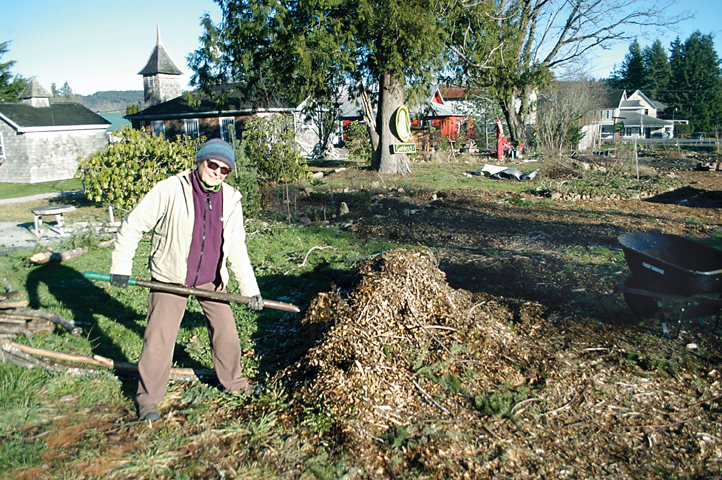
QUILCENE — Just as a seed grows into a mighty tree, Quilcene Gardens since being founded about three years ago has grown into a thriving destination replete with delicious fruits and vegetables tended by the caring hands of volunteers.
When the first seeds were sown, “we had no idea” the garden would be successful, Anne Ricker, owner and executive director of Quilcene Gardens, said last week.
“We did not have a clue that anybody even cared. We were doing this just to see if we could.”
Quilcene Gardens, referred to by locals as “Q Gardens,” is located at 71 Old Church Road.
With a goal of “feeding the world,” Q Gardens last year donated hundreds of pounds of food to the Quilcene Food Bank, Ricker said.
Although the garden lies dormant for the winter at present, in warmer weather it produces kale, chard, cucumbers, squash, tomatoes, tomatillos, leeks, artichokes, apples, peaches, pears, kiwis, cherries, figs and assorted berries, Ricker said.
“We’ve got a lot of things,” she said.
Residents are welcome to come by at any time and pick fruits and veggies for themselves free of charge, but with the caveat they perform a few chores in return, Ricker said.
“We don’t care who takes what,” she said.
“But, you have to pull some weeds. If you are going to take a handful of tomatoes, that is fine, but weed around the plant where you picked them,” Ricker said.
“If you are hungry, you can have anything in here. And people do. There is almost always somebody here.”
Ricker and community volunteers are busy getting the gardens ready for spring planting, installing a windmill to pump water, placing solar panels to power lighting and building a greenhouse and storage shed.
The windmill “is going to be 16 feet tall and about 9 feet wide,” Ricker said.
The windmill will be painted by children living in and around Quilcene, she said.
The solar panels will charge 12-volt batteries, “and we will be able to light everything,” she said.
Come spring, various sculptures will be placed out in the garden, Ricker said.
Currently, the sculptures are in storage to prevent them from becoming damaged during the inclement winter months, Ricker said.
“We are going to have a sculpture garden when the winds stop blowing,” she said.
Ricker and her volunteers also are going to construct a pavilion with an outdoor cooking space on the southern portion of the property that will be used to host cooking classes using fresh produce grown in the garden, Ricker said.
Most everything is being built with recycled materials, she said.
Even the pathways are recycled.
Volunteers are in the process of placing recycled cardboard on the bare dirt and covering it with wood chips to prevent the growth of weeds, which become a real menace during the spring and summer, Ricker said.
Ricker is in need of additional volunteers to prep the garden for spring, she said.
“We need a couple of people to help us build the greenhouse and a storage shed so everything doesn’t have to sit outside,” she said.
“We are just doing cleanup and preparing to start things and pruning and getting ready to build. We are going to improve on what we have and do a couple more [grow] beds.”
For Ricker, beautifying her little corner of Quilcene began in 1989 when she purchased the once decrepit Old Church northeast of the Q Gardens and began restoration efforts.
Now restored, the Old Church is the home base for the Quilcene Artists Collaborative, known by the acronym QuACK.
The arts organization works with schools to bring art into everyday rural life.
Then three years ago, Ricker purchased a one-acre plot to the southeast of the church, known as “John’s Gift,” with $30,000 donated by Madelyn Pitts of Leland and the remainder of the balance placed on Ricker’s charge card, she said.
Then came the hard work.
“We put in a lot of time,” Ricker said.
“It was really hard to make these gardens.”
When Ricker first bought the property, it was flat and had no contours, she said.
It has since been made into a raised-bed organic garden as a memorial to Pitt’s deceased husband, John Pitts, an avid organic gardener who also served as a Jefferson County commissioner and was a veterinarian.
Also installed were two rain gardens, one in open sunlight and the second beneath the shade of a maple tree.
The rain gardens are fed by manmade channels that meander through the property, Ricker said.
Rain is “caught on the roof” of nearby buildings, and “comes down into the tank” and down into the rain gardens, Ricker said.
“A lot of rain is polluted, and if it comes off a roof it is really polluted, so you can’t use it for anything you are going to eat,” she said.
But the water can be used to irrigate the inedible plants and flowers in the rain gardens, she said.
Capturing rain water and using recycled materials to construct the garden’s infrastructure is all part of efforts to “go green” while pursuing the practice of being self-reliant, Ricker said.
Since the Q Gardens are “in the middle of nowhere, we thought it would be a good idea to show people how to be careful about their own health and the health of the land,” she said.
Part of that will be to teach the youngest residents the importance of agriculture by working with Quilcene Elementary School, Ricker said.
“This year, we want to . . . have a much closer relationship with the school,” she said.
When children learn that seeds become food, they “are just bowled over by the whole thing,” Ricker said.
“It is wonderful. For every kid you do that with, there is a ripple [effect] for generations.”
For more information about Q Gardens, visit quilcenegardens.com.
________
Sequim-Dungeness Valley Editor Chris McDaniel can be reached at 360-681-2390, ext. 5052, or cmcdaniel@peninsuladailynews.com.
