
PORT ANGELES — You don’t have to travel to Seattle to get first-class cancer care, an Olympic Medical Center radiation oncologist told hospital commissioners last week.
“I would hate to think somebody went to Seattle and spent all that time, money and effort to get radiation therapy when they can get something just as good, if not better, right here,” said Dr. Rena Zimmerman in a May 16 presentation.
“There’s no reason for 99 percent of radiation therapy to go any further than Sequim.”
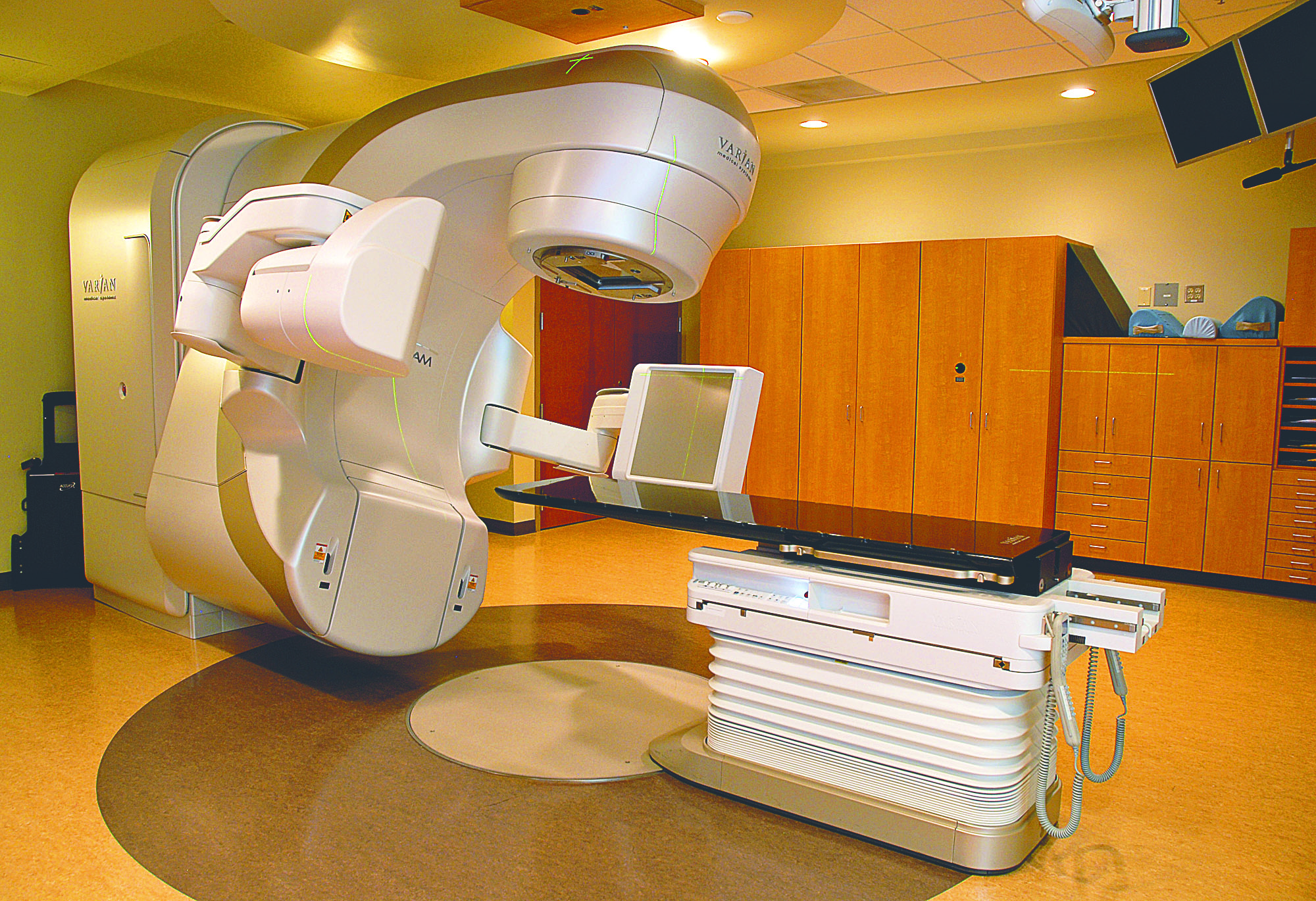
OMC has launched a stereotactic radiosurgery program at the Olympic Medical Cancer Center in Sequim, which boasts a state-of-the-art $2.7 million linear accelerator that is capable of delivering high doses of cancer-killing radiation with submillimeter precision.
“The patients are incredibly awestruck by what we have,” Zimmerman said. “Everybody is credentialed, everybody is trained, and we do absolutely nothing without making sure it is safe for the patient.”
Chief Executive Officer Eric Lewis added: “I think one of the strengths of our current service is patient safety and quality of care.”
When OMC debuted its Varian TrueBeam linear accelerator in April 2011, it was the only one of its kind in the Pacific Northwest.
Other Northwest hospitals have since purchased TrueBeams but have yet to install them.
‘Ahead of the curve’
“It’s been a real learning experience being ahead of the curve like that,” Zimmerman said.
“When we talked about getting a new accelerator, one of the things we wanted to be able to do was offer this new modality in radiation oncology called stereotactic therapy,” Zimmerman said.
“It goes by a couple different names; maybe the most common now might be ablated radiation therapy, but the billers don’t use that, so we’re stuck with the SRS [stereotactic radiosurgery] and SBRT [stereotactic body radiation therapy].”
Using the standard practice of protracted fractionation, a patient with a small lung cancer, for example, had to go in for radiation treatment Mondays through Fridays over a period of about seven weeks.
“We had to be very careful not to overdose the critical structures that were around that cancer,” Zimmerman said.
“And our technology at that point only allowed it to hit that spot with a pretty big margin on it,” she continued.
“That margin often included areas that we really didn’t want to give radiation to, but we couldn’t help it.”
Four or five treatments
Stereotactic radiosurgery can remove the same cancer in four or five treatments. When done right, it leaves the cells around the tumor intact.
“It has to be completely delineated by the physicians using modern imaging,” Zimmerman said.
“It is a very short course, but the amount that you give per time that you treat the patient is very high.”
The machine rotates around the patient while radiation is delivered from multiple angles.
“This is potentially very effective,” Zimmerman said.
“Curative, actually. It is also, you can image, potentially extremely dangerous.”
Zimmerman displayed a cautionary slide showing a man with a hole in his back after he received high-dose radiation treatment at another hospital.
Zimmerman mentioned articles published in The New York Times about stereotactic radiosurgery gone wrong.
“You really, really, really have to pay attention to what you’re doing, and that’s why it took us awhile to get this off the ground,” Zimmerman said.
“There are a number of places that have done this and not done it necessarily very well.”
“When you do just a few beams, you burn holes in people. That’s how high this dose is. You will never see something like this here.”
OMC recently purchased an Aktina immobilization device that restricts movement of the head or body, depending on the cancer being targeted.
Measurements for the linear accelerator are tested on “phantom” dummies and repeatedly checked for accuracy before delivering any radiation to a patient.
“When you are doing a stereotactic program, you want to make sure that the calculations you have done are absolutely 100 percent accurate,” Zimmerman said.
OMC program
OMC opened its stereotactic radiosurgery program last month.
Three patients have been treated.
“I’m happy to say everything went extremely well,” Zimmerman said, adding that the motion on the first patient was 0.01 millimeters.
“We couldn’t have done this without the [immobilization] device,” she added.
“We clearly couldn’t have done it without the accelerator.”
Lewis thanked the Olympic Medical Center Foundation for helping the public hospital district pay for the linear accelerator.
“I think when a person gets cancer, we should give them the best possible care,” Lewis said.
“As state-of-the-art the equipment is and as great a building as we have, the biggest thing why our cancer center is great is our physicians, our RNs, our other caregivers, our techs, our support people, our physicists.
“We have an amazing team of people,” Lewis added.
“Ultimately, the people make the difference, and it’s making a difference for our patients that have cancer.”
________
Reporter Rob Ollikainen can be reached at 360-452-2345, ext. 5072, or at rob.ollikainen@peninsuladailynews.com.
