
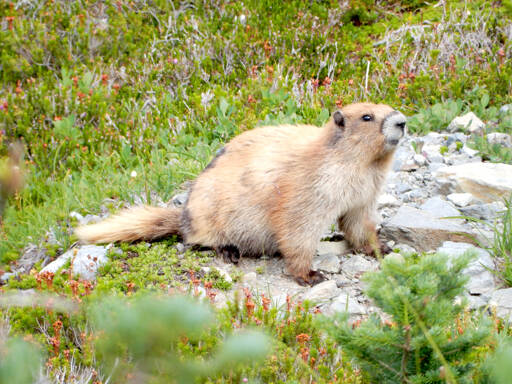
The Olympic marmot is being considered for the endangered species list, the U.S. Department of Fish and Wildlife Service has announced.
“Based on our review of the petition and readily available information regarding habitat loss and fragmentation and predation by coyotes, we find that the petition presents substantial scientific or commercial information indicating that listing the Olympic marmot as a threatened or an endangered species may be warranted,” the agency (USFWS) wrote in a document, which contained 10 species marked as warranting a full review.
The marmot, the state’s official endemic animal, began to see declines in their population in the 1990s and early 2000s and are now estimated to have a population of 2,000 to 4,000, according to a devoted Olympic National Park (ONP) webpage.
They are only found in the alpine and subalpine meadows of the Olympic Mountains, mostly above 4,000 feet.
“As trees keep moving uphill because it’s warmer and more suitable for them, that runs the risk of having them overrun the meadows and fragmenting that habitat, wiping it out,” said Aaron Kunkler, a media specialist with the Center for Biological Diversity (CBD). “Since the marmots are already at the top of the mountain, there’s not really anywhere for them to go.”
With non-native coyotes providing the other main threat to the marmots, reintroducing wolves to the Olympic Peninsula could prove helpful to protecting the small rodents, said John Bridge, president of Olympic Park Advocates.
Wolves do not tend to hunt at alpine elevations and would control the coyote populations, which roam from lowland to alpine elevations, he added.
Kunkler agreed that wolves could be a boon for stabilizing marmot populations.
“Nuzzling, playing, chirping, feeding together; the Olympic marmot is quite possibly one of the most social and gregarious mammals on the peninsula,” according to the ONP webpage.
They have bushy tales. They communicate by whistling loudly. Families of one adult male, one or more adult females and several cohorts of young share home ranges of one-half to 5 acres. They dig burrow systems to live in.
About the size of a house cat and weighing 15 pounds or more before they enter hibernation in the fall, the marmots hibernate for up to eight months out of the year, according to the webpage.
“I would encourage folks, in the spring, when the snow melts and the meadows start coming back, to go up and see the marmots,” Kunkler said. “They come out of hibernation. They’re adorable. You can hear their whistles echoing around the meadows.”
The petition to list the marmot was submitted by the CBD in May 2024.
The Endangered Species Act requires the USFWS to publish initial findings within 90 days of the submission. If the agency finds that a species warrants a full review, it is required to make a final judgment within 12 months of a petition.
“USFWS has already missed both deadlines,” Kunkler wrote.
CBD filed a lawsuit against the agency in October of last year.
The failure to meet the 90-day deadline is somewhat uncommon, Kunkler said, but species warranting the 12-month review often remain in limbo for years.
The USFWS announcing the marmot entering the full review satisfied the desired outcomes of CBD’s lawsuit, Kunkler said.
Since Fish and Wildlife already has passed the 12-month deadline, CBD is likely to sue again within the next several months, at which point the agency will likely be compelled to submit a deadline for a final decision on the marmot’s inclusion or exclusion from the list, he added.
“We’ll probably be back in court,” Kunkler said. “Probably, it’ll be several more years before (the final judgment) happens, but we’re just trying to keep the ball moving.”
The federal government has been extremely unfriendly toward imperiled species under President Donald Trump, Kunkler said.
During Trump’s first term, only 25 species were protected, a record low for any administration up until that time, Kunkler said. Since Trump began his second administration, zero species have received the protections available through the Endangered Species Act.
Bridge, who calls himself a marmoteer, has been participating in Olympic National Park’s volunteer monitoring program since it began about 13 years ago.
Every year, he and a group of hiking buddies receive specific survey locations, GPS units and designated monitoring areas from Olympic National Park.
Bridge has gotten to know marmots through his outings.
“Through that program where we’re surveying for marmots, I’ve gotten to recognize their burrows and the trails that they put in,” he added. “I think that they like lupin more than anything else, but I also see them eating lots of other plants.”
Seeing the marmots listed as endangered would help policymakers think more seriously about how climate change is affecting alpine species and what actions might still be possible to protect them, Bridge said.
To learn more about the Olympic marmot, visit tinyurl.com/mrdxuy5v.
To learn about how to participate in ONP’s volunteer monitoring program, visit tinyurl.com/s6csyaj3. Applications for this summer are open now.
________
Reporter Elijah Sussman can be reached by email at elijah.sussman@peninsuladailynews.com.
