
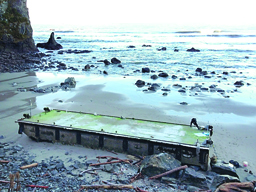
LAPUSH — Officials are seeking funding to pay a private contractor to remove a 64-foot concrete and steel dock that washed ashore on a remote beach in Olympic National Park.
The dock, cleared last Thursday and Friday of between 30 and 50 species native to Japan, is thought to be a piece of the roughly 5 million tons of debris swept into the Pacific Ocean by a tsunami that struck the coast of Japan on March 11, 2011.
The dock washed ashore in December on coastline north of the Hoh River that is in the 3,310-square-mile Olympic Coast National Marine Sanctuary, which stretches 25 to 50 miles seaward and all the way south along the coast to Grays Harbor.
Representatives of seven state and federal agencies discussed options for dock removal via conference call Monday and decided staff with the national marine sanctuary should take the lead in securing a private contractor to remove the ocean-beaten dock.
So said Sanctuary Superintendent Carol Bernthal on Tuesday.
Bernthal said the first step is securing funding — though it is not yet known how much that will be — and she and other sanctuary staff are considering possible sources now.
“We’re just looking at whatever options are available and what the constraints and obligations are,” Bernthal explained.
Possible funding sources include emergency response funds from various state and federal agencies and money from the Japanese government, which is the most likely primary source in Bernthal’s eyes.
The Japanese government has yet to confirm the dock as a piece of tsunami debris, though Bernthal said this verification is not necessarily a prerequisite for getting a piece of the money Japan is sending the U.S. government for tsunami debris recovery.
The dock was spotted by fishing crews Dec. 14 off the coast and was located on the beach 15 miles southwest of Forks on Dec. 18 by a Coast Guard helicopter crew.
Some 400 pounds of non-native plant and animal species were picked and scraped off the dock last week.
The state Department of Ecology said teams also used a diluted bleach solution to wash the entire dock, a method approved as environmentally safe by the National Park Service and the national marine sanctuary.
Experts are analyzing marine life samples taken from the structure to determine what specific species made their home there, Bill Tweit, invasive-species specialist and special assistant to the director of the state Department of Fish and Wildlife, has said.
In initial samples, 30 non-native species were found. None was of the five potentially ecologically damaging species found on a dock section that washed up in Oregon earlier in 2012.
The 66-foot-long Oregon dock was cut up and hauled away after volunteers scraped off 2 tons of seaweed and creatures clinging to it and ran blowtorches over the surface to sterilize it.
Bernthal said she couldn’t estimate how much removing the dock from the beach might cost, adding that the expense would depend upon the manner in which the structure is removed.
“We don’t have a figure yet. We’ll know more sometime next week,” Bernthal said.
“At this point, we have a lot more questions than answers.”
Once funding is secure, Bernthal said, removing the dock will take one of two forms: dragging it intact back into water via tugboat and towing it to a nearby port for salvage, or cutting the dock into smaller chunks on the beach and airlifting each piece out via helicopter.
“All of those have tricky aspects to them,” Bernthal said.
Bernthal said the operation most likely will be more complicated than removing the dock that washed ashore near Newport, Ore., in June, no matter the method chosen.
For one, the crews that removed the non-native species from the Washington dock hiked about five hours round trip over more than 3 miles of logging roads and trudged another 1½ miles across beach sand and cobbles just to get to the dock, said Allen Pleus, an invasive-species coordinator with the state Department of Fish and Wildlife and one of the leads on the most recent trips to the structure.
When the crews initially tried to reach the dock in December, Pleus said, he and teammates had to ford a coursing Mosquito Creek — running so high it was up to their armpits — and witnessed seas running as high as 25 feet.
“This is kind of a unique situation because of the inaccessibility of it,” Bernthal said.
Crews removing a nearly identical dock from Agate Beach near Newport faced no such issues, Oregon Parks and Recreation spokesman Chris Havel said, as the dock was on open beach not far from a paved road.
Havel said Oregon Parks and Recreation paid just less than $85,000 to Seattle-based Ballard Diving and Salvage to chop the dock into smaller pieces and have it carted it away via flatbed trucks, which were able to drive right up to the dock itself after a temporary road was built.
The Oregon dock was completely removed by August after washing ashore in June, Havel said.
Oregon Parks officials also sought bids on towing the dock intact from the beach via tugboat, Havel said, the lowest of which came back at roughly $116,000.
Havel said the piecemeal removal route was chosen in part because of the cost and because Oregon Parks officials could not be sure what species might have survived on the bottom of the dock and did not want to risk unknowingly towing invasive species into the waters of a local port.
For more updates on the Washington dock removal efforts, visit Ecology’s Web page dedicated to the project at http://tinyurl.com/ForksDock.
Anyone sighting other significant debris that may be from the tsunami is asked to report it to DisasterDebris@noaa.gov.
There are two government websites with information on tsunami debris: www.marinedebris.noaa.gov/tsunamidebris and http://marinedebris.wa.gov.
Reporter Jeremy Schwartz can be reached at 360-452-2345, ext. 5074, or at jschwartz@peninsuladailynews.com.
