
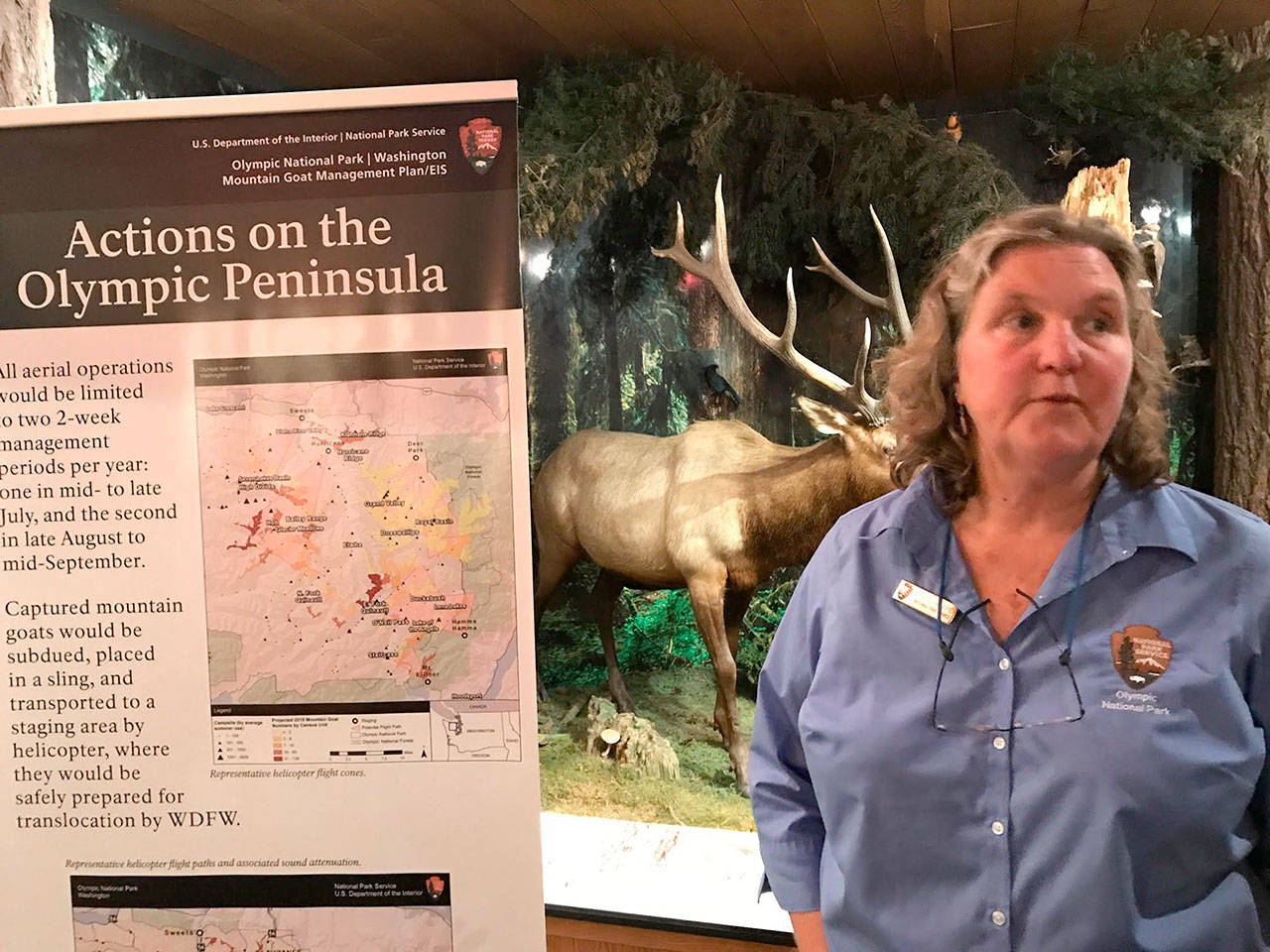
PORT ANGELES — A two-year mountain goat relocation plan for Olympic National Park and Olympic National Forest would start in July 2018 under a proposed project presented this week at the park’s visitor center in Port Angeles.
Goats not relocated would be shot beginning in 2019 under the proposal, officials said. Any goats found in the park after that date would be eliminated.
Speaking before about 60 meeting participants Tuesday, national park and state Department of Fish and Wildlife officials gave a 35-minute presentation on the preferred alternative for dealing with a mountain goat population that has grown to an estimated 625 to 675 animals.
The plan is the top option in a recently released Olympic National Park goat management plan-draft environmental impact statement.
It examines four avenues for managing the population: a status quo combination of hazing and lethal removal inside the park, capturing and relocating animals in the park and Olympic National Forest to North Cascades-area national forests, killing the animals in the park and forest, and a combination of capture-relocation to the North Cascades followed by lethal removal.
Relocation to the North Cascades to revive the depleted mountain goat population there would occur during two-week periods in July and August-September of 2018 and 2019, according to the presentation, available at http://tinyurl.com/PDN-GoatPresentation.
The animals would be transported by helicopter to five staging areas — two would be in operation at all times — where they would be handed over to the state Department of Fish and Wildlife, which would airlift the animals in crates for release in the North Cascades.
Lethal removal using shotguns and rifles on the ground and from helicopters would be employed on animals that could not be captured.
Olympic National Park wildlife biologist Patti Happe estimated that, based on previous capture efforts, about 350 of the animals are catchable.
Younger animals that are separated from their herds could be given to zoos, Rich Harris of Fish and Wildlife said Tuesday in an interview after the presentation.
“The highest mortality is among the younger ones,” Harris said.
“We will do everything we humanly can to make sure the survival rate is as high as it can be.”
A public comment period on the draft EIS that ends Sept. 26 will be followed by a decision by National Park Service officials slated for spring 2018.
The draft EIS, which is the topic of other regional public meetings this week, is at http://tinyurl.com/GoatDraftEIS.
Information on the draft EIS also is available at http://tinyurl.com/PDN-GoatQuestions.
According to the EIS, the purpose of the relocation-lethal-removal project — the culmination of three years of planning by the Park Service— is to reduce the environmental impacts of the mountain goats, which are not native to the Olympics.
Public safety also has been compromised by the increased habituation of the animals, driven to seek out humans and particularly the salt in their urine, Happe said.
The cost of helicoptering the mountain goats to a staging area and transferring ownership of the animals to state Fish and Wildlife is estimated at “a little bit under $700,000” from 2018 through 2020, she said Wednesday.
A third year of funding is provided as a contingency amount that, if not needed, would be spent for lethal removal beginning in fall 2019.
Since about 2005, there have been “more and more encounters of goats aggressively seeking out salt in the Olympics,” Happe said.
Happe said that behavior culminated in the 2010 fatal goring of Bob Boardman of Port Angeles on Klahhane Ridge in Olympic National Park, although mountain goat-management efforts already were underway.
The preferred plan envisions zero to 50 mountain goats remaining by 2028.
“We are aiming for zero,” Happe told meeting attendees.
The presentation Tuesday by officials was followed by 75 minutes of one-on-one availability with project managers.
Happe said there was a high degree of coordination in formulating the relocation-lethal removal plan between the Park Service, U.S. Forest Service and state Department of Fish and Wildlife.
________
Senior Staff Writer Paul Gottlieb can be reached at 360-452-2345, ext. 55650, or at pgottlieb@peninsuladailynews.com.
