
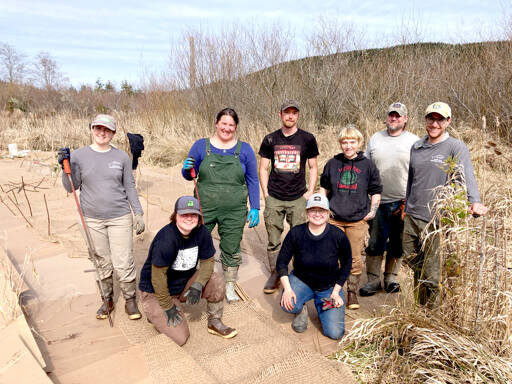
QUILCENE — Northwest Watershed Institute planted 19,000 native trees and shrubs along wetlands and streams in the Tarboo Valley during its winter and spring planting season.
The work was completed by an eight-person field crew, monthly volunteer groups and a number student groups from local schools, said Peter Bahls, the executive director of the Northwest Watershed Institute (NWI).
“We start gathering plants and cutting live stakes in November and December,” Bahls said. “The main planting season is January through April. Then there’s a lot of wrap-up into May, putting on tree cages for deer protection, that kind of thing.”
Live stakes are cuttings from woody plants that are used in revegetation efforts, Bahls said.
Of the plantings, about 16,000 were live stakes, Bahls said. About 3,000 plants were potted from nurseries, he added.
Bahls named willow, red osier dogwood and twin berry among the plants that were cut and collected to be used as live stakes from other conservation sites around Tarboo valley.
Also planted were western red cedar, grand fir, Douglas fir, western hemlock, and Sitka spruce, ninebark and spirea.
“Planting native plants is incredibly rewarding,” said Hanna Petersen, NWI’s assistant field crew leader who returned for her third planting season. “You are often nearby trees and shrubs NWI’s crew and volunteers have planted in previous years that are taller than you are, and you know your work is making a difference.”
“They’re all Northwest native plants, and most of them, except for Douglas fir, like wetter ground, which is where most of our planting is,” Bahls said.
The live stakes are used in a method NWI has developed to control Reed canarygrass, an invasive grass, Bahls said.
“It grows up to 6 feet high, and it crowds everything else out,” Bahls said. “The way we try to deal with it, without herbicides, is we spread cardboard sheeting down, and then we take these stems we’ve cut of willow and other wetland shrubs, and we cut these stakes and we stick them through the cardboard.”
The stakes hold the cardboard down, which holds the grass down, Bahls said. The stakes sprout and, in a year or so, they shade out the Reed canarygrass, he added.
“You’re just expanding good habitat for a variety of fish and wildlife species,” Bahls said. “From a mono-culture of Reed canarygrass to diversity of native plants that wildlife like, everything from migratory songbirds to species like beaver, deer and even wildlife corridors for larger animals like cougars and black bears.”
A semi-truck of corrugated cardboard sheets was donated by Sheets Unlimited in Renton, Bahls said. They’ve been making a similar donation for the past 10 years, he added.
“To make it possible for the crew and volunteers to work in the wetlands, the crew constructed temporary boardwalks with wood donated from Carl’s Lumber,” Bahls wrote in an NWI press release.
The majority of the planting this season occurred on NWI’s Tarboo Wildlife Preserve, Bahls said.
“Close to 5 acres of plantings, probably about a dozen different sites,” he added.
Bahls said the 500-acre preserve was historically productive salmon and wildlife habitat, consisting of spruce and cedar forests and wetlands that were cleared and drained for pasture in the late 19th century.
“Twenty years ago, NWI purchased the old Yarr farm and in 2007 expanded on tree plantings started a few years earlier by the Jefferson County Conservation District with the prior owner,” Bahls said. “We re-meandered streams that had been straightened to restore salmon spawning and rearing areas and restored wetlands for amphibians, birds and mammals. After the initial native plantings, we’ve continued to address challenging areas, trying new planting methods to deal with invasive weeds and learning by trial and error.”
The plantings are a part of the conservation nonprofit’s long-term project, Bahls said.
“To restore fish and wildlife habitat from the headwaters of Tarboo Creek to Tarboo-Dabob Bay,” Bahls said.
Bahls said NWI, along with volunteers, landowners and 40 partnering organizations, has been essential to conserving and restoring nearly 5,000 acres in the watershed since 2002. It amounts to about 75 percent of the 7-mile creek, he added.
NWI’s primary volunteer opportunities come on a monthly basis in the form of Dabob Days. The final event of the season will be held from 10 a.m. to 2 p.m. Friday. The event will be a combination of beach cleanup and English ivy removal, Bahls said.
Those interested in volunteering should contact education and outreach director Megan Brookens by email at megan@nwwatershed.org.
________
Reporter Elijah Sussman can be reached by email at elijah.sussman@sequimgazette.com.
