
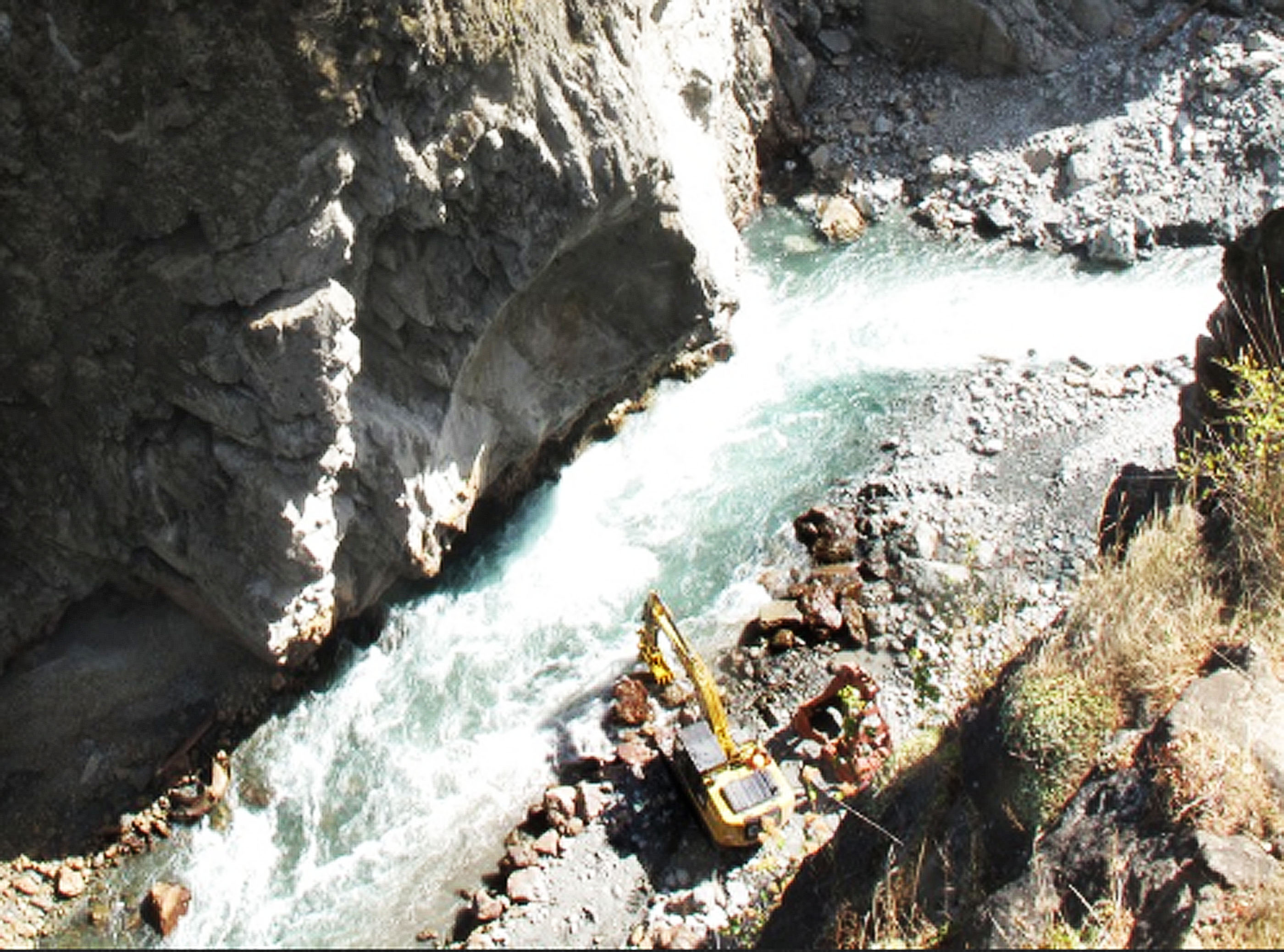
OLYMPIC NATIONAL PARK — With the final piece of Glines Canyon Dam blasted away, demolition workers and others labored Wednesday to complete the final portion of the Elwha River restoration project.
Tons of dam rubble rest at the bottom of Glines Canyon, and the debris will have to be removed before salmon can return to the upper reaches of the river.
Crews continue to work on replanting a few stubborn stretches of sediment in the now-empty Lake Mills and Lake Aldwell lakebeds.
Brian Krohmer, project manager of the Elwha dam demolition project for Barnard Construction Inc. of Bozeman, Mont., said the removal of the rubble in the canyon may finish much faster than earlier estimates, with only two or three weeks possibly needed to remove the remnants of the dam.
“There is roughly 20 to 25 feet of it,” Krohmer said.
It will take another three weeks for the company to remove all of their equipment and gear from the area after the debris comes out, he said.
An excavator will scoop out the blasted cement, rebar and other remnants that prevent the river from returning to the riverbed it last occupied before Glines Canyon Dam was completed in 1927.
A crane will then lift giant buckets of debris out, and it will be shipped to another site to be pulverized and used in Clallam County roadwork.
The water is low enough that the excavator should be able to reach debris on the east side of the river, but the crane is also able to dig out any locations the excavator cannot reach, Krohmer said.
As of Wednesday, the U.S. Geological Survey, which tracks water flow, measured the Elwha as running at 408 cubic feet per second, about 60 percent to 65 percent of the usual flow of the river for late August.
The former Glines Canyon Dam, which once towered 210 feet above the canyon, was located about 13 miles south of the river mouth, just inside of Olympic National Park boundaries.
A second dam, the 108-foot Elwha Dam, was built in 1913 and removed in March 2012.
It was situated 5 miles south of the river mouth, blocking the salmon runs from 65 of the nearly 70 miles of river and tributaries.
The Lower Elwha Klallam tribe, which fought against the dams’ presence for nearly a century, has its reservation and tribal center downstream from the dam.
Tribal elders and tales from area settlers have told of the giant 100-pound chinook that once swam the river by the tens of thousands as part of an estimated annual run of more than 400,000 salmon belonging to all five Pacific salmon species.
“I’m ecstatic. I just can’t believe it,” said Frances Charles, chairwoman of the tribe.
“We have waited over 100 years to see what has taken place.”
Charles praised past members of the tribal council, who have made trips to Washington, D.C., to work against the dams since before they were even built.
Tribal members used to go door to door on the reservation to raise money for the trips, she said.
Those efforts, Charles said, are validated by the return of smelt and salmon to the river.
“It’s actually coming alive,” she said.
“It was so mucky, you couldn’t even see the bottom of the riverbed itself. But it’s happening,” she said. “I think faster than anybody thought.
“Mother Nature, the Creator, is proving everybody wrong.”
The removal of the dams has led to an increasing pride felt by tribal members, she said.
In particular, Charles pointed to the scientific and engineering knowledge the tribe’s children have picked up by talking to workers and scientists overseeing the historic removal.
“The Elwha River is now under the microscope of all nations,” Charles said.
Fish biologists have said the Glines Canyon rapids will not be passable for salmon until the river settles into a series of resting pools.
It was not certain exactly how long it will take for those pools to form, though Robert Ellefson, the restoration manager for the tribe, said many expect the fall 2015 run of chinook could be the first to re-establish the run above the dam.
The salmon were restricted to the lowest 5 miles of the river, but when the lower dam was removed, salmon immediately began spawning in tributaries between the two dams.
_________
Reporter Arwyn Rice can be reached at 360-452-2345, ext. 5070, or at arwyn.rice@peninsuladailynews.com.
Sequim-Dungeness Valley Editor Joe Smillie can be reached at 360-681-2390, ext. 5052, or at jsmillie@peninsuladailynews.com.
