
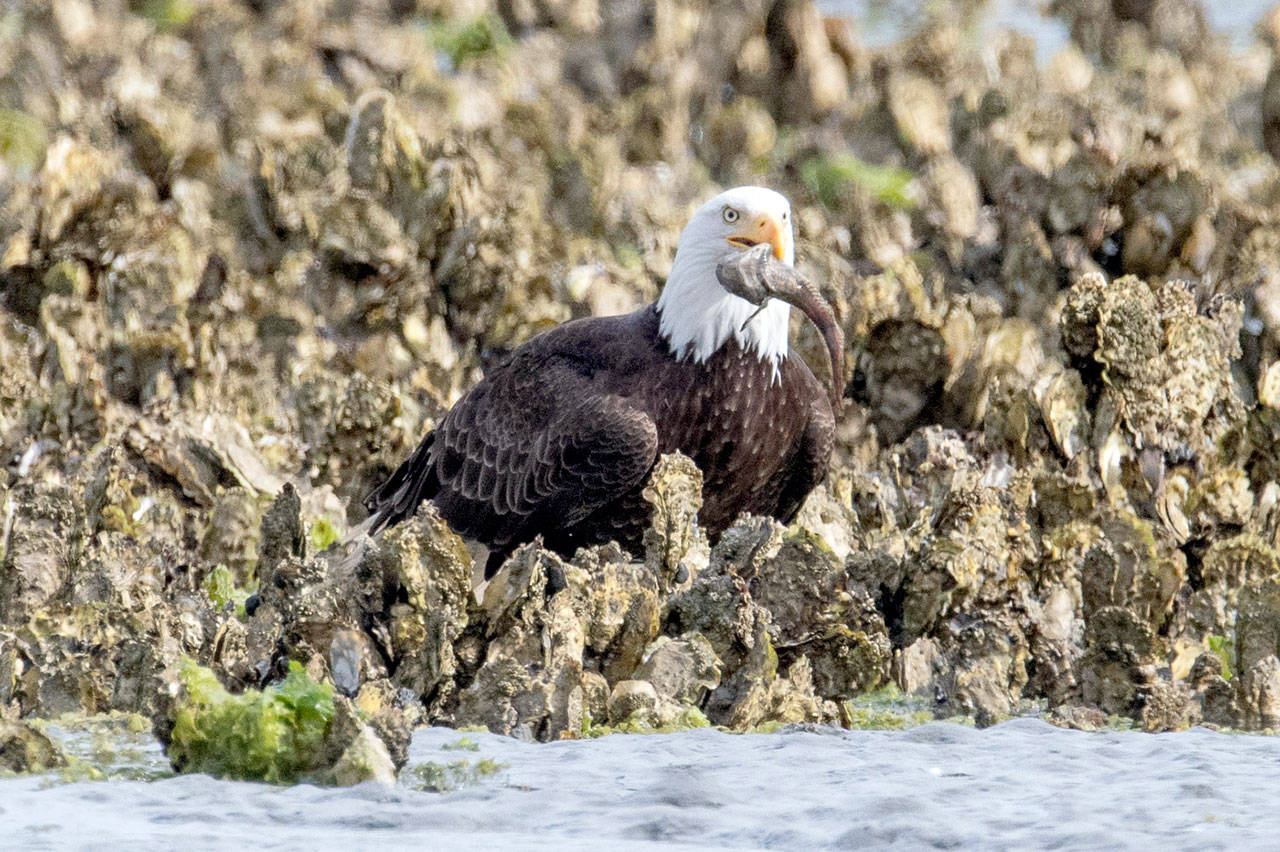
PORT TOWNSEND — Why do eagles gather along more than a mile of shoreline in east Dabob Bay on Hood Canal, and what is the impact of human interference and commercial aquaculture operations on that habitat?
Peter Bahls, aquatic ecologist and executive director of the Northwest Watershed Institute (NWI) set out to answer those questions.
He and NWI biologist Heather Gordon recently completed the first study conducted on spring eagle convocations in the western United States and published their findings in a newly released report, “Bald Eagles, Oyster Beds, and the Plainfin Midshipman: Ecological Relationships in Dabob Bay.”
The only other published research on this phenomenon was a study of an eagle convocation in British Columbia.
Almost nothing was known about why the eagles gather at this one particular stretch of tidelands on Dabob Bay until NWI conducted a three-month field study last spring.
Jane Hall and her husband, Keith Lazelle, have lived on the forested bluff above the beach where the eagles congregate for more than 20 years. They have been counting the eagles since 2012.
“The eagles come to the beach by the dozens in May and June,” Lazelle said. “We have seen up to 175 eagles in a single day.”
Lazelle, a NWI board member, said the study was prompted by the concerns of 70 landowners in the Dabob Bay area worried about the impacts of oyster gear on the eagles.
The study suggests that the eagles gather in large numbers on tidelands between the months of May and July to feed on spawning plainfin midshipman (porichthys notatus), a bottom dwelling fish that lives in ocean depths of nearly 1,000 feet along the Pacific coast. In the spring, the fish migrate up from the depths to the intertidal zone to spawn.
Researchers found that the Dabob Bay eagles were hunting midshipmen under clumps of oysters or in rocks. Foraging was tied closely to the tidal cycle, with gatherings occurring in larger numbers during low tides and more fish captured during outgoing tides.
The state Department of Natural Resources lease on the tidelands belongs to the Port Gamble S’Klallam and Jamestown S’Klallam tribes. The area has been involved in commercial aquaculture production since 1935.
Ralph Riccio, shellfish biologist with the Jamestown S’Klallam Tribe, said the tribes have been harvesting oysters side-by-side with the eagles for a long time.
“When there’s talk of shellfish aquaculture having a negative impact on the eagles, clearly that’s important for the tribes to understand,” he said. Both the tribes and landowners agreed to provide funding for the study by NWI.
After the tribes were made aware of the concerns, they agreed to amend their activities and developed an adaptive management and monitoring plan.
Riccio said the tribes will remove the stand-up structures that hold oyster bags.
“It’s like a line suspended 3½ feet off of the mud. The tide makes the bags float up and down. This isn’t critical to our operation. We understand it may be a deterrent to the eagles. We’ll try several methods to see what works the best for everyone.”
They oyster bags are made of durable plastic and can be used for several years before recycling.
“It’s very typical that the midshipmen burrow under the bags and lay their eggs on them, Riccio said. “They try to find anything in the intertidal zone that’s flat.”
Riccio explained that once he saw a piece of waterlogged plywood that was in the tideflats.
“When we turned it over, there were nine midshipmen guarding thousands of eggs that had been laid on the underside of the board. It covered it entirely.”
He pointed out that if eggs are found, they cannot be tampered with.
“We harvest after those eggs have hatched, he said.
The NWI research also showed that mature eagles made up the majority of birds. There were few nesting pairs observed. Human activity was shown to negatively effect the eagles, with foot traffic being the most disruptive.
Based on the results of the study, Bahls and staff developed a set of recommendations to limit possible disturbance from the proposed aquaculture operations. They included avoiding activities in the midshipman spawning areas, limiting activities from May 1 to July 15 when eagles congregate on the tidelands, and annual monitoring of eagles and midshipman to determine if the stewardship measures are working.
“The eagle study by NWI is great information for us to have. The tribes want to make sure our proposed shellfish operation does not harm the eagle convocation at Dabob Bay,” said Riccio.
________
Jefferson County Editor/Reporter Jeannie McMacken can be reached at 360-385-2335 or at jmcmacken@peninsuladailynews.com.
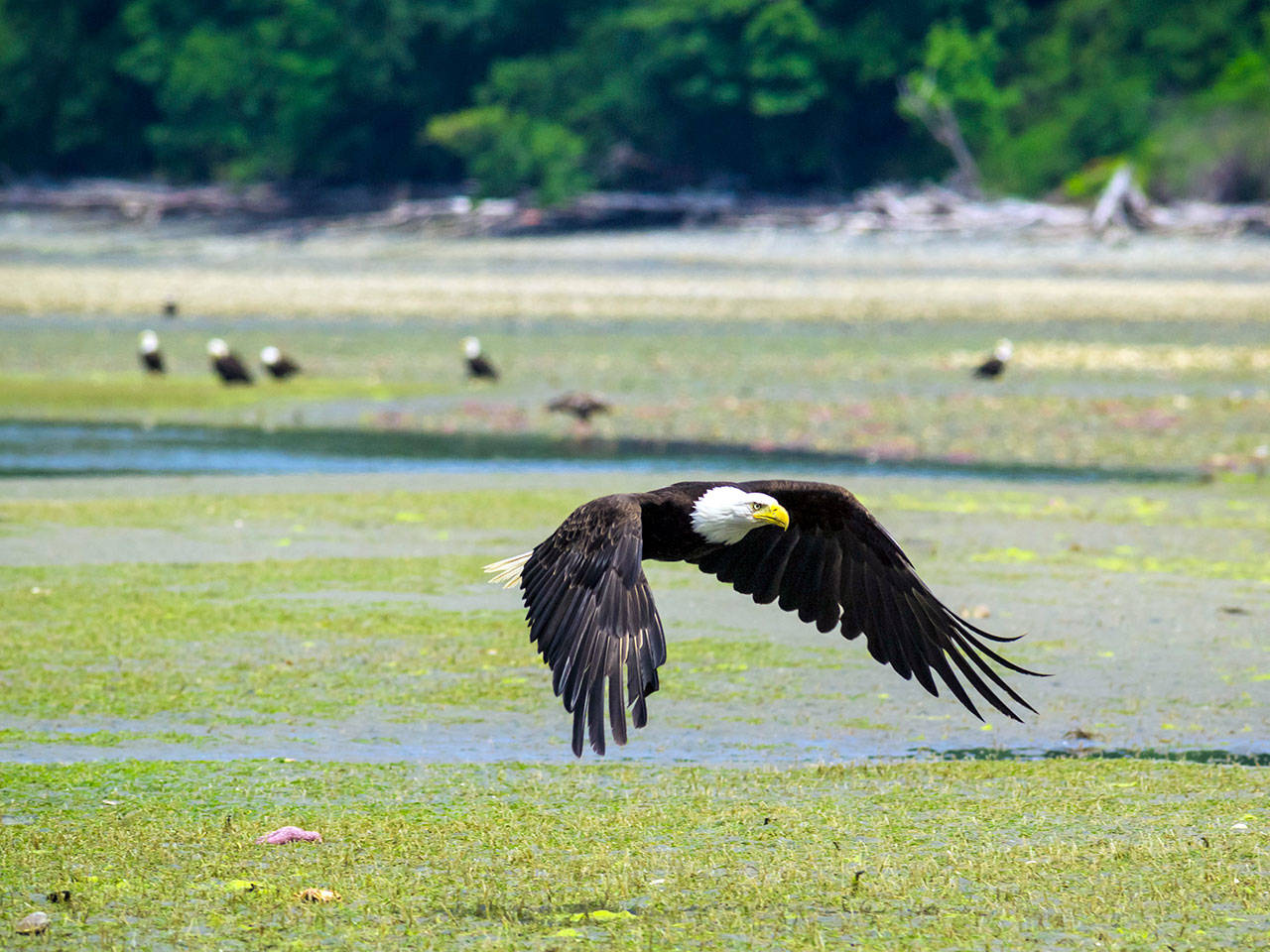
An eagle flies low at Dabob Bay. (Keith Lazelle)
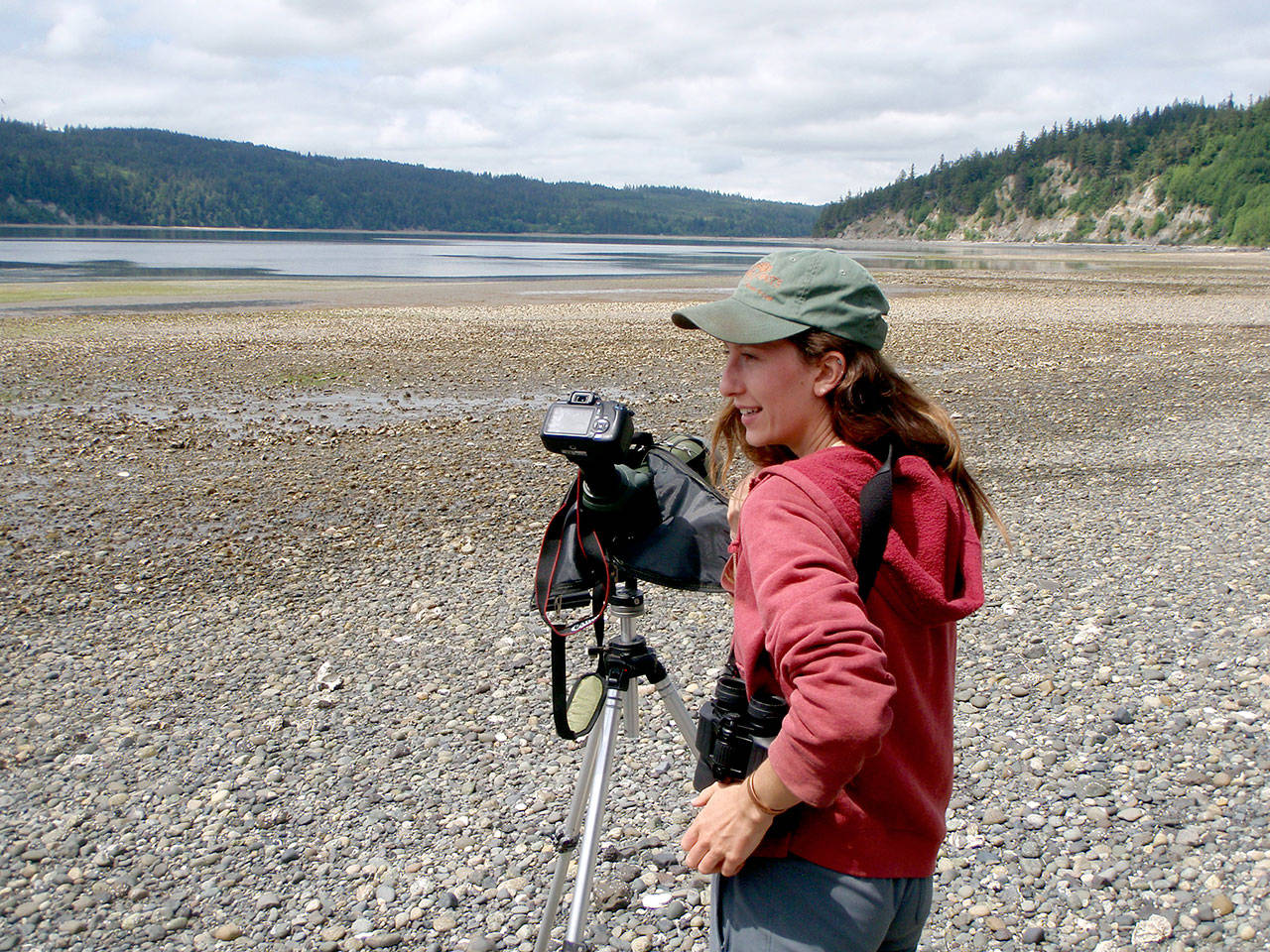
Heather Gordon, field biologist for Northwest Watershed Institute, observes eagles with camera and spotting scope at Dabob Bay. (Peter Bahls)
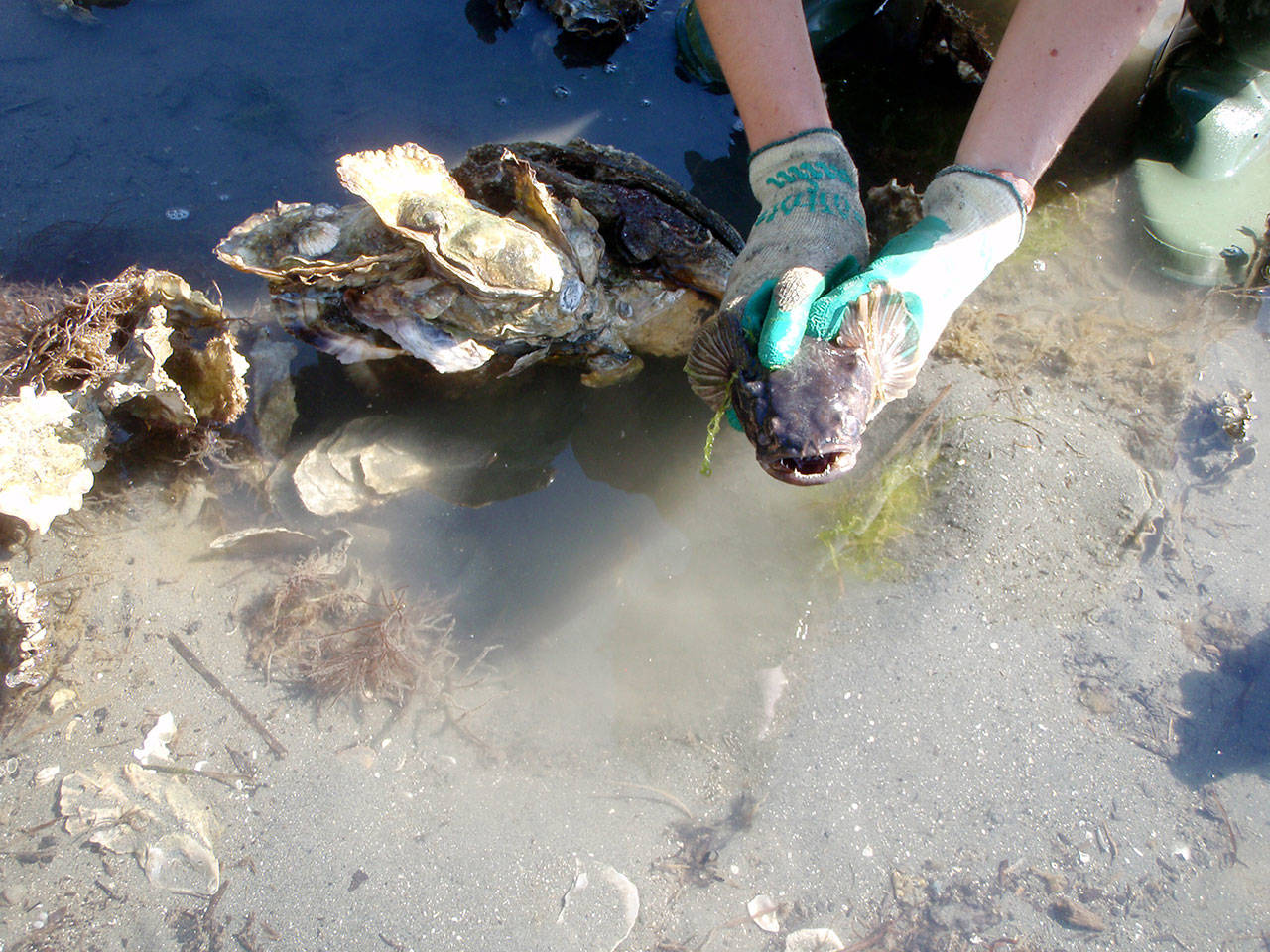
Field biologist Heather Gordon holds a plainfin midshipman found in its nest under an oyster cluster at Dabob Bay.
