
Peninsula Daily News and The Associated Press
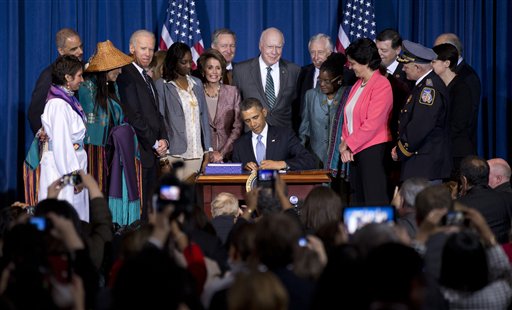
WASHINGTON — Several tribal leaders from the North Olympic Peninsula were among those present for President Barack Obama’s signing Thursday of Senate Bill 47, the Violence Against Women Reauthorization Act of 2013.
The legislation “closes an incredible loophole,” said Ron Allen, chairman of the Jamestown S’Klallam tribe and treasurer of the National Congress of American Indians, who attended the ceremony in the Department of the Interior’s Sidney R. Yates Auditorium in Washington, D.C.
“It’s another bill we achieved that strengthens and reaffirms the tribe’s governance and authority,” Allen added.
“It empowers the tribes to protect women from being violated on our reservations.”
The legislation gives Native American tribes new power to prosecute non-Natives in tribal courts for any crimes linked to domestic violence on reservations.
The law, which won’t go into effect for two years after it is signed, doesn’t change a Supreme Court ruling that tribes don’t have jurisdiction to prosecute non-Natives for other types of crime.
But it does permit tribes to prosecute non-Natives for crimes of domestic violence, date violence and violation-of-protection orders.
Tribes that don’t want to prosecute can turn them over to local, state or federal officials, who still will retain jurisdiction.
Hundreds at ceremony
Allen estimated that between 400 and 500 people attended the ceremony.
“Without a doubt, it was a very exciting event for everyone,” Allen said.
“It was a significant step in terms of recognition of the tribes’ jurisdiction, recognizing that reservations had been a safe harbor for criminals,” he added.
Fawn Sharp, president of the Quinault Indian Nation and the Affiliated Tribes of Northwest Indians, had said she “wouldn’t be anywhere else” at the moment that Obama signed the bill, characterizing it as “one that should be memorialized in history as a turning point in Indian/non-Indian relations in this country.
“Our tribal police will be able to arrest, and our tribal courts will be to legally prosecute those who have literally gotten away with murder and rape for years,” she said.
Frances Charles, Lower Elwha Klallam chairwoman, was in Washington, D.C., with the rest of the tribal council and said that Timothy Green, chairman of the Makah Tribal Council, attended the ceremony.
Unfortunately, a conference with a member of Congress took overly long, and she was not able to attend herself, Charles said.
But she watched it on television.
“It was really overwhelming,” Charles said.
“It was a powerful day for women,” she added, mentioning especially the tales of abuse on reservations told by several survivors.
According to nationwide statistics, more than a third of all Native American women experience rape in their lifetimes, and they are victimized in more than 10 times the average murder cases, with more than 80 percent of the crimes perpetrated by non-tribal men on reservations.
Revitalized act
The revitalized Violence Against Women Act also marked an important win for gay-rights advocates, who will see new protections under the law, and for Obama, whose attempts to push for a renewal failed last year.
“This is your day. This is the day of the advocates, the day of the survivors. This is your victory,” Obama said.
“This victory shows that when the American people make their voices heard, Washington listens.”
The rate of sexual violence against women and girls age 12 or older fell 64 percent in a decade and has remained stable for five years, the Justice Department said in a survey released Thursday.
In 2010, women and girls nationwide experienced about 270,000 rapes or sexual assaults, compared with 556,000 in 1995.
The survey also showed that rapes and sexual assault rates involving women have plateaued while violent crime rates overall have declined.
Women’s advocacy groups called the report proof that the Violence Against Women Act and heightened awareness of the problem by police has had a positive effect.
Still, 1 in 5 women will be raped during their lifetime, said Obama, asserting a continued need for action nearly two decades after the bill’s original passage in 1994.
“It didn’t just change the rules, it changed our culture. It empowered people to start speaking out,” Obama said.
The law authorizes some $659 million a year over five years for programs that strengthen the criminal justice system’s response to crimes against women and some men, such as transitional housing, legal assistance, law enforcement training and hot lines.
One element of this year’s renewal focuses on ways to reduce sexual assault on college campuses.
It also reauthorizes the Trafficking Victims Protection Act, adds stalking to the list of crimes that make immigrants eligible for protection and authorizes programs to reduce the backlog in rape investigations.
