
LAKE SUTHERLAND — Predatory bluegill fish have been found in Lake Sutherland, a situation that could stymie efforts to protect other species.
The bluegills “shouldn’t be in there,” said Matt Beirne, Lower Elwha Klallam environmental coordinator, who is among those studying the problem.
The non-native fish, found by divers in July, represent a potentially big problem for Lake Sutherland and related waterways because they feed on the eggs and juveniles of other fish.
They also reproduce rapidly, laying up to 50,000 eggs in each nest dug into the bottom of a shallow area.
Bluegills could threaten sockeye salmon that are expected to appear in the lake.
Before the removal of the Elwha and Glines Canyon dams on the Elwha River in 2012 and 2014, Lake Sutherland was cut off from the ocean, Beirne explained.
The lake is now connected to the Strait of Juan de Fuca via the Elwha and Indian Creek, which should allow salmon to migrate upstream as they did before the construction of the dams.
Beirne and other environmentalists have been watching for sockeye salmon making their way up the undammed Elwha River to Indian Creek and eventually back to Lake Sutherland.
Sockeye have not been spotted in the lake yet, but, he said, “it’s just a matter of time.”
If sockeye migrate upstream to the lake, bluegills could feed on their eggs and make it difficult for them to spawn successfully, not just in Lake Sutherland, but in Indian Creek and the Elwha, too.
“We really don’t want them spreading into the lower Elwha” from Lake Sutherland, said state Fish and Wildlife biologist Mike Gross.
Beirne also is concerned about what the hard-feeding bluegills could do to native fish already in the lake.
They might eat the eggs of coastal cutthroat trout, rainbow trout and kokanee.
Officials are monitoring the bluegills for now — primarily relying on fishermen, residents and milfoil-removal contractors for observations and information — and are trying to determine how they got there.
Kathy Lucero, Clallam County’s noxious weed coordinator who has been working with residents for years on reducing the presence of a weed called milfoil in the lake, hypothesized that a fisherman may have used bluegill as bait and accidentally introduced it to the lake.
Lake Sutherland resident Theresa Schmid, who been working on the milfoil effort for 10 years, is concerned that someone might have introduced the fish intentionally.
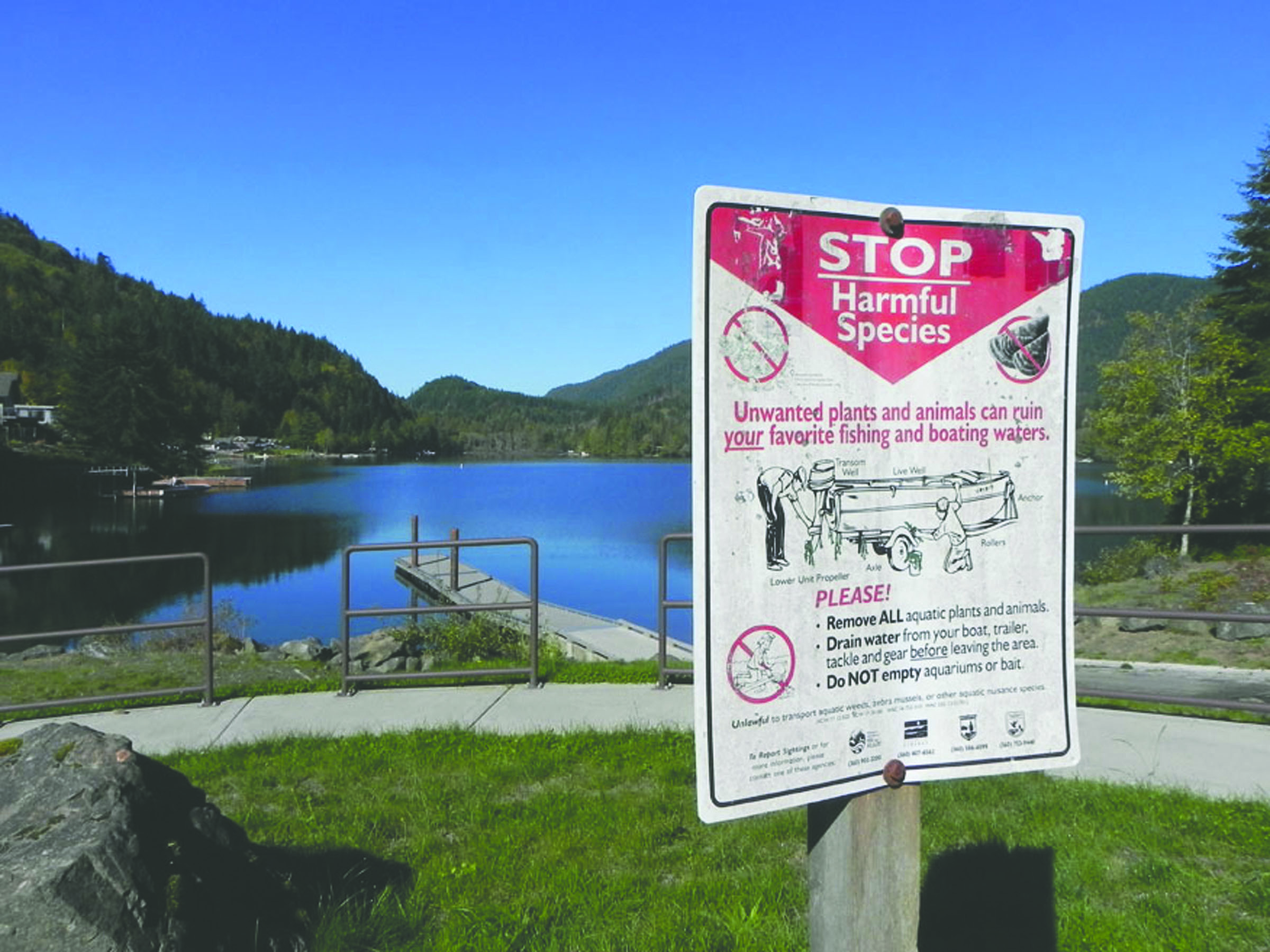
Either way, transporting an aquatic invasive species from one body of water to another is illegal in the state of Washington.
Violators face a maximum penalty of one year in jail and $5,000 in fines.
What can be done about the bluegills?
The first step will probably involve various environmental agencies getting together to pool resources, Gross said.
Beirne agreed, saying he would like to assemble a team of biologists to look at control measures.
“I’m not sure they can be controlled,” Gross said, but he stressed that agencies need to work on a solution.
One thing that is not a possibility is the use of chemicals to kill the bluegills, he said. The chemicals would kill other fish.
Introducing another fish to eat the bluegills, said Beirne, would be a “nightmare,” resulting in too many of another species.
He said one option to explore might be “electrofishing,” in which fish are electrically stunned via a probe in the water.
Once stunned, fish float to the surface where they can be identified and counted.
Electrofishing would allow officials to not only count the bluegills but also remove them from the lake.
The method is harmless, he said, and the fish soon return to their normal routines.
Beirne said officials also could look at catching them in nets and controlling their environment — like removing the logs and weeds where bluegills tend to live.
Lucero said temperature might moderate the bluegills’ reproduction: Sixty degrees is too cold for the bluegills to reproduce. Last week, it was already back to 63 degrees, she added.
In the shallows, the lake can still be as warm as 70 degrees.
In the deep parts of the lake, it gets very cold, she said, and Lake Sutherland is up to 90 feet deep.
Most of all, Beirne wants to educate the public to identify bluegills.
Bluegills, which are in the sunfish family, grow to about 6 inches long, are flat and have blue spots on their gills.
Fishermen who catch bluegills, Beirne said, should not return them to the lake.
Schmid said it was a cleanup of the milfoil, a water-growing weed, that led to the bluegills’ discovery.
Property owners who have direct access to Lake Sutherland are taxed to raise funds for a land management district, which contracts to control the growth of milfoil.
Divers in the lake working on the milfoil issue in July found small fish that didn’t seem to belong. They called Lucero.
Lucero, Schmid said, went to the lake in July and netted one, which turned out to be a bluegill.
They hide around old tree stumps and other underwater structures and like to find shelter among water plants — like milfoil.
“We’ve worked really hard for 14 years to keep the [milfoil] down,” Schmid said. “It’s important that we stop whomever is putting this into the lake.”
________
Reporter Mark Swanson can be reached at 360-452-2345, ext. 5054, or mswanson@peninsuladailynews.com.
