
SEQUIM –– Property owners in much of rural East Clallam County who want to drill new wells to build homes will have to spend an additional $1,000 if they want to water their lawns under the recently enacted Dungeness Water rule — and some won’t be able to at all.
Property owners must purchase water-mitigation certificates to drill new wells or use water from existing wells for new purposes from the Washington Water Trust under the state Department of Ecology rule.
Those who drill wells or use existing water rights to provide water to their property also will need to install meters on the wells to measure how much water is being used.
Some who live in certain areas won’t be able to get water for more than indoor use.
Landowners now using existing wells are exempt.
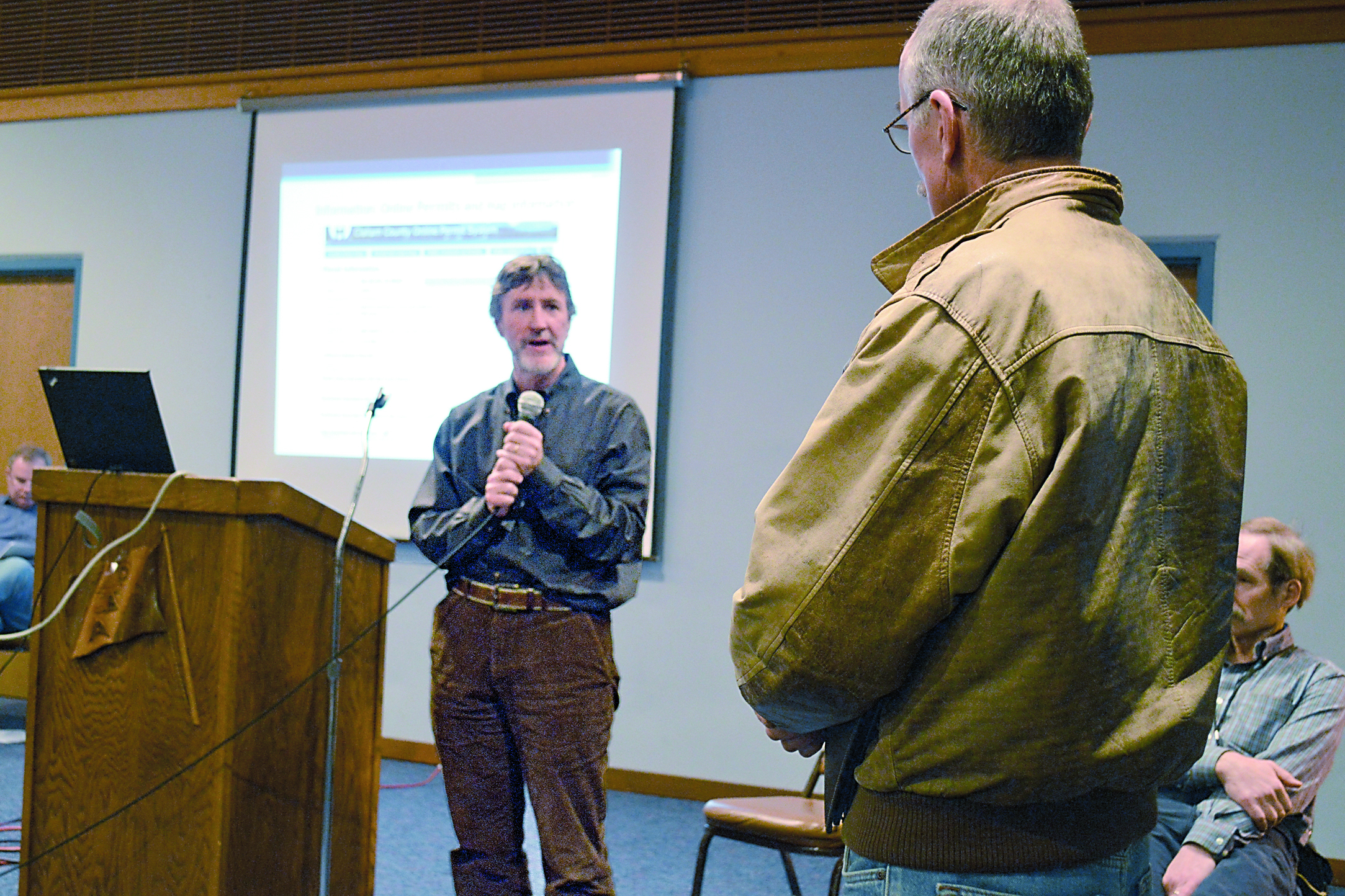
The process for obtaining mitigation credits, which had not been determined when the rule came into effect Jan. 2, was presented during a Thursday night workshop at the John Wayne Marina.
Scores of people packed the meeting room to hear from the Washington Water Trust, Ecology and Clallam County how the new rule will affect the way they use water on their land.
Sheila Roark Miller, director of Clallam County’s Department of Community Development, moderated.
Roark Miller’s department issues building permits and also will obtain mitigation certificates from the water trust for landowners.
The office in the Clallam County Courthouse at 223 E. Fourth St., Suite 5, is open from 8:30 a.m. to 4:30 p.m. Mondays through Fridays.
Bob Barwin of Ecology said the new costs and metering system are intended to preserve usable water in the Dungeness River watershed, an area between Bagley Creek on the west and Sequim Bay on the east.
The goal, said Tom Loranger, Ecology’s deputy manager of water resource programs, is to maintain a minimum flow in the Dungeness River of 105 cubic feet per second.
Owners of a large portion of land in the southern portion of the watershed will not be able to acquire water for outdoor use, though they can obtain water for indoor domestic use.
“If you’re pumping a well in any one of these areas, you’re affecting more than one stream,” Barwin told the crowd about the areas that include parts of such streams as Siebert, Matriotti, Bear, Caracco and Canyon creeks, as well as others.
Barwin’s message was not warmly received.
“Ecology sucks,” exclaimed Sequim native Pearl Rains Hewett.
Landowners can check the status of their parcels at http://tinyurl.com/bj6nzmg to see if they need a mitigation certificate, if their land is outside the irrigation zone or if they have to tap into a public water system.
Builders who have the ability to tap into one of the 20 public water systems in the watershed will have to do so, said Tom Shindler, permit center manager for Clallam County.
Those systems primarily would be the city of Sequim and the Clallam County Public Utility District, which can distribute water under senior water rights.
Revenue from the mitigation certificates will be traded for water rights in the Dungeness Water Exchange.
Amanda Cronin, Washington Water Trust project manager, said money will be used to fund projects to enhance water levels within the watershed.
Ecology reserved water rights for the water exchange to sell to builders.
Cronin said the water trust is working with the Sequim-Dungeness Agricultural Water Users Association to secure senior water rights that will be available in the exchange in the future.
Landowners who are using water for new houses have three certificates they can purchase.
A certificate for 150 gallons of indoor use per day can be purchased for $1,000. For $2,000, some developers will be able to purchase enough water to irrigate 0.06 acres of outside ground. A $3,000 certificate allows for irrigation of 0.13 acres.
“How did you arrive at that number?” asked Kaj Ahlburg, a retired lawyer and investment banker from Port Angeles.
Both Sequim and the PUD, according to Loranger, reported the average use by their customers is about 168 gallons per day.
That average includes homes filled by both single people and families, he said.
Cronin said mitigation projects will require the water trust to acquire land easements and install pipes to move water to aquifer recharge zones that will require extensive earth work. The trust also will be purchasing more water rights to sell through the bank.
Shindler said the certificate will be another step in proving to the county that a potential new home can be supplied with water. Builders also have to prove there is enough water of sufficient quality to supply a home.
“Now the mitigation certificate will show not only that the water is there and the water is good, but that you have a right to that water,” Shindler said.
Shindler said 72 homes built in 2012 would have had to obtain mitigation certificates.
He noted that number was higher than in 2011 because construction spiked at the end of last year as developers looked to get their permits before the water rule went into effect.
Barwin said meters that are now mandatory will be used to collect data and see if the certificate criteria needs to be adjusted.
Those who exceed the 150-gallon-a-day limit will not be penalized, he said, unless they are using water for an unauthorized use — if they are irrigating without having purchased that right.
If the meters throughout the water-rule area show the limit is not high enough for consumption, he said, the mitigation package will increase, along with the price.
“If it turns out the assumptions are wrong and the demand is higher, the price will rise,” Barwin said.
But if the meters show the limit is too high, the price will go the other way, Cronin said.
“If we can do this for less money, we want to,” Cronin said.
The water trust will report to Ecology if meters record regular exceptional use. Ecology will then investigate.
“If it’s August and you see they have a huge, green lawn, I think it’s a pretty good indication that some irrigation is going on,” Loranger said.
Barwin said Ecology will then tell landowners to stop unauthorized water use.
If they fail to comply, they could be fined up to $5,000 a day for every day they are found to have exceeded their water allotment. Habitual violators also could have their water shut off.
Many at Thursday’s meeting were leery of the water trust, unsure where the nonprofit received its authority and what money in the Dungeness Water Exchange would be funded.
“Who made the Washington Water Trust the bank?” landowner Carol Johnson asked.
County commissioners contracted with the nonprofit water trust to manage the water bank. The firm previously managed a water bank for Walla Walla County.
Trust Director Susan Adams said it was formed to broker water-rights transfers between owners and the state.
According to records on file with the state Secretary of State’s Office, $1,421,953 of the trust’s total 2011 expenses of $1,590,026 was spent directly on programs.
For more information on the water rule, visit http://tinyurl.com/b3htfeq.
For more on the county Department of Community Development, phone 360-417-2321 or visit www.clallam.net/dcd.
________
Sequim-Dungeness Valley Editor Joe Smillie can be reached at 360-681-2390, ext. 5052, or at jsmillie@peninsuladailynews.com.
