
By Keith Ridler
The Associated Press
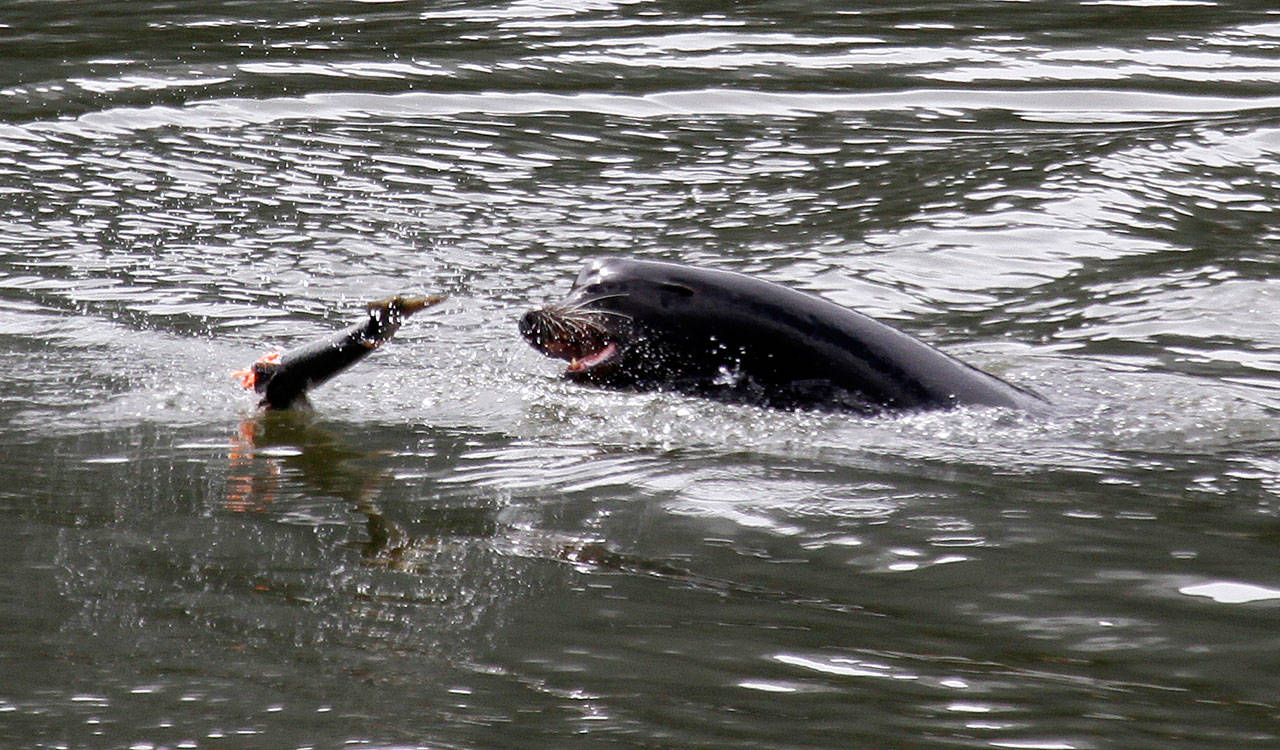
BOISE, Idaho — More than 1,100 sea lions could be killed annually along a stretch of the Columbia River on the Oregon-Washington border to boost faltering populations of salmon and steelhead.
The National Marine Fisheries Service said Friday it’s taking public comments through Oct. 29 on the plan requested by Washington, Idaho, Oregon and Native American tribes.
The agency said billions of dollars on habitat restoration, fish passage at dams and other efforts have been spent in the three states in the past several decades to save 13 species of Columbia Basin salmon and steelhead protected under the Endangered Species Act.
But sea lions have learned that fish bunch up at dams and are easy to catch, an opportunity not available when the Columbia was free-flowing.
“The changes in the system have created this sort of pinch-point where sea lions can take advantage of the fish,” said Michael Milstein, a spokesman for National Marine Fisheries Service.
About 900 California sea lions and 250 Steller sea lions could be killed each year, starting about 110 miles from the river’s mouth and extending 300 miles upstream. Experts have said sea lions in that area are exclusively preying on salmon and steelhead.
The Wild Fish Conservancy, which works to recover and conserve wild fish, opposes killing sea lions. The group said habitat destruction, dams and overharvest have far greater impacts.
Killing sea lions “is a kind of scapegoating when there are a lot of other actions we are choosing not to do that would have a larger impact,” said Emma Helverson, spokeswoman for the group.
The National Marine Fisheries Service already allows up to 92 California sea lions to be killed annually at Bonneville Dam, which is within the stretch of river in the new plan.
The new plan expands the area where sea lions can be killed, allows tribes to take part in removing sea lions and adds Steller sea lions for removal. Currently, state and federal workers live-capture California sea lions near Bonneville Dam and they are later euthanized.
Last year, Steller sea lions outnumbered California sea lions at Bonneville dam. Nearly all the sea lions are males bulking up on fish before heading back to the Pacific Ocean and then to breeding grounds.
California sea lions, which can weigh 1,000 pounds, are heading south to the Channel Islands off the California coast. Steller sea lions, which can reach 2,000 pounds, are heading north to breeding areas.
California sea lions number about 300,000, and the eastern population of Steller sea lions about 52,000. Neither population is listed as threatened or endangered.
The number of sea lions from each population that can be killed in the plan is based on a formula allowing each population to maintain an optimal sustainable level.
Overall, ocean conditions and habitat degradation along the migration corridor in the Columbia River are generally considered the main factors limiting salmon and steelhead populations.
But much work has been done and money spent in restoring habitat in the three states.
“We want to make sure we get as many fish back as possible to take advantage of that habitat that’s being restored,” said Russ Kiefer, an Idaho Fish and Game fisheries biologist.
Snake River sockeye salmon, which swim up the Columbia and reproduce in high-elevation Idaho lakes, teetered on extinction for several years before an elaborate hatchery program involving Fish and Game was created.
