
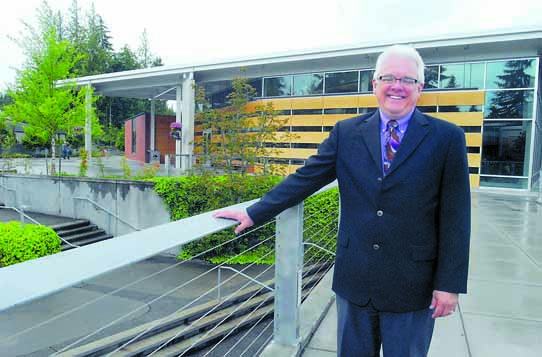
PORT ANGELES — Luke Robins’ office, situated in a corner overlooking the main entrance to Peninsula College, is large and on Tuesday, mostly empty.
It was officially Robins’ third day on the job as the new president of Peninsula College, and he was still working on getting his home and family moved to Port Angeles.
“We’re waiting for the moving van,” Robins said, noting that while he and his family haven’t selected a permanent home, they have found an interim home to rent until they decide on a neighborhood.
Meanwhile, he spent his first week getting to know his staff and the instructors at Peninsula College.
He said he wanted to get a feel for the school’s culture before making any changes to an institution that has been on the same path for a decade.
Robins is Peninsula College’s sixth president in its 50-year-old history.
He replaced Tom Keegan, who left in February to be Skagit Valley College’s new president after 10 years of leading Peninsula College.
Brinton Sprague, a retired community-college leader, served as interim president March 8 through June 30.
Robins will earn $175,000 in his first year at Peninsula College. Keegan was earning $204,434 in the 10th and final year of his tenure.
Robins spent the past six years as chancellor of Louisiana Delta Community College in Monroe, La., where he built up the college from an unaccredited school offering classes in a converted university cafeteria to an accredited institution with a brand-new campus.
Louisiana Delta is a two-year college with 2,700 enrolled students.
There are several clear differences between the school he is coming from and Peninsula College, Robins said.
First is that Peninsula College is an established school with traditions of its own, Robins said, offering humanities, the arts and sports.
“It’s a more comprehensive college,” he said.
Having the arts and sports helps connect the school with the community, as people who might not attend classes come to the campus to see an art show, concert or sporting event, he said.
Louisiana Delta is a brand-new school in a brand-new community college system, with a narrow focus on vocational training and preparation for transfer to a university, he said.
There are also strong similarities, with both schools offering classes to students in a rural, far-flung region, he said.
More people should know about Peninsula College, and the school needs to “put itself out there” to be better-known in the community college world.
Small community colleges need exemplars, and Robins said he believes Peninsula College is a prime candidate for the role and should build on its successes.
“It’s a really outstanding institution. That’s one of the primary reasons I wanted to be here,” Robins said.
When Robins was introduced to Port Angeles during a finalists forum in February, Robins emphasized using an entrepreneurial approach in response to ongoing state and federal cuts to higher education.
There is a clear pattern in all states in the U.S. that funding for community colleges is going to continue falling, he said.
Robins followed the state Legislature actions on educational funding and learned early that there would be no funding cut this year to the community college system.
“I was really pleased,” Robins said.
Robins has served as executive vice president and chief academic officer at National Park Community College in Hot Springs, Ark., and dean of instruction at Eastern Idaho Technical College in Idaho Falls, Idaho.
He received his doctorate in educational administration with a specialty in community college leadership from the University of Texas at Austin; his master’s degree in English, community college teaching track, from Illinois State University in Normal, Ill.; and his bachelor’s degree in Christian education from Wheaton College in Wheaton, Ill.
Reporter Arwyn Rice can be reached at 360-452-2345, ext. 5070, or at arwyn.rice@peninsuladailynews.com.
