
By Gene Johnson
The Associated Press
SEATTLE — Federal scientists said Thursday they are monitoring a new ocean heat wave off the U.S. West Coast, a development that could badly disrupt marine life including salmon, whales and sea lions.
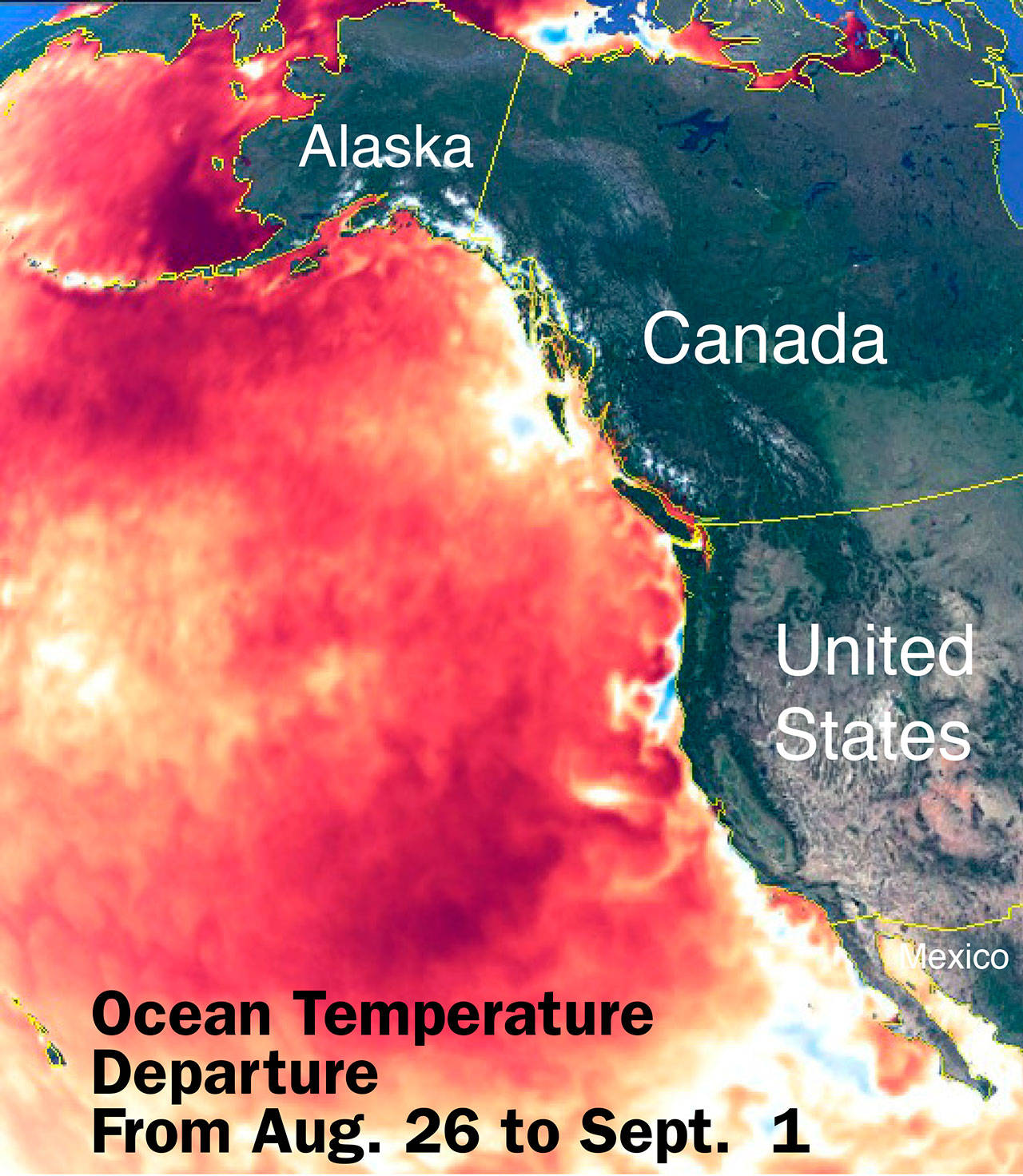
The expanse of unusually warm water stretches from Alaska to California, researchers with the National Oceanic and Atmospheric Administration (NOAA) said Thursday.
It resembles a similar heat wave about five years ago that was blamed for poorer survival rates for young salmon, more humpback whales becoming entangled in fishing gear as they hunted closer to shore, and an algae bloom that shut down crabbing and clamming.
“Given the magnitude of what we saw last time, we want to know if this evolves on a similar path,” said Chris Harvey, a research scientist at the Northwest Fisheries Science Center.
NOAA Fisheries said the water has reached temperatures more than 5 degrees Fahrenheit above average. It remains to be seen whether this heat wave dissipates more quickly than the last one, the agency said.
If it lingers, it could be disastrous for the Pacific Northwest’s endangered orcas, which largely depend on chinook salmon. The warmer waters can weaken the food web that sustain the salmon and bring predators of young salmon, including seabirds, closer to shore, further reducing their abundance. Chinook returns have been extremely low in recent years following the last heat wave, which scientists dubbed “the blob.”
The new heat wave has emerged throughout the past few months, growing in a similar pattern in the same area. After “the blob,” it’s the second-most widespread heat wave in the northern Pacific Ocean in the past 40 years — as far back as the relevant data goes.
“It’s on a trajectory to be as strong as the prior event,” said Andrew Leising, a research scientist at NOAA Fisheries’ Southwest Fisheries Science Center in La Jolla, Calif., who developed a way to use satellite data to track marine heat waves in the Pacific.
“It’s similar in size and shape, and it appears to have reached the coast in much of the state of Washington and northern Oregon,” he said. “Time will tell” about the impacts of the current blob.
Among the causes is a persistent low-pressure weather pattern between Hawaii and Alaska that has weakened winds that otherwise might mix and cool surface waters across much of the North Pacific, said Nathan Mantua, a NOAA research scientist.
What’s causing that, he said, is unclear: It might simply reflect the normal chaotic motion of the atmosphere, or it might be related to the warming of the oceans and other effects of human-made climate change.
The agency said it will provide fisheries managers with information on how the unusually warm conditions could affect the marine ecosystem and fish stocks.
The last heat wave spanned 2014 and 2015 and resulted in several declared fisheries disasters. Among the other effects, thousands of young sea lions were stranded on beaches after their mothers were forced to forage further from their rookeries in the Channel Islands off Southern California.
